 Add to Chrome
 Add to Firefox
 Add to Edge
Z-Opt: A Near-Optimal Reduced-Complexity Two-Dimensional Grassmannian Constellation
May 06, 2026
Grassmannian constellations are known to achieve the capacity of noncoherent communications over Rayleigh fading channels in the high-SNR regime, yet their efficient construction remains challenging. In this paper, we propose two construction methods for Grassmannian constellations of one-dimensional subspaces in a two-dimensional space, termed S-Opt and Z-Opt, along with two low-complexity detectors. Both the construction and detection procedures are performed on the unit sphere, known as the Bloch sphere in quantum computing. We show that the chordal distance on the Grassmann manifold is proportional to the Euclidean distance on the Bloch sphere and derive a corresponding theoretical upper bound based on the Fejes--Tóth bound on the minimum chordal distance. The S-Opt constellation is constructed from sphere-packing solutions and attains the derived upper bound for the optimal Bloch-sphere packings considered. The S-Opt detector can be applied to arbitrary Grassmannian constellations on $\mathcal{G}(2,1)$, and its time complexity scales linearly with the number of receive antennas and logarithmically with the constellation size, while yielding the same detection performance as the GLRT detector. Furthermore, based on the insight obtained through the S-Opt construction, the Z-Opt constellation is constructed by stacking regular polygons on the Bloch sphere, and its minimum chordal distance approaches the derived upper bound over the evaluated constellation sizes. The Z-Opt detector's time complexity scales linearly with the number of receive antennas, while yielding the same detection performance as the GLRT detector for Z-Opt.

Sparsification of Precoding Codebooks for PAPR Reduction via Grassmannian Representations
Apr 21, 2026In this letter, we propose a sparsification method for precoding codebooks that reduces the peak-to-average power ratio (PAPR) while preserving the achievable rate. By exploiting the fact that precoder matrices lie on the Grassmann manifold, we formulate a codebook design problem that enables sparsification without modifying the existing feedback mechanism. We develop two sparsification approaches, namely exact sparsification via unitary transformation and approximate sparsification via sparse principal component analysis, and integrate them into a unified design algorithm. The proposed sparsified codebooks incur negligible performance loss while reducing PAPR by more than 1 dB in uplink scenarios.
Penalty-Free Two-Step Optimization of Higher-Order Ising Problems for Two-Dimensional Line-Controlled RIS
Apr 01, 2026Reconfigurable intelligent surfaces (RISs) are often assumed to allow continuous phase control over all elements, leading to hardware cost that scales with the number of elements. Treating the phase of each element as a discrete variable is essential for improving cost effectiveness toward ubiquitous RIS deployment. However, the resulting discrete optimization problem is inherently difficult to solve. To address this challenge, this letter proposes a two-dimensional line-control method to reduce the degrees of freedom of the phase variables. The formulation yields a fourth-order objective function and is not directly compatible with physical optimizers such as coherent Ising machines and quantum annealers, which are designed for quadratic interactions. Conventional methods for reducing the order of the objective function with additional auxiliary variables increase the number of variables and require additional penalty parameters, limiting scalability. We therefore propose a two-step optimization method that transforms the fourth-order objective into two successive quadratic optimization problems. For a RIS with 5,476 elements, the required number of discrete variables is reduced from 11,100 to 5,476. Experiments using a real coherent Ising machine demonstrated that the proposed approach solved the discrete-phase optimization problem with 5,476 elements, while limiting the beamforming-gain loss to 2 dB compared with the full continuous-control case.
Repeater-Assisted MIMO Can Also Boost Frequency Diversity: A Semi-Analytic Study
Mar 27, 2026Massive multiple-input multiple-output (MIMO) has enabled substantial spatial multiplexing and array gains in real-world systems, while distributed MIMO (D-MIMO) improves macro-diversity over wide areas at the cost of deployment complexity. Repeater-assisted massive MIMO (RA-MIMO) is a lower-cost alternative that can recover key distributed-MIMO advantages. This paper asks whether repeater assistance can also enhance frequency diversity. We study an uncoded discrete Fourier transform-spread orthogonal frequency-division multiplexing (DFT-s-OFDM) uplink with one-tap single-carrier frequency-domain equalization (SC-FDE) based on minimum mean-square error (MMSE) and derive a receiver-matched semi-analytic bit-error rate (BER) expression by averaging over channel and interference realizations, without Gaussian approximation of residual despreading interference. The analysis clarifies how repeater delay reshapes frequency correlation, and waveform simulations confirm tight agreement with the derived expression together with improved high-signal-to-noise ratio (SNR) BER decay, highlighting delay as a practical tuning knob.
Low-Complexity and Power-Efficient Precoding Codebook Design on Sparse Grassmannian
Mar 03, 2026We propose a sparse Grassmannian design for precoding codebooks. Due to their sparse structure, our proposed codebooks achieve low peak-to-average power ratio (PAPR), low complexity of precoder multiplication, and low storage cost, while demonstrating performance comparable to the optimal codebook. Specifically, we introduce a method for constructing codebooks based on Schubert cell decomposition on the Grassmann manifold. Designing an optimal Grassmannian precoding codebook generally requires high computational complexity. In the proposed approach, by exploiting its sparsity, the objective function can be simplified, and the search space can also be significantly reduced compared to state-of-the-art codebooks. Numerical simulations in uplink systems demonstrate that the proposed sparse codebook asymptotically approaches the optimal codebook and outperforms the codebook currently adopted in 5G NR, in terms of achievable rate under uncorrelated Rayleigh fading channels, while maintaining substantially lower PAPR than conventional dense designs. These results confirm that the proposed sparse codebook can be a practical and power-efficient alternative to conventional codebooks for a wide range of uplink transmission scenarios.
Sparse Grassmannian Design for Noncoherent Codes via Schubert Cell Decomposition
Jan 28, 2026In this paper, we propose a method for designing sparse Grassmannian codes for noncoherent multiple-input multiple-output systems. Conventional pairwise error probability formulations under uncorrelated Rayleigh fading channels fail to account for rank deficiency induced by sparse configurations. We revise these formulations to handle such cases in a unified manner. Furthermore, we derive a closed-form metric that effectively maximizes the noncoherent average mutual information (AMI) at a given signal-to-noise ratio. We focus on the fact that the Schubert cell decomposition of the Grassmann manifold provides a mathematically sparse property, and establish design criteria for sparse noncoherent codes based on our analyses. In numerical results, the proposed sparse noncoherent codes outperform conventional methods in terms of both symbol error rate and AMI, and asymptotically approach the performance of the optimal Grassmannian constellations in the high-signal-to-noise ratio regime. Moreover, they reduce the time and space complexity, which does not scale with the number of transmit antennas.
Single-Carrier Delay-Doppler Domain Equalization
Mar 25, 2024
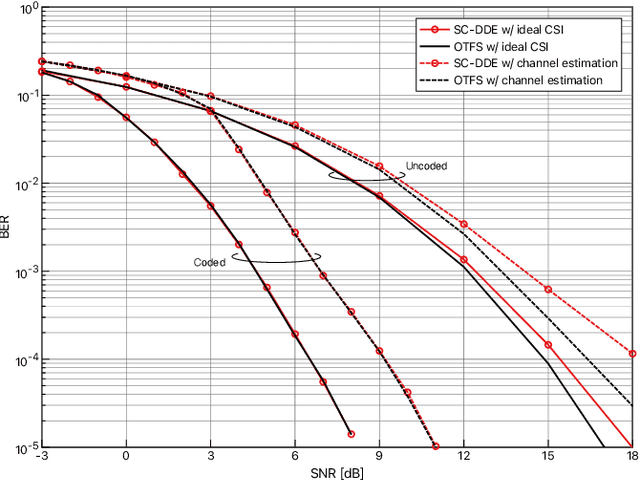
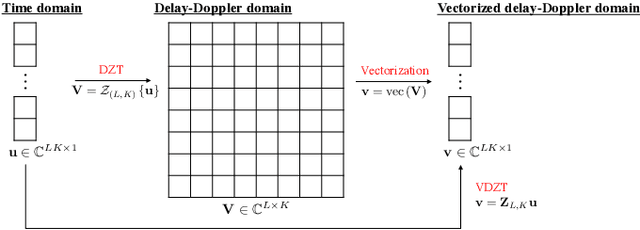

For doubly-selective channels, delay-Doppler (DD) modulation, mostly known as orthogonal time frequency space (OTFS) modulation, enables simultaneous compensation of delay and Doppler shifts. However, OTFS modulated signal has high peak-to-average power ratio (PAPR) because of its precoding operation performed over the DD domain. In order to deal with this problem, we propose a single-carrier transmission with delay-Doppler domain equalization (SC-DDE). In this system, the discretized time-domain SC signal is converted to the DD domain by discrete Zak transform (DZT) at the receiver side, followed by delay-Doppler domain equalization (DDE). Since equalization is performed in the DD domain, the SC-DDE receiver should acquire the channel delay-Doppler response. To this end, we introduce an embedded pilot-aided channel estimation scheme designed for SC-DDE, which does not affect the peak power property of transmitted signals. Through computer simulation, distribution of PAPR and bit error rate (BER) performance of the proposed system are compared with those of the conventional OTFS and SC with frequency-domain equalization (SC-FDE). As a result, our proposed SC-DDE significantly outperforms SC-FDE in terms of BER at the expense of additional computational complexity at the receiver. Furthermore, SC-DDE shows much lower PAPR than OTFS even though they achieve comparable coded BER performance.
Secrecy Design of Indoor Visible Light Communication Network under Downlink NOMA Transmission
Apr 18, 2023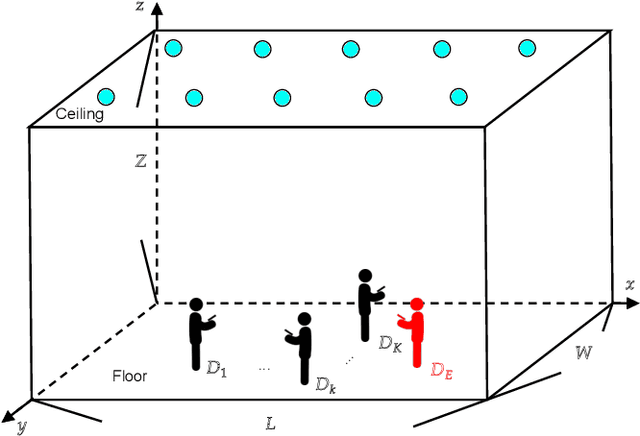
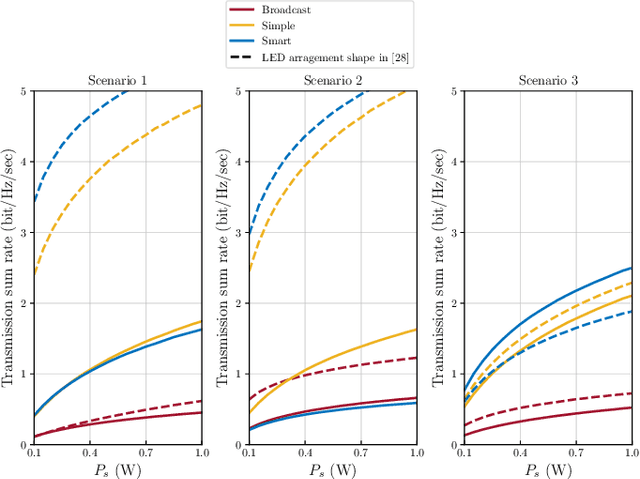
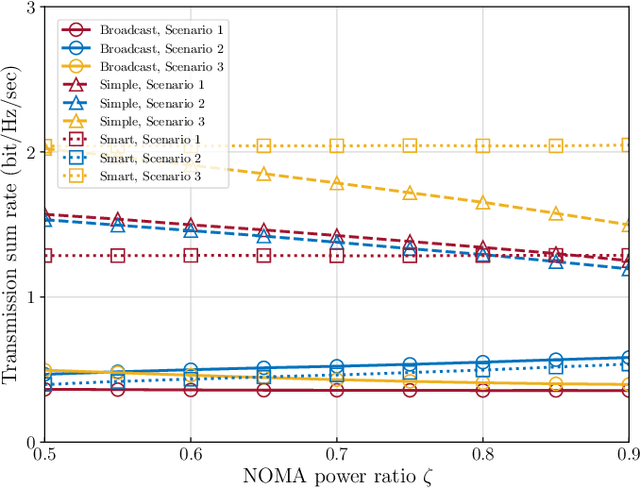
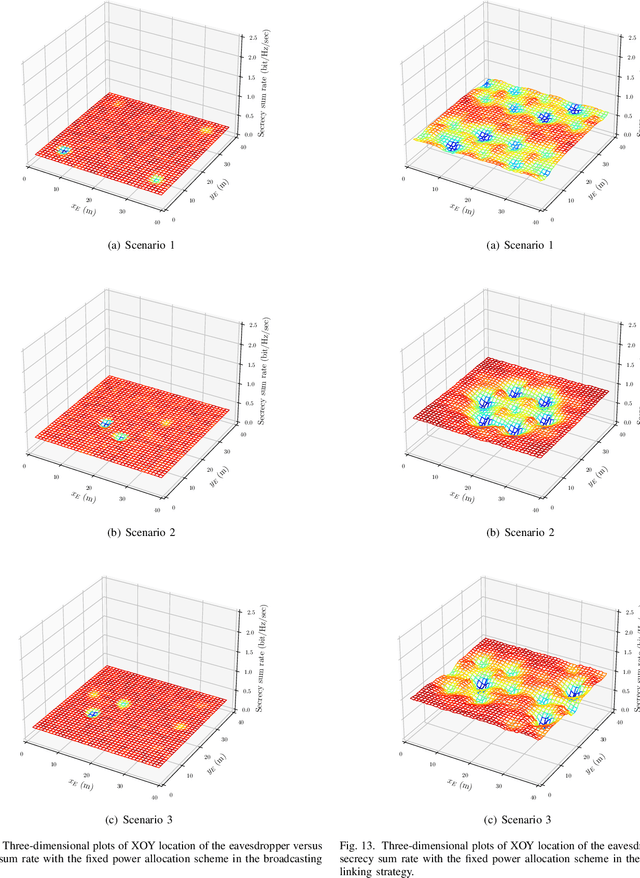
In this work, we investigate the transmission sum rate as well as the secrecy sum rate of indoor visible light communication (VLC) networks for mobile devices with the power domain non-orthogonal multiple access (NOMA) transmission, where multiple legitimate users are equipped with photodiodes (PDs). We introduce a body blockage model of the legitimate users as well as the eavesdropper to focus on the case where the communications from transmitting light-emitting diodes (LEDs) to receiving devices are blocked by the bodies of receiving users. Furthermore, in order to improve the secrecy without any knowledge of the channel state information (CSI) of the eavesdropper, a novel LED arrangement is introduced to reduce the overlapping area covered by LED units supporting different users. We also propose two LED operation strategies, called simple and smart LED linking, and evaluate their performance against the conventional broadcasting in terms of transmission sum rate and secrecy sum rate. Through computer simulations, the superiority of our proposed strategies is demonstrated.