 Add to Chrome
 Add to Firefox
 Add to Edge
Quantum-Native Maximum Likelihood Detection in Random Access Channel with Overloaded MIMO
May 19, 2026
In this paper, we propose a quantum-native formulation of maximum likelihood detection (MLD) for overloaded multiple-input multiple-output (MIMO) systems in a random access channel, where numerous user terminals share the same channel resource and asynchronously transmit signals. Classical linear detectors suffer from significant performance degradation in this scenario, whereas the exhaustive-search MLD achieves the optimal performance but incurs an exponential computational complexity. To overcome this trade-off, we formulate the MLD as a binary optimization problem and solve it via Grover adaptive search (GAS) -- a quantum exhaustive search algorithm offering quadratic speedup in fault-tolerant quantum computing. We then introduce a search space reduction technique to substantially decrease the required computational resources. In addition, we investigate efficient parameter settings for GAS through probability analysis to improve convergence performance. We demonstrate that the proposed detector achieves the optimal detection performance while reducing the required Grover rotation count to reach the solution by up to approximately 65% compared with the conventional GAS, showing its potential as a viable solution for future quantum-accelerated wireless systems.

Z-Opt: A Near-Optimal Reduced-Complexity Two-Dimensional Grassmannian Constellation
May 06, 2026Grassmannian constellations are known to achieve the capacity of noncoherent communications over Rayleigh fading channels in the high-SNR regime, yet their efficient construction remains challenging. In this paper, we propose two construction methods for Grassmannian constellations of one-dimensional subspaces in a two-dimensional space, termed S-Opt and Z-Opt, along with two low-complexity detectors. Both the construction and detection procedures are performed on the unit sphere, known as the Bloch sphere in quantum computing. We show that the chordal distance on the Grassmann manifold is proportional to the Euclidean distance on the Bloch sphere and derive a corresponding theoretical upper bound based on the Fejes--Tóth bound on the minimum chordal distance. The S-Opt constellation is constructed from sphere-packing solutions and attains the derived upper bound for the optimal Bloch-sphere packings considered. The S-Opt detector can be applied to arbitrary Grassmannian constellations on $\mathcal{G}(2,1)$, and its time complexity scales linearly with the number of receive antennas and logarithmically with the constellation size, while yielding the same detection performance as the GLRT detector. Furthermore, based on the insight obtained through the S-Opt construction, the Z-Opt constellation is constructed by stacking regular polygons on the Bloch sphere, and its minimum chordal distance approaches the derived upper bound over the evaluated constellation sizes. The Z-Opt detector's time complexity scales linearly with the number of receive antennas, while yielding the same detection performance as the GLRT detector for Z-Opt.
Sparsification of Precoding Codebooks for PAPR Reduction via Grassmannian Representations
Apr 21, 2026In this letter, we propose a sparsification method for precoding codebooks that reduces the peak-to-average power ratio (PAPR) while preserving the achievable rate. By exploiting the fact that precoder matrices lie on the Grassmann manifold, we formulate a codebook design problem that enables sparsification without modifying the existing feedback mechanism. We develop two sparsification approaches, namely exact sparsification via unitary transformation and approximate sparsification via sparse principal component analysis, and integrate them into a unified design algorithm. The proposed sparsified codebooks incur negligible performance loss while reducing PAPR by more than 1 dB in uplink scenarios.
Penalty-Free Two-Step Optimization of Higher-Order Ising Problems for Two-Dimensional Line-Controlled RIS
Apr 01, 2026Reconfigurable intelligent surfaces (RISs) are often assumed to allow continuous phase control over all elements, leading to hardware cost that scales with the number of elements. Treating the phase of each element as a discrete variable is essential for improving cost effectiveness toward ubiquitous RIS deployment. However, the resulting discrete optimization problem is inherently difficult to solve. To address this challenge, this letter proposes a two-dimensional line-control method to reduce the degrees of freedom of the phase variables. The formulation yields a fourth-order objective function and is not directly compatible with physical optimizers such as coherent Ising machines and quantum annealers, which are designed for quadratic interactions. Conventional methods for reducing the order of the objective function with additional auxiliary variables increase the number of variables and require additional penalty parameters, limiting scalability. We therefore propose a two-step optimization method that transforms the fourth-order objective into two successive quadratic optimization problems. For a RIS with 5,476 elements, the required number of discrete variables is reduced from 11,100 to 5,476. Experiments using a real coherent Ising machine demonstrated that the proposed approach solved the discrete-phase optimization problem with 5,476 elements, while limiting the beamforming-gain loss to 2 dB compared with the full continuous-control case.
Low-Complexity and Power-Efficient Precoding Codebook Design on Sparse Grassmannian
Mar 03, 2026We propose a sparse Grassmannian design for precoding codebooks. Due to their sparse structure, our proposed codebooks achieve low peak-to-average power ratio (PAPR), low complexity of precoder multiplication, and low storage cost, while demonstrating performance comparable to the optimal codebook. Specifically, we introduce a method for constructing codebooks based on Schubert cell decomposition on the Grassmann manifold. Designing an optimal Grassmannian precoding codebook generally requires high computational complexity. In the proposed approach, by exploiting its sparsity, the objective function can be simplified, and the search space can also be significantly reduced compared to state-of-the-art codebooks. Numerical simulations in uplink systems demonstrate that the proposed sparse codebook asymptotically approaches the optimal codebook and outperforms the codebook currently adopted in 5G NR, in terms of achievable rate under uncorrelated Rayleigh fading channels, while maintaining substantially lower PAPR than conventional dense designs. These results confirm that the proposed sparse codebook can be a practical and power-efficient alternative to conventional codebooks for a wide range of uplink transmission scenarios.
Sparse Grassmannian Design for Noncoherent Codes via Schubert Cell Decomposition
Jan 28, 2026In this paper, we propose a method for designing sparse Grassmannian codes for noncoherent multiple-input multiple-output systems. Conventional pairwise error probability formulations under uncorrelated Rayleigh fading channels fail to account for rank deficiency induced by sparse configurations. We revise these formulations to handle such cases in a unified manner. Furthermore, we derive a closed-form metric that effectively maximizes the noncoherent average mutual information (AMI) at a given signal-to-noise ratio. We focus on the fact that the Schubert cell decomposition of the Grassmann manifold provides a mathematically sparse property, and establish design criteria for sparse noncoherent codes based on our analyses. In numerical results, the proposed sparse noncoherent codes outperform conventional methods in terms of both symbol error rate and AMI, and asymptotically approach the performance of the optimal Grassmannian constellations in the high-signal-to-noise ratio regime. Moreover, they reduce the time and space complexity, which does not scale with the number of transmit antennas.
Quantum-Accelerated Wireless Communications: Concepts, Connections, and Implications
Jun 25, 2025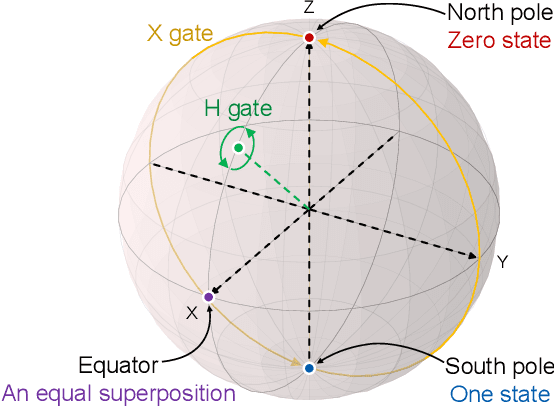
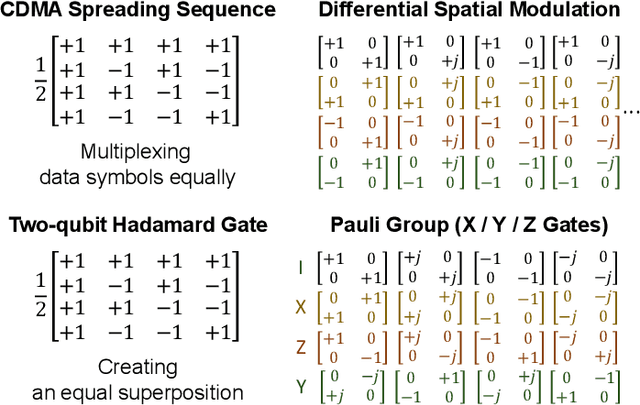

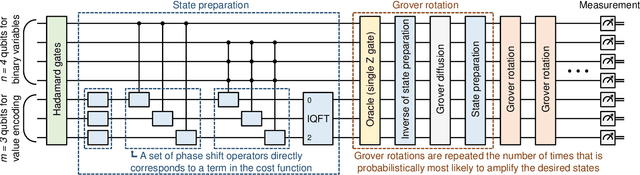
Quantum computing is poised to redefine the algorithmic foundations of communication systems. While quantum superposition and entanglement enable quadratic or exponential speedups for specific problems, identifying use cases where these advantages yield engineering benefits is, however, still nontrivial. This article presents the fundamentals of quantum computing in a style familiar to the communications society, outlining the current limits of fault-tolerant quantum computing and uncovering a mathematical harmony between quantum and wireless systems, which makes the topic more enticing to wireless researchers. Based on a systematic review of pioneering and state-of-the-art studies, we distill common design trends for the research and development of quantum-accelerated communication systems and highlight lessons learned. The key insight is that classical heuristics can sharpen certain quantum parameters, underscoring the complementary strengths of classical and quantum computing. This article aims to catalyze interdisciplinary research at the frontier of quantum information processing and future communication systems.
Maximizing Spectrum Efficiency of Data-Carrying Reference Signals via Bayesian Optimization
Feb 20, 2025Data-carrying reference signals are a type of reference signal (RS) constructed on the Grassmann manifold, which allows for simultaneous data transmission and channel estimation to achieve boosted spectral efficiency at high signal-to-noise ratios (SNRs). However, they do not improve spectral efficiency at low to middle SNRs compared with conventional RSs. To address this problem, we propose a numerical optimization-based Grassmann constellation design on the Grassmann manifold that accounts for both data transmission and channel estimation. In our numerical optimization, we derive an upper bound on the normalized mean squared error (NMSE) of estimated channel matrices and a lower bound on the noncoherent average mutual information (AMI), and these bounds are optimized simultaneously by using a Bayesian optimization technique. The proposed objective function outperforms conventional design metrics in obtaining Pareto-optimal constellations for NMSE and AMI. The constellation obtained by our method achieves an NMSE comparable to conventional non-data-carrying RSs while enabling data transmission, resulting in superior AMI performance and improved spectral efficiency even at middle SNRs.
Superimposed Pilot-Based OTFS -- Will it Work?
Jan 27, 2025Orthogonal time frequency space (OTFS) modulation is a promising solution to handle doubly-selective fading, but its channel estimation is a nontrivial task in terms of maximizing spectral efficiency. Conventional pilot assignment approaches face challenges: the standard embedded pilot-based scheme suffers from low transmission rates, and the single superimposed pilot (SP)-based scheme experiences inevitable data-pilot interference, leading to coarse channel estimation. To cope with this issue, focusing on the SP-based OTFS system in channel coded scenarios, we propose a novel pilot assignment scheme and an iterative algorithm. The proposed scheme allocates multiple SPs per frame to estimate channel coefficients accurately. Furthermore, the proposed algorithm performs refined interference cancellation, utilizing a replica of data symbols generated from soft-decision outputs provided by a decoder. Assuming fair and unified conditions, we evaluate each pilot assignment scheme in terms of reliability, channel estimation accuracy, effective throughput, and computational complexity. Our numerical simulations demonstrate that the multiple SP-based scheme, which balances the transmission rate and the interference cancellation performance, has the best throughput at the expense of slightly increased complexity. In addition, we confirm that the multiple SP-based scheme achieves further improved throughput due to the proposed interference cancellation algorithm.
Quantum Speedup for Polar Maximum Likelihood Decoding
Nov 07, 2024Conventional decoding algorithms for polar codes strive to balance achievable performance and computational complexity in classical computing. While maximum likelihood (ML) decoding guarantees optimal performance, its NP-hard nature makes it impractical for real-world systems. In this letter, we propose a novel ML decoding architecture for polar codes based on the Grover adaptive search, a quantum exhaustive search algorithm. Unlike conventional studies, our approach, enabled by a newly formulated objective function, uniquely supports Gray-coded multi-level modulation without expanding the search space size compared to the classical ML decoding. Simulation results demonstrate that our proposed quantum decoding achieves ML performance while providing a pure quadratic speedup in query complexity.