 Add to Chrome
 Add to Firefox
 Add to Edge
Ask Self, Ask Others: Relation Is All You Need
Aug 20, 2026
Attention directly derives normalized information flow from pairwise scores. We introduce Relation, an alternative token-mixing primitive that first organizes pairwise evidence into explicit Self and Exchange relations and derives information flow afterward. This relational organization gives rise to Full Relation, FlashRelation, Linear Relation, Hybrid Relation, and a KV-style Relation Cache. Across matched decoder-only models at approximately 10M, 30M, and 100M parameters, Full Relation achieves lower final validation NLL than MHA at all three scales. In a fixed-context reference benchmark, FlashRelation is 3.60-4.41x faster than the materialized Full Relation implementation. Across scale-matched production workloads, it reaches 76.4-84.9% of PyTorch FlashAttention throughput while executing the Full Relation operator. Hybrid Relation uses 75% Linear Relation layers and achieves strong language-modeling quality. These results support a relation-first view of token mixing: ask Self, ask Others, then let Flow follow Relation.

Is SwiGLU's Open Positive Tail Necessary? Evidence from Closed-Tail Gating with MemGLU
Aug 07, 2026We test whether decoder-only language-model FFNs require SwiGLU's open positive tail. We introduce MemGLU as a closed-tail comparator derived from a memristive branch geometry. Across paired 9M and 30M pretraining runs with three seeds, MemGLU remains within about 0.1% of SwiGLU in validation NLL. Trained SwiGLU checkpoints are sensitive to positive-tail suppression, while mechanism diagnostics show that the two models use their gates differently despite similar losses. These results suggest that models adapt to the gate geometry available during pretraining. At the tested scales, SwiGLU's open positive tail is not necessary for decoder-only language-model FFNs.
VPHO: Joint Visual-Physical Cue Learning and Aggregation for Hand-Object Pose Estimation
Nov 15, 2025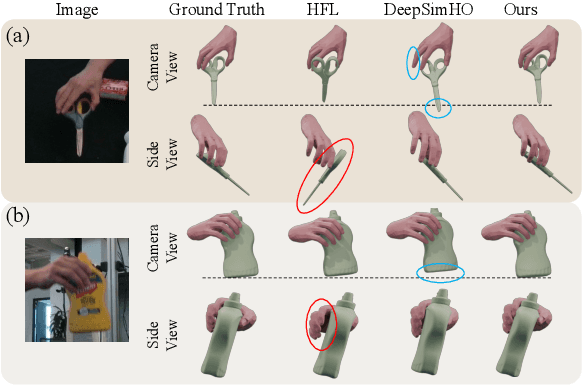
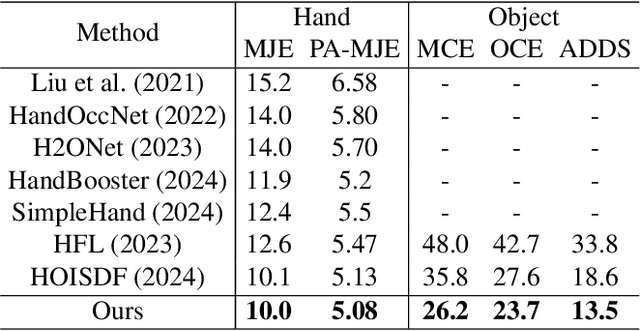
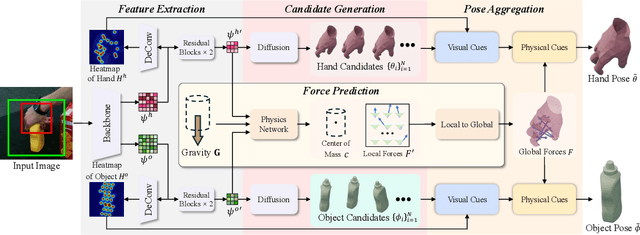
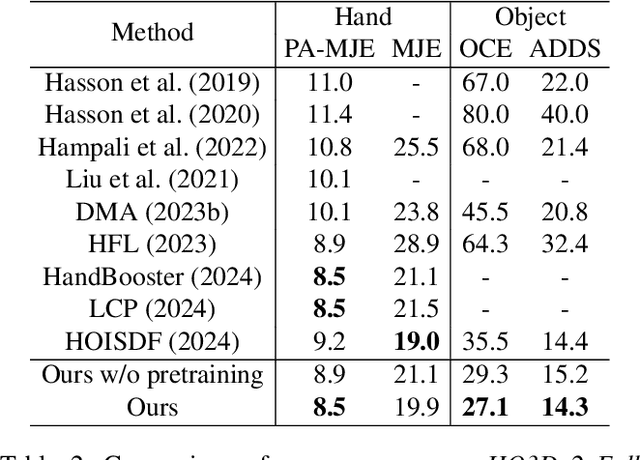
Estimating the 3D poses of hands and objects from a single RGB image is a fundamental yet challenging problem, with broad applications in augmented reality and human-computer interaction. Existing methods largely rely on visual cues alone, often producing results that violate physical constraints such as interpenetration or non-contact. Recent efforts to incorporate physics reasoning typically depend on post-optimization or non-differentiable physics engines, which compromise visual consistency and end-to-end trainability. To overcome these limitations, we propose a novel framework that jointly integrates visual and physical cues for hand-object pose estimation. This integration is achieved through two key ideas: 1) joint visual-physical cue learning: The model is trained to extract 2D visual cues and 3D physical cues, thereby enabling more comprehensive representation learning for hand-object interactions; 2) candidate pose aggregation: A novel refinement process that aggregates multiple diffusion-generated candidate poses by leveraging both visual and physical predictions, yielding a final estimate that is visually consistent and physically plausible. Extensive experiments demonstrate that our method significantly outperforms existing state-of-the-art approaches in both pose accuracy and physical plausibility.