 Add to Chrome
 Add to Firefox
 Add to Edge
Towards Controllable Low-Light Image Enhancement: A Continuous Multi-illumination Dataset and Efficient State Space Framework
Mar 26, 2026
Low-light image enhancement (LLIE) has traditionally been formulated as a deterministic mapping. However, this paradigm often struggles to account for the ill-posed nature of the task, where unknown ambient conditions and sensor parameters create a multimodal solution space. Consequently, state-of-the-art methods frequently encounter luminance discrepancies between predictions and labels, often necessitating "gt-mean" post-processing to align output luminance for evaluation. To address this fundamental limitation, we propose a transition toward Controllable Low-light Enhancement (CLE), explicitly reformulating the task as a well-posed conditional problem. To this end, we introduce CLE-RWKV, a holistic framework supported by Light100, a new benchmark featuring continuous real-world illumination transitions. To resolve the conflict between luminance control and chromatic fidelity, a noise-decoupled supervision strategy in the HVI color space is employed, effectively separating illumination modulation from texture restoration. Architecturally, to adapt efficient State Space Models (SSMs) for dense prediction, we leverage a Space-to-Depth (S2D) strategy. By folding spatial neighborhoods into channel dimensions, this design allows the model to recover local inductive biases and effectively bridge the "scanning gap" inherent in flattened visual sequences without sacrificing linear complexity. Experiments across seven benchmarks demonstrate that our approach achieves competitive performance and robust controllability, providing a real-world multi-illumination alternative that significantly reduces the reliance on gt-mean post-processing.

VPHO: Joint Visual-Physical Cue Learning and Aggregation for Hand-Object Pose Estimation
Nov 15, 2025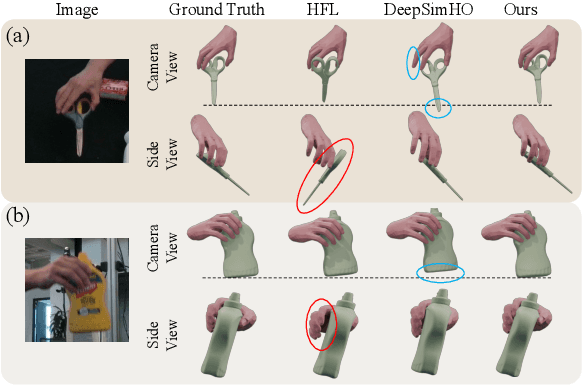
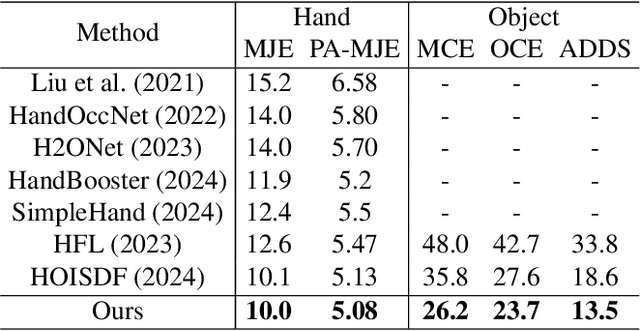
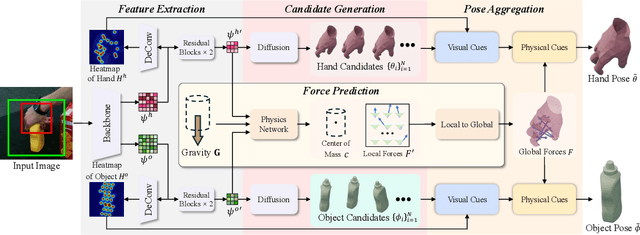
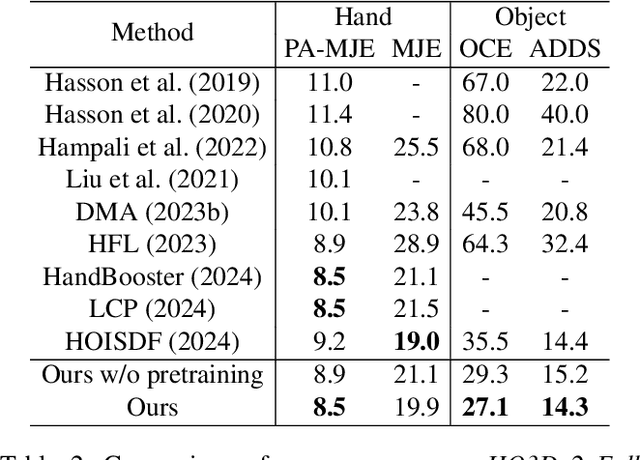
Estimating the 3D poses of hands and objects from a single RGB image is a fundamental yet challenging problem, with broad applications in augmented reality and human-computer interaction. Existing methods largely rely on visual cues alone, often producing results that violate physical constraints such as interpenetration or non-contact. Recent efforts to incorporate physics reasoning typically depend on post-optimization or non-differentiable physics engines, which compromise visual consistency and end-to-end trainability. To overcome these limitations, we propose a novel framework that jointly integrates visual and physical cues for hand-object pose estimation. This integration is achieved through two key ideas: 1) joint visual-physical cue learning: The model is trained to extract 2D visual cues and 3D physical cues, thereby enabling more comprehensive representation learning for hand-object interactions; 2) candidate pose aggregation: A novel refinement process that aggregates multiple diffusion-generated candidate poses by leveraging both visual and physical predictions, yielding a final estimate that is visually consistent and physically plausible. Extensive experiments demonstrate that our method significantly outperforms existing state-of-the-art approaches in both pose accuracy and physical plausibility.