 Add to Chrome
 Add to Firefox
 Add to Edge
SCoRe: Clean Image Generation from Diffusion Models Trained on Noisy Images
Apr 10, 2026
Diffusion models trained on noisy datasets often reproduce high-frequency training artifacts, significantly degrading generation quality. To address this, we propose SCoRe (Spectral Cutoff Regeneration), a training-free, generation-time spectral regeneration method for clean image generation from diffusion models trained on noisy images. Leveraging the spectral bias of diffusion models, which infer high-frequency details from low-frequency cues, SCoRe suppresses corrupted high-frequency components of a generated image via a frequency cutoff and regenerates them via SDEdit. Crucially, we derive a theoretical mapping between the cutoff frequency and the SDEdit initialization timestep based on Radially Averaged Power Spectral Density (RAPSD), which prevents excessive noise injection during regeneration. Experiments on synthetic (CIFAR-10) and real-world (SIDD) noisy datasets demonstrate that SCoRe substantially outperforms post-processing and noise-robust baselines, restoring samples closer to clean image distributions without any retraining or fine-tuning.

cvpaper.challenge in 2016: Futuristic Computer Vision through 1,600 Papers Survey
Jul 20, 2017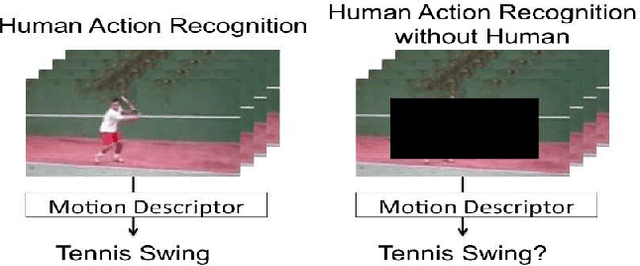
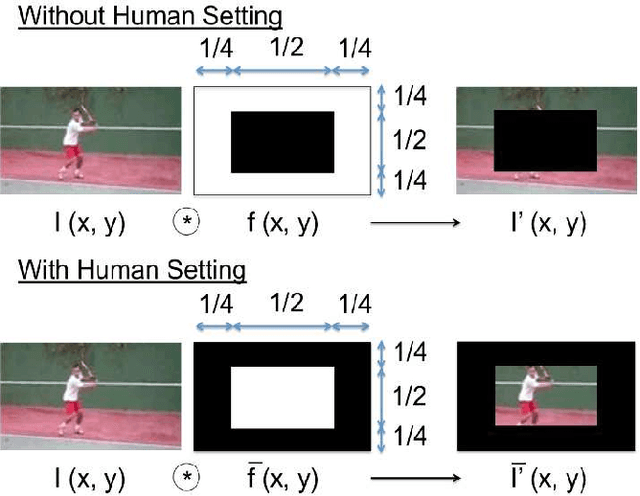
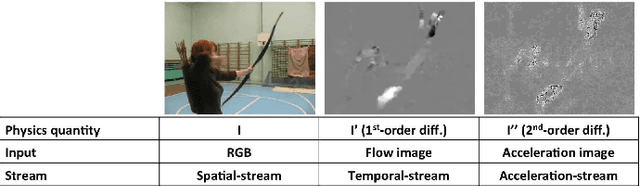
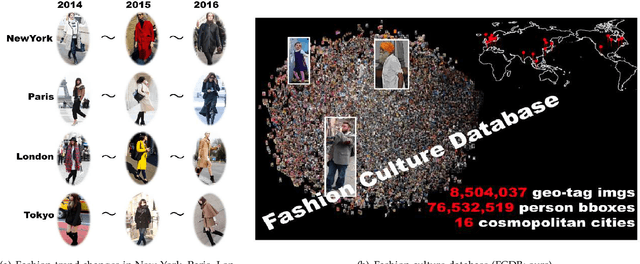
The paper gives futuristic challenges disscussed in the cvpaper.challenge. In 2015 and 2016, we thoroughly study 1,600+ papers in several conferences/journals such as CVPR/ICCV/ECCV/NIPS/PAMI/IJCV.
Could you guess an interesting movie from the posters?: An evaluation of vision-based features on movie poster database
Apr 07, 2017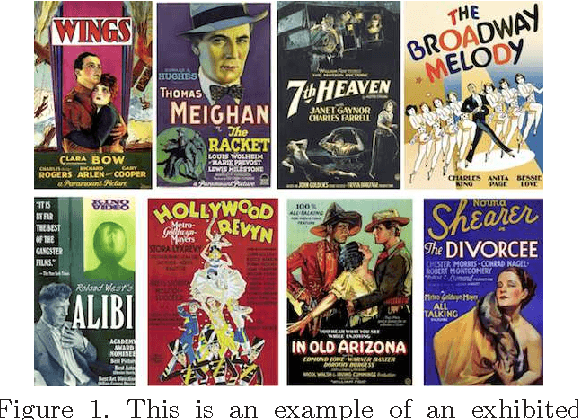

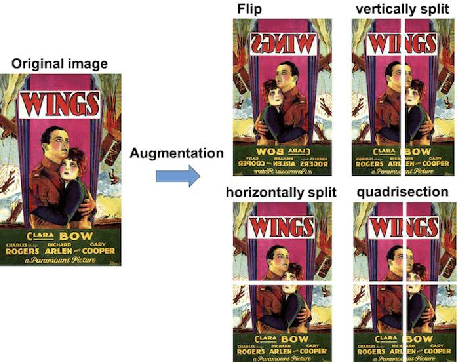
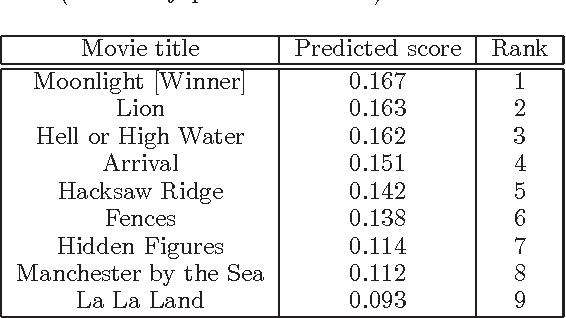
In this paper, we aim to estimate the Winner of world-wide film festival from the exhibited movie poster. The task is an extremely challenging because the estimation must be done with only an exhibited movie poster, without any film ratings and box-office takings. In order to tackle this problem, we have created a new database which is consist of all movie posters included in the four biggest film festivals. The movie poster database (MPDB) contains historic movies over 80 years which are nominated a movie award at each year. We apply a couple of feature types, namely hand-craft, mid-level and deep feature to extract various information from a movie poster. Our experiments showed suggestive knowledge, for example, the Academy award estimation can be better rate with a color feature and a facial emotion feature generally performs good rate on the MPDB. The paper may suggest a possibility of modeling human taste for a movie recommendation.