 Add to Chrome
 Add to Firefox
 Add to Edge
Handwriting Trajectory Recovery with Diffusion Models
Jul 03, 2026
Recovering online pen trajectories from offline handwriting images, often referred to as handwriting trajectory recovery (stroke recovery), is an offline-to-online conversion task with applications in stroke-level editing and forensic analysis. We propose, to the best of our knowledge, the first diffusion-model-based framework for this task. Our method formulates trajectory recovery as image-conditioned generation and uses a denoising diffusion model to sample pen trajectories consistent with the observed ink trace. Through extensive quantitative evaluations on CASIA-OLHWDB (1.0-1.1), we verify that the proposed approach enables accurate recovery even for complex multi-stroke characters, substantially improving both temporal similarity (DTW/LDTW) and shape fidelity (AIoU) over representative prior methods such as PEN-Net and Cross-VAE. We further show that the model captures general stroke-order tendencies and generalizes to classes unseen during training, exemplified by cross-script transfer: a model trained on Chinese characters can recover reasonable stroke orders for Latin letters to some extent.

SCoRe: Clean Image Generation from Diffusion Models Trained on Noisy Images
Apr 10, 2026Diffusion models trained on noisy datasets often reproduce high-frequency training artifacts, significantly degrading generation quality. To address this, we propose SCoRe (Spectral Cutoff Regeneration), a training-free, generation-time spectral regeneration method for clean image generation from diffusion models trained on noisy images. Leveraging the spectral bias of diffusion models, which infer high-frequency details from low-frequency cues, SCoRe suppresses corrupted high-frequency components of a generated image via a frequency cutoff and regenerates them via SDEdit. Crucially, we derive a theoretical mapping between the cutoff frequency and the SDEdit initialization timestep based on Radially Averaged Power Spectral Density (RAPSD), which prevents excessive noise injection during regeneration. Experiments on synthetic (CIFAR-10) and real-world (SIDD) noisy datasets demonstrate that SCoRe substantially outperforms post-processing and noise-robust baselines, restoring samples closer to clean image distributions without any retraining or fine-tuning.
Hierarchical Co-Embedding of Font Shapes and Impression Tags
Apr 05, 2026Font shapes can evoke a wide range of impressions, but the correspondence between fonts and impression descriptions is not one-to-one: some impressions are broadly compatible with diverse styles, whereas others strongly constrain the set of plausible fonts. We refer to this graded constraint strength as style specificity. In this paper, we propose a hyperbolic co-embedding framework that models font--impression correspondence through entailment rather than simple paired alignment. Font images and impression descriptions, represented as single tags or tag sets, are embedded in a shared hyperbolic space with two complementary entailment constraints: impression-to-font entailment and low-to-high style-specificity entailment among impressions. This formulation induces a radial structure in which low style-specificity impressions lie near the origin and high style-specificity impressions lie farther away, yielding an interpretable geometric measure of how strongly an impression constrains font style. Experiments on the MyFonts dataset demonstrate improved bidirectional retrieval over strong one-to-one baselines. In addition, traversal and tag-level analyses show that the learned space captures a coherent progression from ambiguous to more style-specific impressions and provides a meaningful, data-driven quantification of style specificity.
Ranking-Guided Semi-Supervised Domain Adaptation for Severity Classification
Apr 02, 2026Semi-supervised domain adaptation leverages a few labeled and many unlabeled target samples, making it promising for addressing domain shifts in medical image analysis. However, existing methods struggle with severity classification due to unclear class boundaries. Severity classification involves naturally ordered class labels, complicating adaptation. We propose a novel method that aligns source and target domains using rank scores learned via ranking with class order. Specifically, Cross-Domain Ranking ranks sample pairs across domains, while Continuous Distribution Alignment aligns rank score distributions. Experiments on ulcerative colitis and diabetic retinopathy classification validate the effectiveness of our approach, demonstrating successful alignment of class-specific rank score distributions.
Embedding Font Impression Word Tags Based on Co-occurrence
Aug 26, 2025Different font styles (i.e., font shapes) convey distinct impressions, indicating a close relationship between font shapes and word tags describing those impressions. This paper proposes a novel embedding method for impression tags that leverages these shape-impression relationships. For instance, our method assigns similar vectors to impression tags that frequently co-occur in order to represent impressions of fonts, whereas standard word embedding methods (e.g., BERT and CLIP) yield very different vectors. This property is particularly useful for impression-based font generation and font retrieval. Technically, we construct a graph whose nodes represent impression tags and whose edges encode co-occurrence relationships. Then, we apply spectral embedding to obtain the impression vectors for each tag. We compare our method with BERT and CLIP in qualitative and quantitative evaluations, demonstrating that our approach performs better in impression-guided font generation.
Enhancing Reliability of Medical Image Diagnosis through Top-rank Learning with Rejection Module
Aug 11, 2025In medical image processing, accurate diagnosis is of paramount importance. Leveraging machine learning techniques, particularly top-rank learning, shows significant promise by focusing on the most crucial instances. However, challenges arise from noisy labels and class-ambiguous instances, which can severely hinder the top-rank objective, as they may be erroneously placed among the top-ranked instances. To address these, we propose a novel approach that enhances toprank learning by integrating a rejection module. Cooptimized with the top-rank loss, this module identifies and mitigates the impact of outliers that hinder training effectiveness. The rejection module functions as an additional branch, assessing instances based on a rejection function that measures their deviation from the norm. Through experimental validation on a medical dataset, our methodology demonstrates its efficacy in detecting and mitigating outliers, improving the reliability and accuracy of medical image diagnoses.
Inverse Scene Text Removal
Jun 26, 2025Scene text removal (STR) aims to erase textual elements from images. It was originally intended for removing privacy-sensitiveor undesired texts from natural scene images, but is now also appliedto typographic images. STR typically detects text regions and theninpaints them. Although STR has advanced through neural networksand synthetic data, misuse risks have increased. This paper investi-gates Inverse STR (ISTR), which analyzes STR-processed images andfocuses on binary classification (detecting whether an image has un-dergone STR) and localizing removed text regions. We demonstrate inexperiments that these tasks are achievable with high accuracies, en-abling detection of potential misuse and improving STR. We also at-tempt to recover the removed text content by training a text recognizerto understand its difficulty.
Instance-wise Supervision-level Optimization in Active Learning
Mar 09, 2025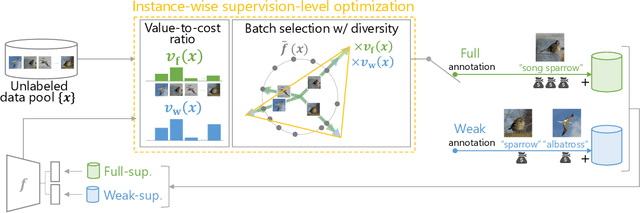
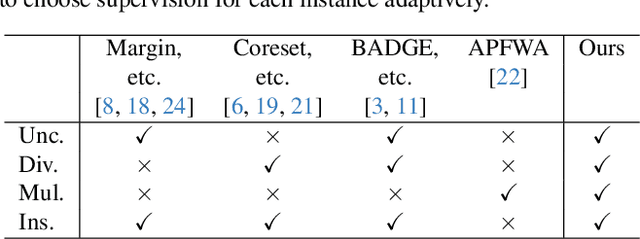
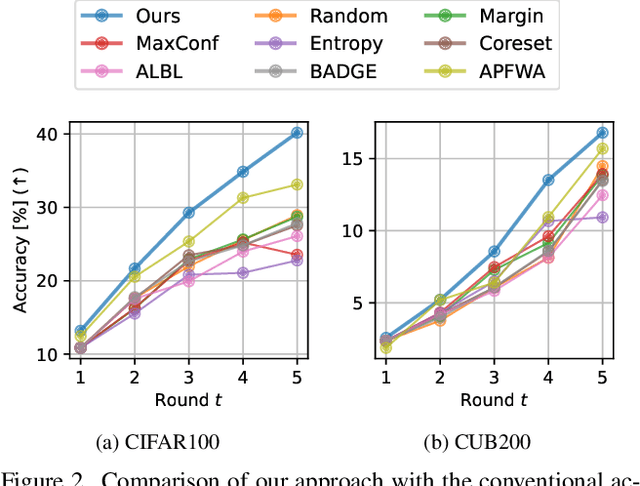
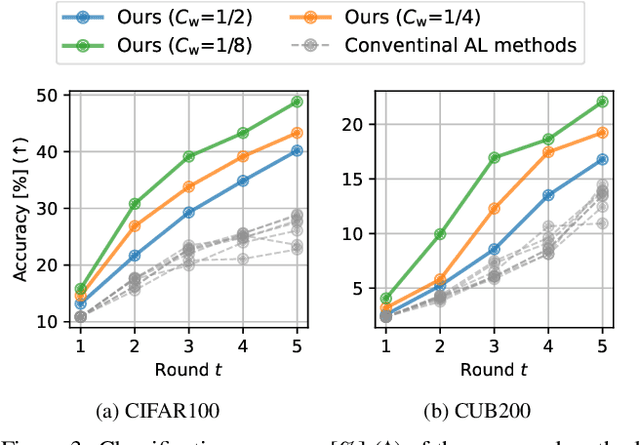
Active learning (AL) is a label-efficient machine learning paradigm that focuses on selectively annotating high-value instances to maximize learning efficiency. Its effectiveness can be further enhanced by incorporating weak supervision, which uses rough yet cost-effective annotations instead of exact (i.e., full) but expensive annotations. We introduce a novel AL framework, Instance-wise Supervision-Level Optimization (ISO), which not only selects the instances to annotate but also determines their optimal annotation level within a fixed annotation budget. Its optimization criterion leverages the value-to-cost ratio (VCR) of each instance while ensuring diversity among the selected instances. In classification experiments, ISO consistently outperforms traditional AL methods and surpasses a state-of-the-art AL approach that combines full and weak supervision, achieving higher accuracy at a lower overall cost. This code is available at https://github.com/matsuo-shinnosuke/ISOAL.
Self-Relaxed Joint Training: Sample Selection for Severity Estimation with Ordinal Noisy Labels
Oct 29, 2024
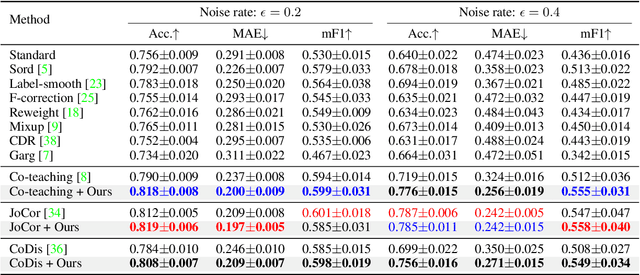


Severity level estimation is a crucial task in medical image diagnosis. However, accurately assigning severity class labels to individual images is very costly and challenging. Consequently, the attached labels tend to be noisy. In this paper, we propose a new framework for training with ``ordinal'' noisy labels. Since severity levels have an ordinal relationship, we can leverage this to train a classifier while mitigating the negative effects of noisy labels. Our framework uses two techniques: clean sample selection and dual-network architecture. A technical highlight of our approach is the use of soft labels derived from noisy hard labels. By appropriately using the soft and hard labels in the two techniques, we achieve more accurate sample selection and robust network training. The proposed method outperforms various state-of-the-art methods in experiments using two endoscopic ulcerative colitis (UC) datasets and a retinal Diabetic Retinopathy (DR) dataset. Our codes are available at https://github.com/shumpei-takezaki/Self-Relaxed-Joint-Training.
Can GPTs Evaluate Graphic Design Based on Design Principles?
Oct 11, 2024Recent advancements in foundation models show promising capability in graphic design generation. Several studies have started employing Large Multimodal Models (LMMs) to evaluate graphic designs, assuming that LMMs can properly assess their quality, but it is unclear if the evaluation is reliable. One way to evaluate the quality of graphic design is to assess whether the design adheres to fundamental graphic design principles, which are the designer's common practice. In this paper, we compare the behavior of GPT-based evaluation and heuristic evaluation based on design principles using human annotations collected from 60 subjects. Our experiments reveal that, while GPTs cannot distinguish small details, they have a reasonably good correlation with human annotation and exhibit a similar tendency to heuristic metrics based on design principles, suggesting that they are indeed capable of assessing the quality of graphic design. Our dataset is available at https://cyberagentailab.github.io/Graphic-design-evaluation .