 Add to Chrome
 Add to Firefox
 Add to Edge
Geometry Meets Light: Leveraging Geometric Priors for Universal Photometric Stereo under Limited Multi-Illumination Cues
Nov 18, 2025
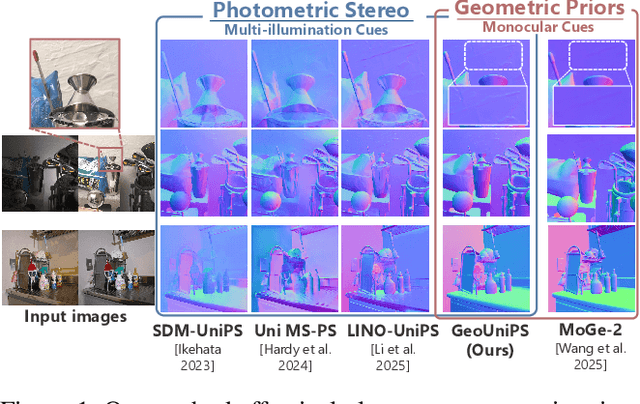
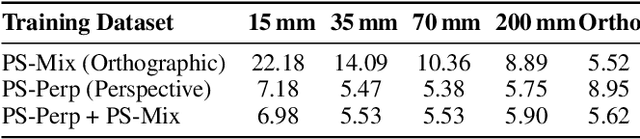
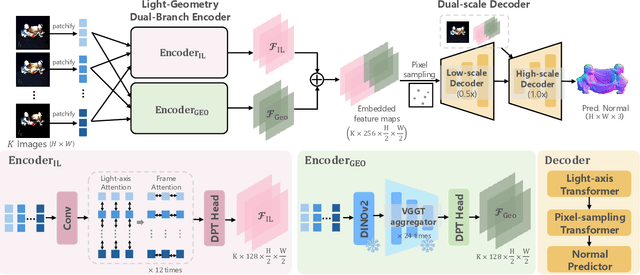
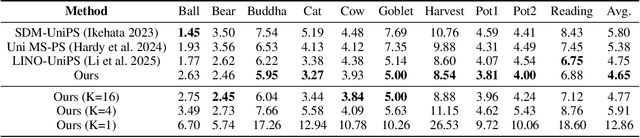
Universal Photometric Stereo is a promising approach for recovering surface normals without strict lighting assumptions. However, it struggles when multi-illumination cues are unreliable, such as under biased lighting or in shadows or self-occluded regions of complex in-the-wild scenes. We propose GeoUniPS, a universal photometric stereo network that integrates synthetic supervision with high-level geometric priors from large-scale 3D reconstruction models pretrained on massive in-the-wild data. Our key insight is that these 3D reconstruction models serve as visual-geometry foundation models, inherently encoding rich geometric knowledge of real scenes. To leverage this, we design a Light-Geometry Dual-Branch Encoder that extracts both multi-illumination cues and geometric priors from the frozen 3D reconstruction model. We also address the limitations of the conventional orthographic projection assumption by introducing the PS-Perp dataset with realistic perspective projection to enable learning of spatially varying view directions. Extensive experiments demonstrate that GeoUniPS delivers state-of-the-arts performance across multiple datasets, both quantitatively and qualitatively, especially in the complex in-the-wild scenes.

Physics-Free Spectrally Multiplexed Photometric Stereo under Unknown Spectral Composition
Oct 28, 2024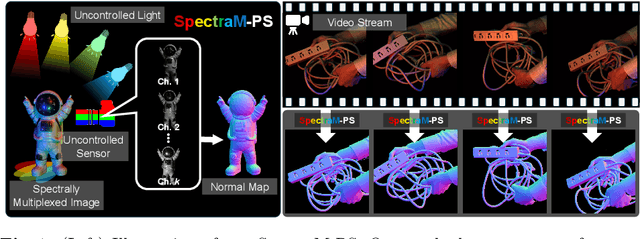
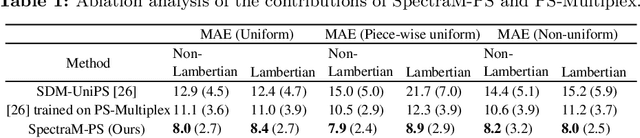
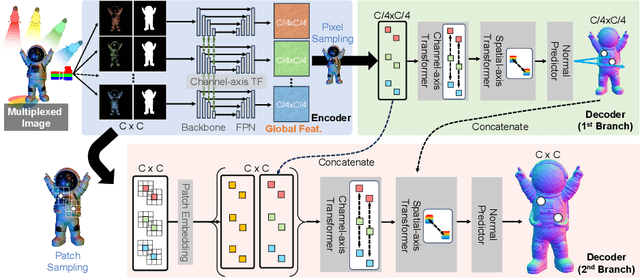
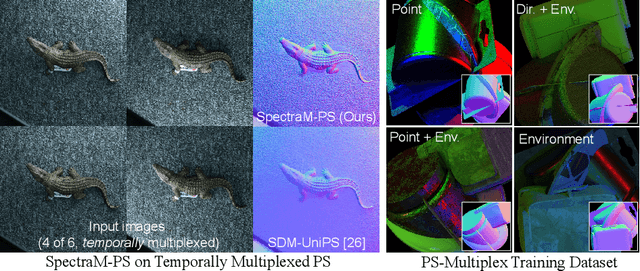
In this paper, we present a groundbreaking spectrally multiplexed photometric stereo approach for recovering surface normals of dynamic surfaces without the need for calibrated lighting or sensors, a notable advancement in the field traditionally hindered by stringent prerequisites and spectral ambiguity. By embracing spectral ambiguity as an advantage, our technique enables the generation of training data without specialized multispectral rendering frameworks. We introduce a unique, physics-free network architecture, SpectraM-PS, that effectively processes multiplexed images to determine surface normals across a wide range of conditions and material types, without relying on specific physically-based knowledge. Additionally, we establish the first benchmark dataset, SpectraM14, for spectrally multiplexed photometric stereo, facilitating comprehensive evaluations against existing calibrated methods. Our contributions significantly enhance the capabilities for dynamic surface recovery, particularly in uncalibrated setups, marking a pivotal step forward in the application of photometric stereo across various domains.
ColorVideoVDP: A visual difference predictor for image, video and display distortions
Jan 21, 2024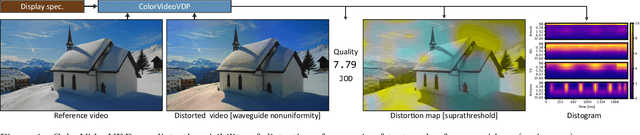
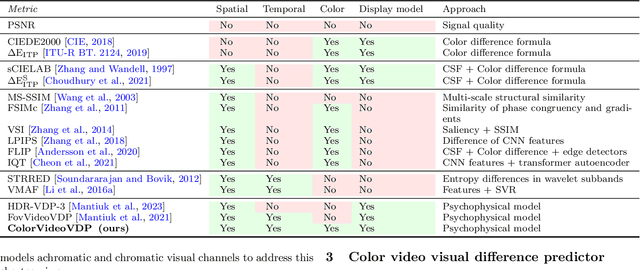


ColorVideoVDP is a video and image quality metric that models spatial and temporal aspects of vision, for both luminance and color. The metric is built on novel psychophysical models of chromatic spatiotemporal contrast sensitivity and cross-channel contrast masking. It accounts for the viewing conditions, geometric, and photometric characteristics of the display. It was trained to predict common video streaming distortions (e.g. video compression, rescaling, and transmission errors), and also 8 new distortion types related to AR/VR displays (e.g. light source and waveguide non-uniformities). To address the latter application, we collected our novel XR-Display-Artifact-Video quality dataset (XR-DAVID), comprised of 336 distorted videos. Extensive testing on XR-DAVID, as well as several datasets from the literature, indicate a significant gain in prediction performance compared to existing metrics. ColorVideoVDP opens the doors to many novel applications which require the joint automated spatiotemporal assessment of luminance and color distortions, including video streaming, display specification and design, visual comparison of results, and perceptually-guided quality optimization.
Multi-view 3D Reconstruction of a Texture-less Smooth Surface of Unknown Generic Reflectance
May 25, 2021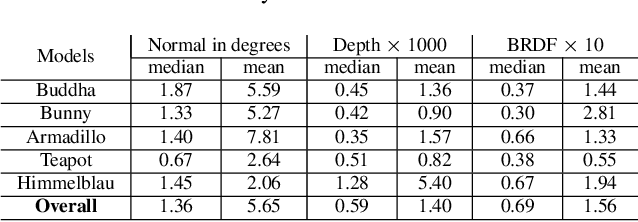
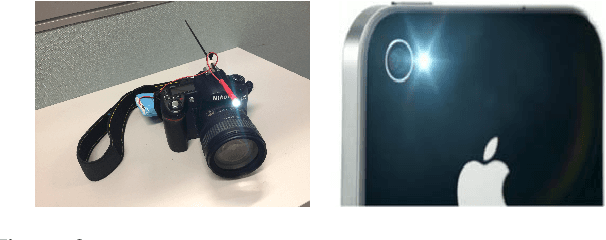
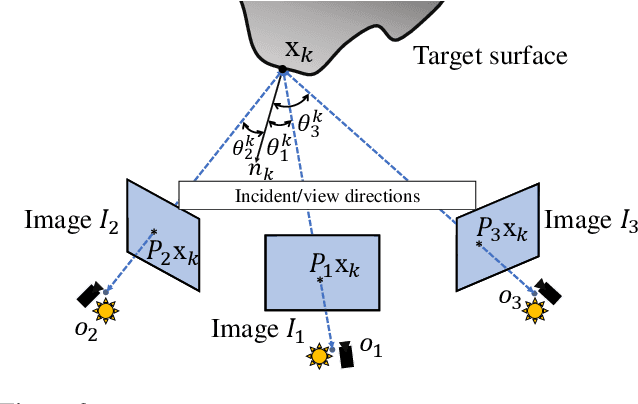
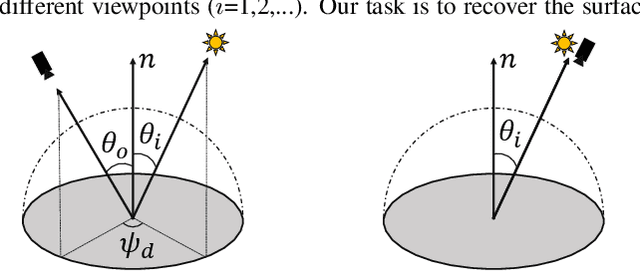
Recovering the 3D geometry of a purely texture-less object with generally unknown surface reflectance (e.g. non-Lambertian) is regarded as a challenging task in multi-view reconstruction. The major obstacle revolves around establishing cross-view correspondences where photometric constancy is violated. This paper proposes a simple and practical solution to overcome this challenge based on a co-located camera-light scanner device. Unlike existing solutions, we do not explicitly solve for correspondence. Instead, we argue the problem is generally well-posed by multi-view geometrical and photometric constraints, and can be solved from a small number of input views. We formulate the reconstruction task as a joint energy minimization over the surface geometry and reflectance. Despite this energy is highly non-convex, we develop an optimization algorithm that robustly recovers globally optimal shape and reflectance even from a random initialization. Extensive experiments on both simulated and real data have validated our method, and possible future extensions are discussed.