 Add to Chrome
 Add to Firefox
 Add to Edge
LapidaryEngine: Fully Conversational Crystal Generation
Jun 12, 2026
The emergence of Large Language Models (LLMs) has inspired the vision of generating bespoke crystal materials directly from natural-language instructions, enabling users to design materials through intuitive, conversational interaction. Existing text-to-crystal generative models represent important early steps toward this goal, but they suffer from two critical limitations: (i) restricted input formats that require highly structured descriptions (e.g., chemical formulas), and (ii) one-directional generation, where models can map text to crystal but cannot perform the inverse. These limitations prevent fully conversational workflows and hinder alignment with users' inherently ambiguous and evolving desiderata. We address these challenges with LapidaryEngine, the first model to support fully conversational crystal generation. LapidaryEngine accepts free-form natural-language requests and performs iterative refinement and editing in a dialogue-like manner. The key innovation is a pivot representation, a third, intermediate form that enables bidirectional translation between text and crystal structures despite the absence of direct paired datasets. Leveraging this pivot allows robust interpretation of user feedback and precise structural control. We demonstrate LapidaryEngine across diverse tasks, including insulator discovery, stability optimization, compositional modification, and structural editing, showcasing its ability to align generated materials with user intent in an interactive manner.

CrystalFramer: Rethinking the Role of Frames for SE(3)-Invariant Crystal Structure Modeling
Mar 04, 2025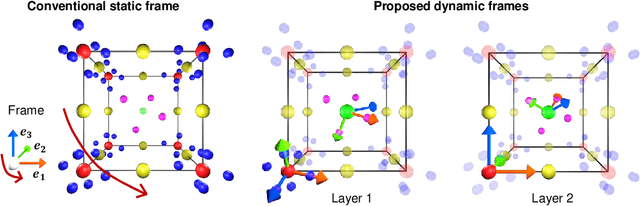

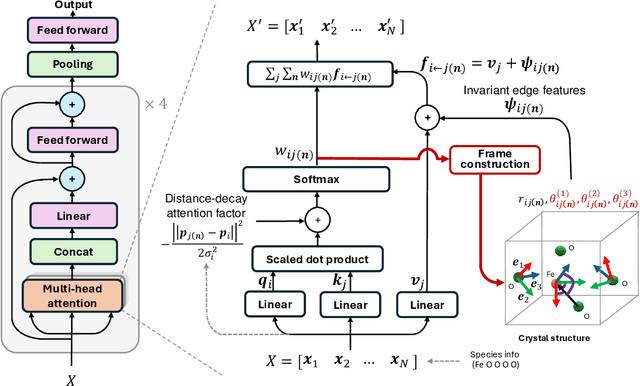
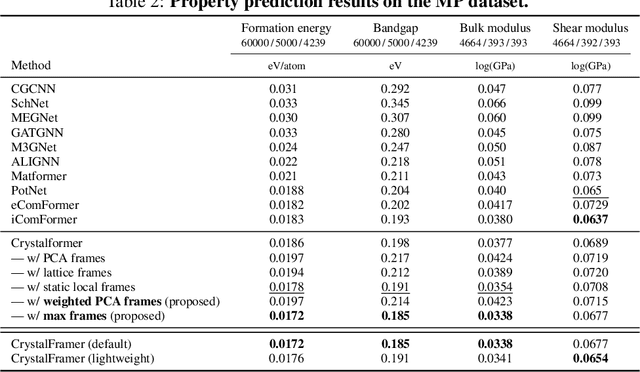
Crystal structure modeling with graph neural networks is essential for various applications in materials informatics, and capturing SE(3)-invariant geometric features is a fundamental requirement for these networks. A straightforward approach is to model with orientation-standardized structures through structure-aligned coordinate systems, or"frames." However, unlike molecules, determining frames for crystal structures is challenging due to their infinite and highly symmetric nature. In particular, existing methods rely on a statically fixed frame for each structure, determined solely by its structural information, regardless of the task under consideration. Here, we rethink the role of frames, questioning whether such simplistic alignment with the structure is sufficient, and propose the concept of dynamic frames. While accommodating the infinite and symmetric nature of crystals, these frames provide each atom with a dynamic view of its local environment, focusing on actively interacting atoms. We demonstrate this concept by utilizing the attention mechanism in a recent transformer-based crystal encoder, resulting in a new architecture called CrystalFramer. Extensive experiments show that CrystalFramer outperforms conventional frames and existing crystal encoders in various crystal property prediction tasks.