 Add to Chrome
 Add to Firefox
 Add to Edge
WSBD: Freezing-Based Optimizer for Quantum Neural Networks
Feb 11, 2026
The training of Quantum Neural Networks (QNNs) is hindered by the high computational cost of gradient estimation and the barren plateau problem, where optimization landscapes become intractably flat. To address these challenges, we introduce Weighted Stochastic Block Descent (WSBD), a novel optimizer with a dynamic, parameter-wise freezing strategy. WSBD intelligently focuses computational resources by identifying and temporarily freezing less influential parameters based on a gradient-derived importance score. This approach significantly reduces the number of forward passes required per training step and helps navigate the optimization landscape more effectively. Unlike pruning or layer-wise freezing, WSBD maintains full expressive capacity while adapting throughout training. Our extensive evaluation shows that WSBD converges on average 63.9% faster than Adam for the popular ground-state-energy problem, an advantage that grows with QNN size. We provide a formal convergence proof for WSBD and show that parameter-wise freezing outperforms traditional layer-wise approaches in QNNs. Project page: https://github.com/Damrl-lab/WSBD-Stochastic-Freezing-Optimizer.

Three Birds with One Stone: Improving Performance, Convergence, and System Throughput with Nest
Oct 10, 2025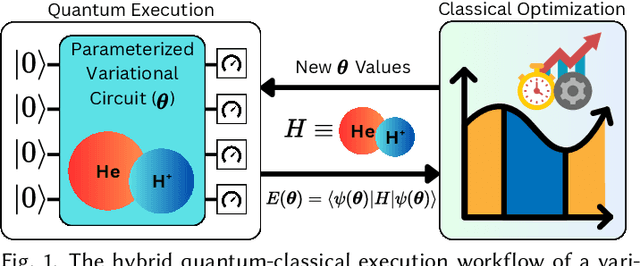

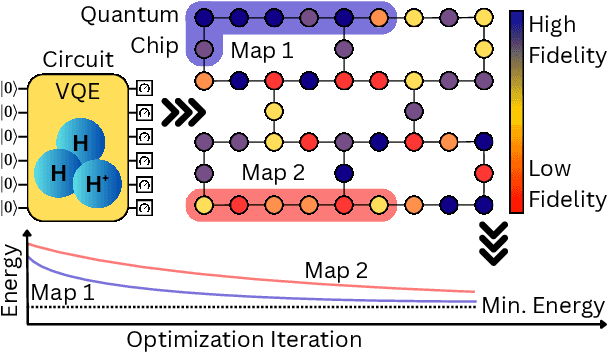
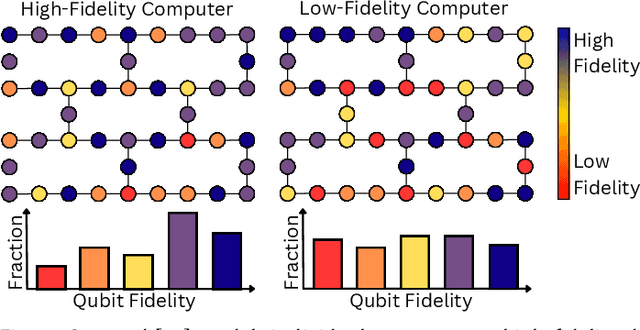
Variational quantum algorithms (VQAs) have the potential to demonstrate quantum utility on near-term quantum computers. However, these algorithms often get executed on the highest-fidelity qubits and computers to achieve the best performance, causing low system throughput. Recent efforts have shown that VQAs can be run on low-fidelity qubits initially and high-fidelity qubits later on to still achieve good performance. We take this effort forward and show that carefully varying the qubit fidelity map of the VQA over its execution using our technique, Nest, does not just (1) improve performance (i.e., help achieve close to optimal results), but also (2) lead to faster convergence. We also use Nest to co-locate multiple VQAs concurrently on the same computer, thus (3) increasing the system throughput, and therefore, balancing and optimizing three conflicting metrics simultaneously.
ReCon: Reconfiguring Analog Rydberg Atom Quantum Computers for Quantum Generative Adversarial Networks
Aug 23, 2024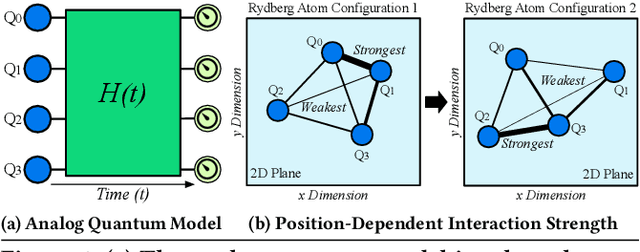
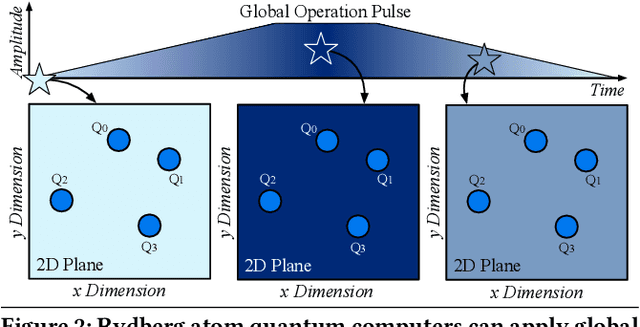
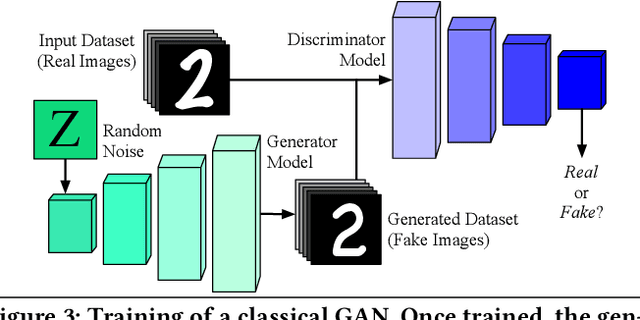

Quantum computing has shown theoretical promise of speedup in several machine learning tasks, including generative tasks using generative adversarial networks (GANs). While quantum computers have been implemented with different types of technologies, recently, analog Rydberg atom quantum computers have been demonstrated to have desirable properties such as reconfigurable qubit (quantum bit) positions and multi-qubit operations. To leverage the properties of this technology, we propose ReCon, the first work to implement quantum GANs on analog Rydberg atom quantum computers. Our evaluation using simulations and real-computer executions shows 33% better quality (measured using Frechet Inception Distance (FID)) in generated images than the state-of-the-art technique implemented on superconducting-qubit technology.