 Add to Chrome
 Add to Firefox
 Add to Edge
WorldMark: A Plug-and-Play World Knowledge Interface for Cross-Host Language Model Watermarking
Aug 05, 2026
Watermarking traces the provenance of text produced by large language models by embedding statistically detectable signals during decoding. Existing schemes fall into logits-based, sampling-based, entropy-aware, and adaptive-strength families, yet all of them place watermark signals according to local token statistics. In the open-ended text-generation settings evaluated in this work, local statistics may provide insufficient guidance for placing robust watermark signals. We introduce WorldMark, a plug-and-play interface that uses World Knowledge Memory (WKM) to organize semantic and episodic knowledge in a memory graph, converts the retrieved knowledge into a token-level knowledge saliency score, and adjusts the strength of a host watermark through Asymmetric Knowledge Modulation (AKM). WorldMark requires no backbone retraining and introduces no additional detector-side model or parameter. On the primary C4 evaluation, the complete WorldMark interface improves clean and attacked detection across three adaptive-strength host variants while slightly reducing perplexity. Additional pilot experiments on C4 and OpenGen show that direct memory conditioning transfers across multiple watermark families but can be unstable without saliency-aware modulation. WorldMark requires no additional detector-side model or parameter and introduces negligible overhead under the primary protocol.

PT: A Plain Transformer is Good Hospital Readmission Predictor
Dec 17, 2024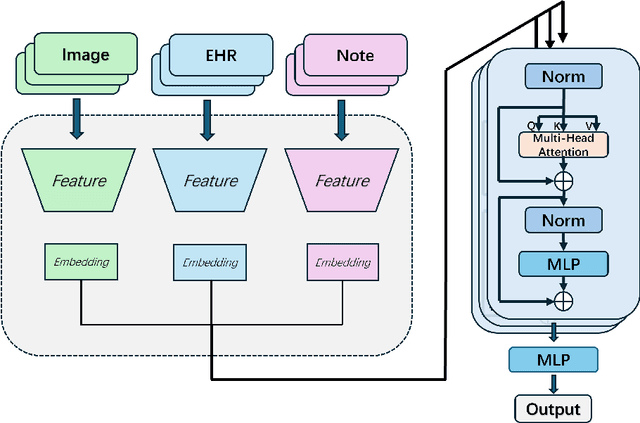
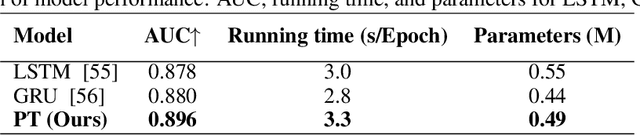
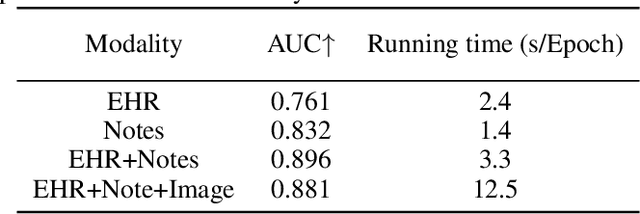
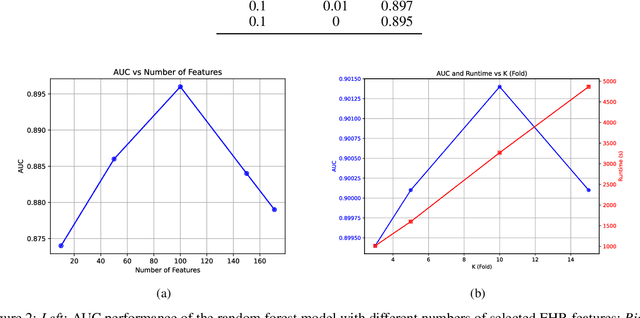
Hospital readmission prediction is critical for clinical decision support, aiming to identify patients at risk of returning within 30 days post-discharge. High readmission rates often indicate inadequate treatment or post-discharge care, making effective prediction models essential for optimizing resources and improving patient outcomes. We propose PT, a Transformer-based model that integrates Electronic Health Records (EHR), medical images, and clinical notes to predict 30-day all-cause hospital readmissions. PT extracts features from raw data and uses specialized Transformer blocks tailored to the data's complexity. Enhanced with Random Forest for EHR feature selection and test-time ensemble techniques, PT achieves superior accuracy, scalability, and robustness. It performs well even when temporal information is missing. Our main contributions are: (1)Simplicity: A powerful and efficient baseline model outperforming existing ones in prediction accuracy; (2)Scalability: Flexible handling of various features from different modalities, achieving high performance with just clinical notes or EHR data; (3)Robustness: Strong predictive performance even with missing or unclear temporal data.