 Add to Chrome
 Add to Firefox
 Add to Edge
TrafficClaw: Generalizable Urban Traffic Control via Unified Physical Environment Modeling
Apr 19, 2026
Urban traffic control is a system-level coordination problem spanning heterogeneous subsystems, including traffic signals, freeways, public transit, and taxi services. Existing optimization-based, reinforcement learning (RL), and emerging LLM-based approaches are largely designed for isolated tasks, limiting both cross-task generalization and the ability to capture coupled physical dynamics across subsystems. We argue that effective system-level control requires a unified physical environment in which subsystems share infrastructure, mobility demand, and spatiotemporal constraints, allowing local interventions to propagate through the network. To this end, we propose TrafficClaw, a framework for general urban traffic control built upon a unified runtime environment. TrafficClaw integrates heterogeneous subsystems into a shared dynamical system, enabling explicit modeling of cross-subsystem interactions and closed-loop agent-environment feedback. Within this environment, we develop an LLM agent with executable spatiotemporal reasoning and reusable procedural memory, supporting unified diagnostics across subsystems and continual strategy refinement. Furthermore, we introduce a multi-stage training pipeline with supervised initialization and agentic RL with system-level optimization, further enabling coordinated and system-aware performance. Experiments demonstrate that TrafficClaw achieves robust, transferable, and system-aware performance across unseen traffic scenarios, dynamics, and task configurations. Our project is available at https://github.com/usail-hkust/TrafficClaw.

An LLM-Powered Cooperative Framework for Large-Scale Multi-Vehicle Navigation
Oct 09, 2025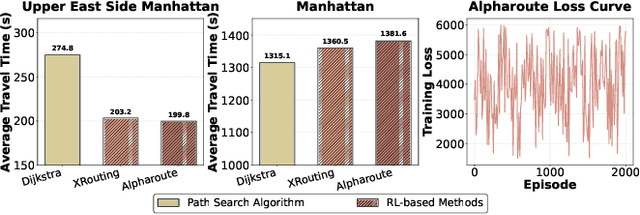
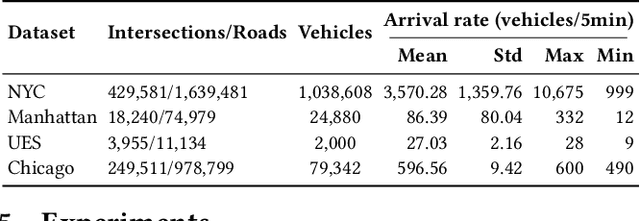
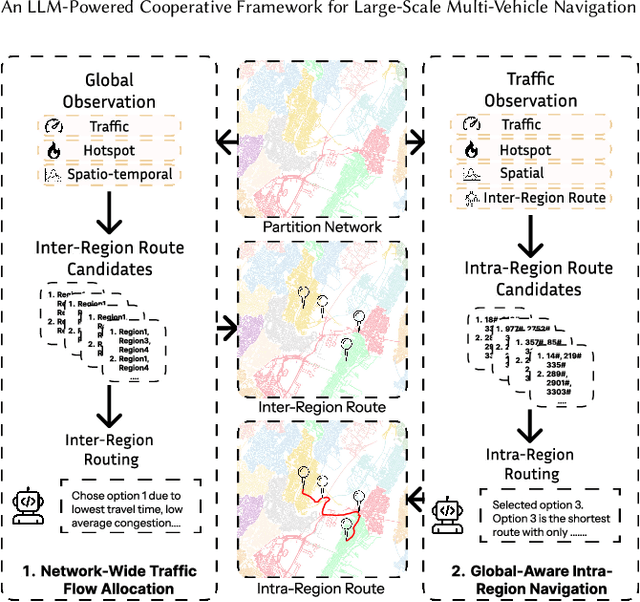
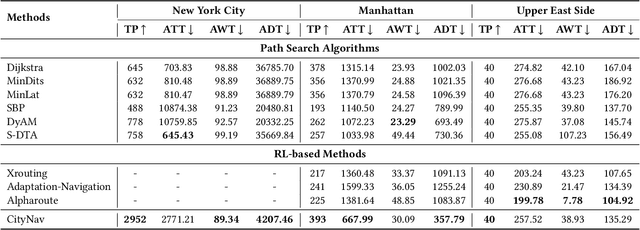
The rise of Internet of Vehicles (IoV) technologies is transforming traffic management from isolated control to a collective, multi-vehicle process. At the heart of this shift is multi-vehicle dynamic navigation, which requires simultaneously routing large fleets under evolving traffic conditions. Existing path search algorithms and reinforcement learning methods struggle to scale to city-wide networks, often failing to capture the nonlinear, stochastic, and coupled dynamics of urban traffic. To address these challenges, we propose CityNav, a hierarchical, LLM-powered framework for large-scale multi-vehicle navigation. CityNav integrates a global traffic allocation agent, which coordinates strategic traffic flow distribution across regions, with local navigation agents that generate locally adaptive routes aligned with global directives. To enable effective cooperation, we introduce a cooperative reasoning optimization mechanism, in which agents are jointly trained with a dual-reward structure: individual rewards promote per-vehicle efficiency, while shared rewards encourage network-wide coordination and congestion reduction. Extensive experiments on four real-world road networks of varying scales (up to 1.6 million roads and 430,000 intersections) and traffic datasets demonstrate that CityNav consistently outperforms nine classical path search and RL-based baselines in city-scale travel efficiency and congestion mitigation. Our results highlight the potential of LLMs to enable scalable, adaptive, and cooperative city-wide traffic navigation, providing a foundation for intelligent, large-scale vehicle routing in complex urban environments. Our project is available at https://github.com/usail-hkust/CityNav.