 Add to Chrome
 Add to Firefox
 Add to Edge
Efficient, Robust, and Anti-Collusion Fingerprinting of Image Diffusion Models
Jun 11, 2026
Model fingerprinting, embedding user-specific identifiers (fingerprints) into generated outputs, has recently emerged as a popular solution to protect the intellectual property rights (IPR) of generative text-to-image (T2I) models and prevent unauthorized redistribution. In this work, we reveal a previously unexplored systematic vulnerability in existing generative model fingerprinting methods: they lack robustness against collusion attacks, where multiple attackers combine their models to remove or obscure the fingerprints. To address this issue, we take the first step towards a robust fingerprinting method for T2I models with anti-collusion capabilities. The proposed method encodes strings of bits, namely fingerprints, into the coefficients of a personalized normalization module (PNM) incorporated into T2I models, so that fingerprints can be reliably recovered from any generated image. To defend against collusion attacks and prevent unauthorized model redistribution, we introduce an anti-collusion mechanism based on lossless function-invariant parameter transformations. This mechanism significantly degrades the image generation quality of colluded models, making them effectively unusable. Moreover, our method allows developers to efficiently create multiple copies of fingerprinted T2I models by reparameterizing the PNM without the need for retraining. We also introduce a worst-case optimization strategy to improve robustness against model-level attacks. Our experiments demonstrate that the proposed method achieves high fidelity and robustness across multiple T2I image generation and editing tasks, with fingerprint extraction accuracy exceeding 99.5%. Compared with existing methods, our method demonstrates, for the first time, a notable proactive robustness to collusion attacks by significantly increasing the FID of colluded models.

High-Fidelity Face Content Recovery via Tamper-Resilient Versatile Watermarking
Mar 25, 2026The proliferation of AIGC-driven face manipulation and deepfakes poses severe threats to media provenance, integrity, and copyright protection. Prior versatile watermarking systems typically rely on embedding explicit localization payloads, which introduces a fidelity--functionality trade-off: larger localization signals degrade visual quality and often reduce decoding robustness under strong generative edits. Moreover, existing methods rarely support content recovery, limiting their forensic value when original evidence must be reconstructed. To address these challenges, we present VeriFi, a versatile watermarking framework that unifies copyright protection, pixel-level manipulation localization, and high-fidelity face content recovery. VeriFi makes three key contributions: (1) it embeds a compact semantic latent watermark that serves as an content-preserving prior, enabling faithful restoration even after severe manipulations; (2) it achieves fine-grained localization without embedding localization-specific artifacts by correlating image features with decoded provenance signals; and (3) it introduces an AIGC attack simulator that combines latent-space mixing with seamless blending to improve robustness to realistic deepfake pipelines. Extensive experiments on CelebA-HQ and FFHQ show that VeriFi consistently outperforms strong baselines in watermark robustness, localization accuracy, and recovery quality, providing a practical and verifiable defense for deepfake forensics.
Learning to mask: Towards generalized face forgery detection
Dec 29, 2022Generalizability to unseen forgery types is crucial for face forgery detectors. Recent works have made significant progress in terms of generalization by synthetic forgery data augmentation. In this work, we explore another path for improving the generalization. Our goal is to reduce the features that are easy to learn in the training phase, so as to reduce the risk of overfitting on specific forgery types. Specifically, in our method, a teacher network takes as input the face images and generates an attention map of the deep features by a diverse multihead attention ViT. The attention map is used to guide a student network to focus on the low-attended features by reducing the highly-attended deep features. A deep feature mixup strategy is also proposed to synthesize forgeries in the feature domain. Experiments demonstrate that, without data augmentation, our method is able to achieve promising performances on unseen forgeries and highly compressed data.
General GAN-generated image detection by data augmentation in fingerprint domain
Dec 27, 2022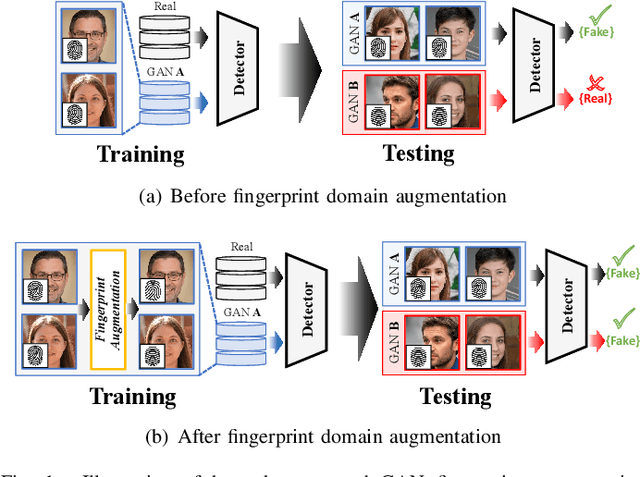
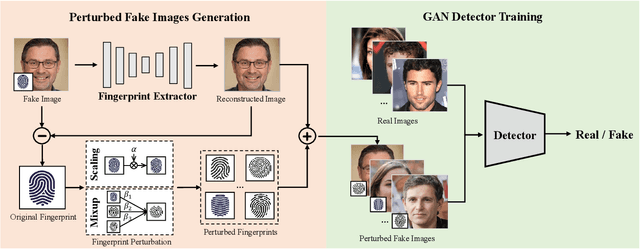
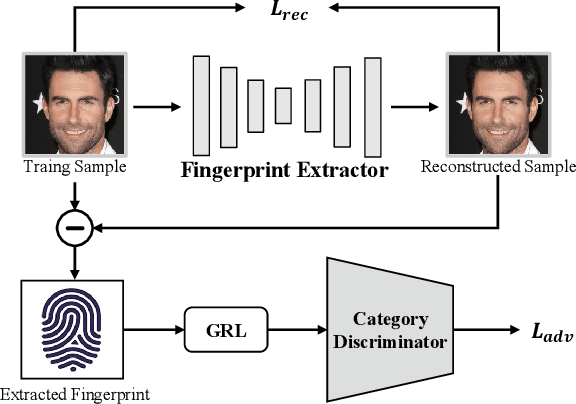
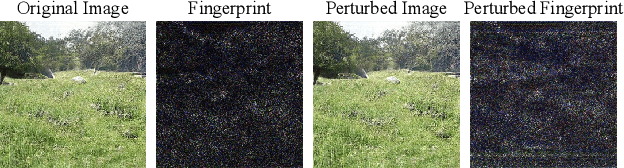
In this work, we investigate improving the generalizability of GAN-generated image detectors by performing data augmentation in the fingerprint domain. Specifically, we first separate the fingerprints and contents of the GAN-generated images using an autoencoder based GAN fingerprint extractor, followed by random perturbations of the fingerprints. Then the original fingerprints are substituted with the perturbed fingerprints and added to the original contents, to produce images that are visually invariant but with distinct fingerprints. The perturbed images can successfully imitate images generated by different GANs to improve the generalization of the detectors, which is demonstrated by the spectra visualization. To our knowledge, we are the first to conduct data augmentation in the fingerprint domain. Our work explores a novel prospect that is distinct from previous works on spatial and frequency domain augmentation. Extensive cross-GAN experiments demonstrate the effectiveness of our method compared to the state-of-the-art methods in detecting fake images generated by unknown GANs.
Learning Second Order Local Anomaly for General Face Forgery Detection
Sep 30, 2022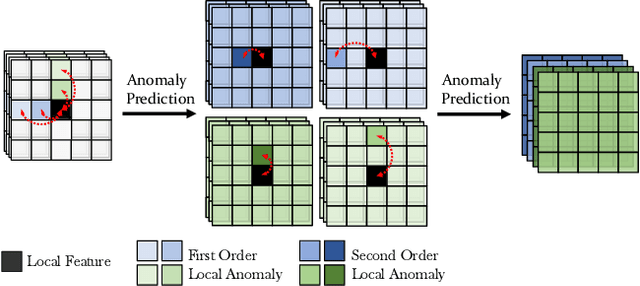
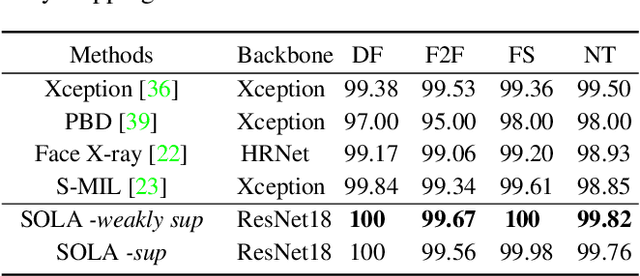
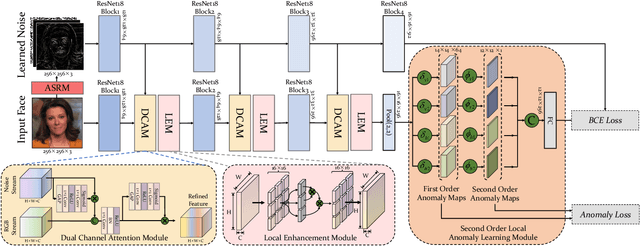
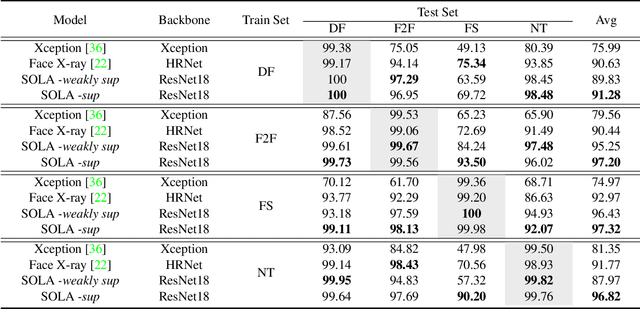
In this work, we propose a novel method to improve the generalization ability of CNN-based face forgery detectors. Our method considers the feature anomalies of forged faces caused by the prevalent blending operations in face forgery algorithms. Specifically, we propose a weakly supervised Second Order Local Anomaly (SOLA) learning module to mine anomalies in local regions using deep feature maps. SOLA first decomposes the neighborhood of local features by different directions and distances and then calculates the first and second order local anomaly maps which provide more general forgery traces for the classifier. We also propose a Local Enhancement Module (LEM) to improve the discrimination between local features of real and forged regions, so as to ensure accuracy in calculating anomalies. Besides, an improved Adaptive Spatial Rich Model (ASRM) is introduced to help mine subtle noise features via learnable high pass filters. With neither pixel level annotations nor external synthetic data, our method using a simple ResNet18 backbone achieves competitive performances compared with state-of-the-art works when evaluated on unseen forgeries.