 Add to Chrome
 Add to Firefox
 Add to Edge
High-Fidelity Face Content Recovery via Tamper-Resilient Versatile Watermarking
Mar 25, 2026
The proliferation of AIGC-driven face manipulation and deepfakes poses severe threats to media provenance, integrity, and copyright protection. Prior versatile watermarking systems typically rely on embedding explicit localization payloads, which introduces a fidelity--functionality trade-off: larger localization signals degrade visual quality and often reduce decoding robustness under strong generative edits. Moreover, existing methods rarely support content recovery, limiting their forensic value when original evidence must be reconstructed. To address these challenges, we present VeriFi, a versatile watermarking framework that unifies copyright protection, pixel-level manipulation localization, and high-fidelity face content recovery. VeriFi makes three key contributions: (1) it embeds a compact semantic latent watermark that serves as an content-preserving prior, enabling faithful restoration even after severe manipulations; (2) it achieves fine-grained localization without embedding localization-specific artifacts by correlating image features with decoded provenance signals; and (3) it introduces an AIGC attack simulator that combines latent-space mixing with seamless blending to improve robustness to realistic deepfake pipelines. Extensive experiments on CelebA-HQ and FFHQ show that VeriFi consistently outperforms strong baselines in watermark robustness, localization accuracy, and recovery quality, providing a practical and verifiable defense for deepfake forensics.

A Content-Preserving Secure Linguistic Steganography
Nov 16, 2025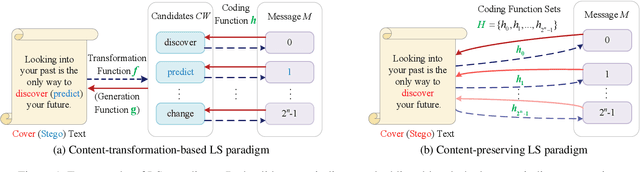
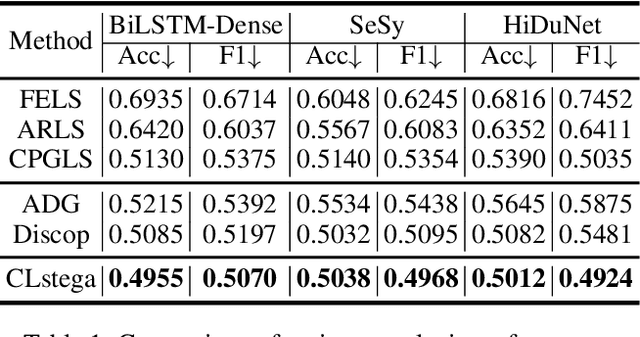
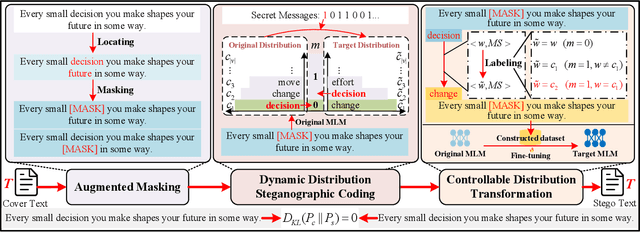
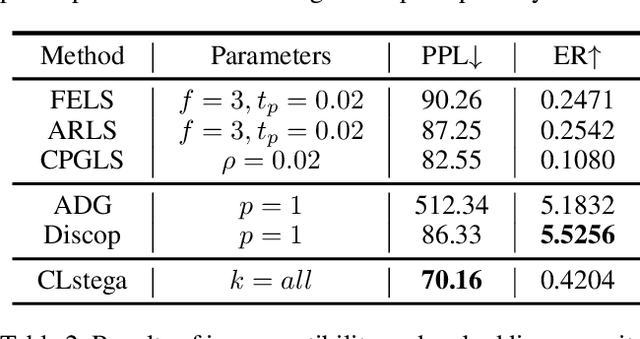
Existing linguistic steganography methods primarily rely on content transformations to conceal secret messages. However, they often cause subtle yet looking-innocent deviations between normal and stego texts, posing potential security risks in real-world applications. To address this challenge, we propose a content-preserving linguistic steganography paradigm for perfectly secure covert communication without modifying the cover text. Based on this paradigm, we introduce CLstega (\textit{C}ontent-preserving \textit{L}inguistic \textit{stega}nography), a novel method that embeds secret messages through controllable distribution transformation. CLstega first applies an augmented masking strategy to locate and mask embedding positions, where MLM(masked language model)-predicted probability distributions are easily adjustable for transformation. Subsequently, a dynamic distribution steganographic coding strategy is designed to encode secret messages by deriving target distributions from the original probability distributions. To achieve this transformation, CLstega elaborately selects target words for embedding positions as labels to construct a masked sentence dataset, which is used to fine-tune the original MLM, producing a target MLM capable of directly extracting secret messages from the cover text. This approach ensures perfect security of secret messages while fully preserving the integrity of the original cover text. Experimental results show that CLstega can achieve a 100\% extraction success rate, and outperforms existing methods in security, effectively balancing embedding capacity and security.