 Add to Chrome
 Add to Firefox
 Add to Edge
Bayesian Classification with Probit-link Split-and-merge Gaussian Process Prior in EEG-based Brain-Computer Interfaces
May 29, 2026
A Brain-Computer Interface (BCI) speller systems based on Event-Related Potentials (ERPs) enables users to select characters by detecting brain responses to visual stimuli, recorded through electroencephalogram (EEG). One challenge is to accurately identify target-related responses, such as the P300 component. However, existing methods tend to ignore feature selection, perform feature selection without interpretability, or require large computational effort or data manipulation. To address these limitations, we propose a novel Bayesian generative modeling framework to the binary classification of EEG responses to stimuli. Our approach employs a Probit-link Split-and-merge Gaussian Process (P-SMGP) prior to perform spatial-temporal feature selection, effectively capturing the distinctions between target and non-target ERP responses. Through both simulation studies and real EEG data analysis, our approach can reduce computational complexity and provide statistical interpretations on transformed ERP functions while maintaining comparable prediction accuracy. These findings underscore the value of interpretable, stimulus-level modeling for advancing predictive and personalized BCI systems.

TSGN: Temporal Scene Graph Neural Networks with Projected Vectorized Representation for Multi-Agent Motion Prediction
May 14, 2023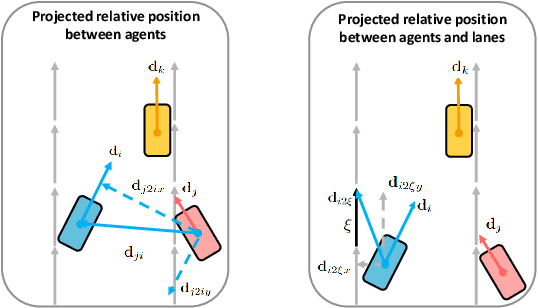
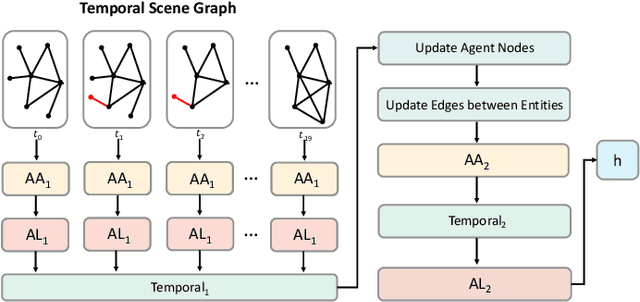
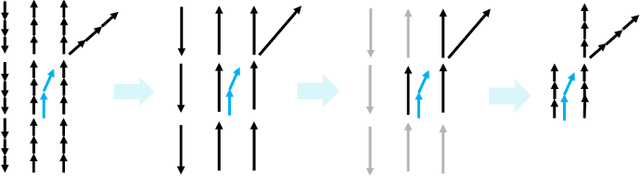
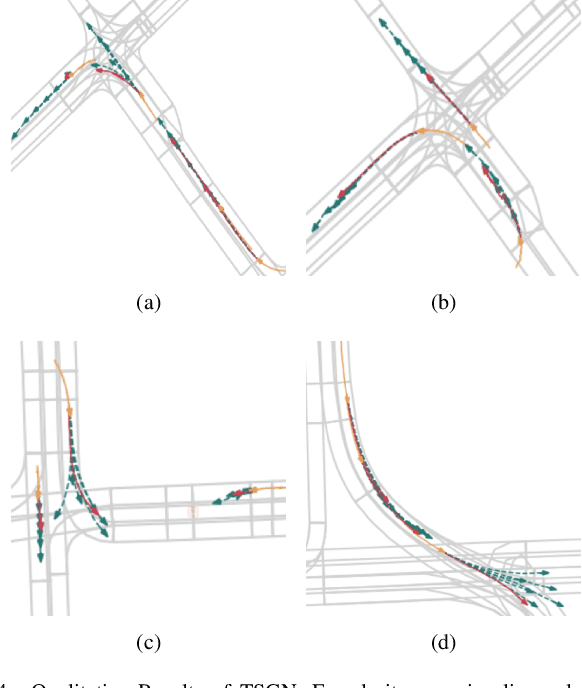
Predicting future motions of nearby agents is essential for an autonomous vehicle to take safe and effective actions. In this paper, we propose TSGN, a framework using Temporal Scene Graph Neural Networks with projected vectorized representations for multi-agent trajectory prediction. Projected vectorized representation models the traffic scene as a graph which is constructed by a set of vectors. These vectors represent agents, road network, and their spatial relative relationships. All relative features under this representation are both translationand rotation-invariant. Based on this representation, TSGN captures the spatial-temporal features across agents, road network, interactions among them, and temporal dependencies of temporal traffic scenes. TSGN can predict multimodal future trajectories for all agents simultaneously, plausibly, and accurately. Meanwhile, we propose a Hierarchical Lane Transformer for capturing interactions between agents and road network, which filters the surrounding road network and only keeps the most probable lane segments which could have an impact on the future behavior of the target agent. Without sacrificing the prediction performance, this greatly reduces the computational burden. Experiments show TSGN achieves state-of-the-art performance on the Argoverse motion forecasting benchmar.