 Add to Chrome
 Add to Firefox
 Add to Edge
Move What Matters: Parameter-Efficient Domain Adaptation via Optimal Transport Flow for Collaborative Perception
Feb 12, 2026
Fast domain adaptation remains a fundamental challenge for deploying multi-agent systems across diverse environments in Vehicle-to-Everything (V2X) collaborative perception. Despite the success of Parameter-Efficient Fine-Tuning (PEFT) in natural language processing and conventional vision tasks, directly applying PEFT to multi-agent settings leads to significant performance degradation and training instability. In this work, we conduct a detailed analysis and identify two key factors: (i) inter-frame redundancy in heterogeneous sensory streams, and (ii) erosion of fine-grained semantics in deep-layer representations under PEFT adaptation. To address these issues, we propose FlowAdapt, a parameter-efficient framework grounded in optimal transport theory, which minimizes information transport costs across both data distributions and network hierarchies. Specifically, we introduce a Wasserstein Greedy Sampling strategy to selectively filter redundant samples via a bounded covering radius. Furthermore, Progressive Knowledge Transfer module is designed to progressively inject compressed early-stage representations into later stages through learnable pathways, alleviating semantic degradation in late-stage adaptation. Extensive experiments on three benchmarks demonstrate that FlowAdapt achieves state-of-the-art performance with only 1% of trainable parameters, effectively bridging domain gaps with superior sample efficiency and generalization.

CoDynTrust: Robust Asynchronous Collaborative Perception via Dynamic Feature Trust Modulus
Feb 12, 2025
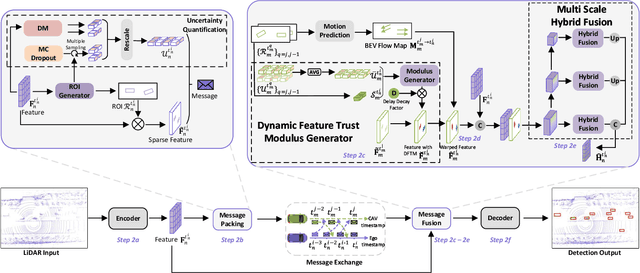
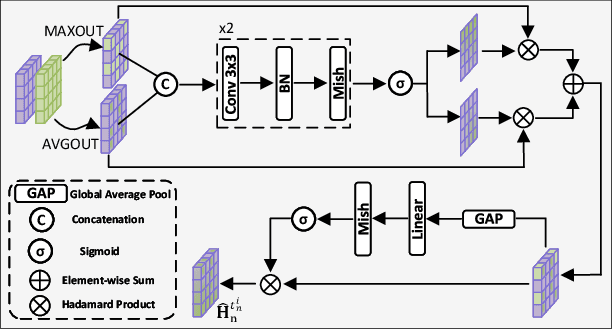
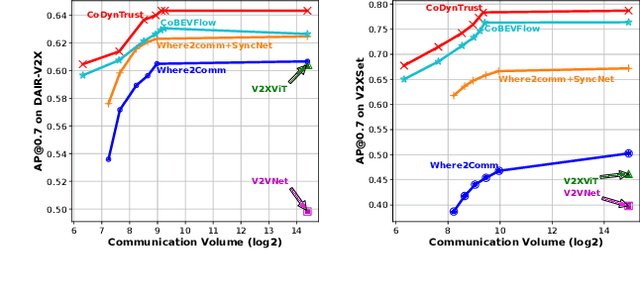
Collaborative perception, fusing information from multiple agents, can extend perception range so as to improve perception performance. However, temporal asynchrony in real-world environments, caused by communication delays, clock misalignment, or sampling configuration differences, can lead to information mismatches. If this is not well handled, then the collaborative performance is patchy, and what's worse safety accidents may occur. To tackle this challenge, we propose CoDynTrust, an uncertainty-encoded asynchronous fusion perception framework that is robust to the information mismatches caused by temporal asynchrony. CoDynTrust generates dynamic feature trust modulus (DFTM) for each region of interest by modeling aleatoric and epistemic uncertainty as well as selectively suppressing or retaining single-vehicle features, thereby mitigating information mismatches. We then design a multi-scale fusion module to handle multi-scale feature maps processed by DFTM. Compared to existing works that also consider asynchronous collaborative perception, CoDynTrust combats various low-quality information in temporally asynchronous scenarios and allows uncertainty to be propagated to downstream tasks such as planning and control. Experimental results demonstrate that CoDynTrust significantly reduces performance degradation caused by temporal asynchrony across multiple datasets, achieving state-of-the-art detection performance even with temporal asynchrony. The code is available at https://github.com/CrazyShout/CoDynTrust.