 Add to Chrome
 Add to Firefox
 Add to Edge
QuantumQA: Enhancing Scientific Reasoning via Physics-Consistent Dataset and Verification-Aware Reinforcement Learning
Apr 20, 2026
Large language models (LLMs) show strong capabilities in general reasoning but typically lack reliability in scientific domains like quantum mechanics, which demand strict adherence to physical constraints. This limitation arises from the scarcity of verifiable training resources and the inadequacy of coarse feedback signals in standard alignment paradigms. To address the data challenge, we introduce QuantumQA, a large-scale dataset constructed via a task-adaptive strategy and a hybrid verification protocol that combines deterministic solvers with semantic auditing to guarantee scientific rigor. Building on this foundation, we propose the verification-aware reward model (VRM) tailored for Reinforcement Learning with Verifiable Rewards (RLVR), which employs an adaptive reward fusion (ARF) mechanism to dynamically integrate deterministic signals from a scientific execution suite (SES) with multidimensional semantic evaluations for precise supervision. Experimental results demonstrate that our method consistently outperforms baselines and general-purpose preference models. Notably, our optimized 8B model achieves performance competitive with proprietary models, validating that incorporating verifiable, rule-based feedback into the reinforcement learning loop offers a parameter-efficient alternative to pure scaling.

Statistics-Informed Parameterized Quantum Circuit via Maximum Entropy Principle for Data Science and Finance
Jun 03, 2024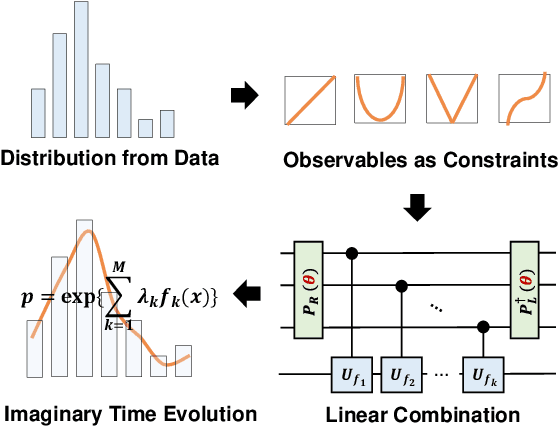
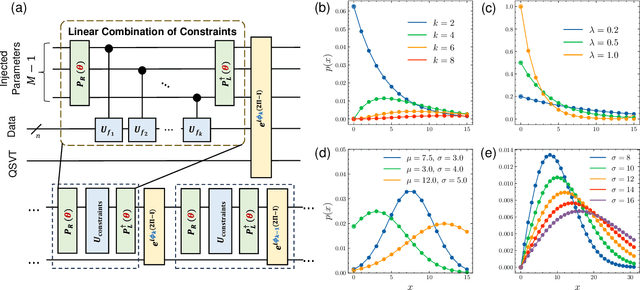

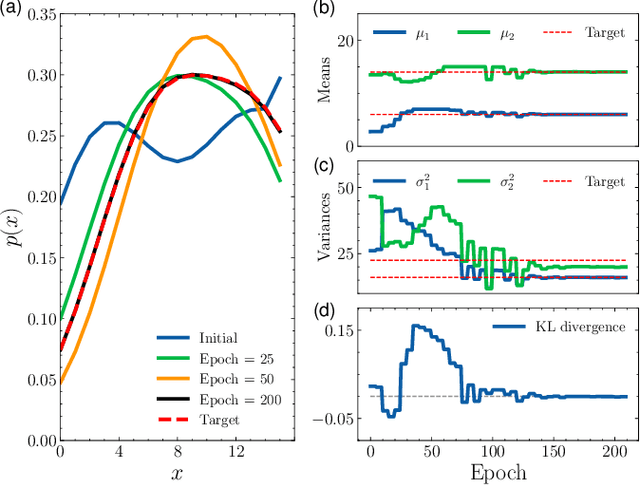
Quantum machine learning has demonstrated significant potential in solving practical problems, particularly in statistics-focused areas such as data science and finance. However, challenges remain in preparing and learning statistical models on a quantum processor due to issues with trainability and interpretability. In this letter, we utilize the maximum entropy principle to design a statistics-informed parameterized quantum circuit (SI-PQC) that efficiently prepares and trains quantum computational statistical models, including arbitrary distributions and their weighted mixtures. The SI-PQC features a static structure with trainable parameters, enabling in-depth optimized circuit compilation, exponential reductions in resource and time consumption, and improved trainability and interpretability for learning quantum states and classical model parameters simultaneously. As an efficient subroutine for preparing and learning in various quantum algorithms, the SI-PQC addresses the input bottleneck and facilitates the injection of prior knowledge.