 Add to Chrome
 Add to Firefox
 Add to Edge
Leveraging LLMs for Title and Abstract Screening for Systematic Review: A Cost-Effective Dynamic Few-Shot Learning Approach
Dec 12, 2025
Systematic reviews are a key component of evidence-based medicine, playing a critical role in synthesizing existing research evidence and guiding clinical decisions. However, with the rapid growth of research publications, conducting systematic reviews has become increasingly burdensome, with title and abstract screening being one of the most time-consuming and resource-intensive steps. To mitigate this issue, we designed a two-stage dynamic few-shot learning (DFSL) approach aimed at improving the efficiency and performance of large language models (LLMs) in the title and abstract screening task. Specifically, this approach first uses a low-cost LLM for initial screening, then re-evaluates low-confidence instances using a high-performance LLM, thereby enhancing screening performance while controlling computational costs. We evaluated this approach across 10 systematic reviews, and the results demonstrate its strong generalizability and cost-effectiveness, with potential to reduce manual screening burden and accelerate the systematic review process in practical applications.

Representation Learning to Advance Multi-institutional Studies with Electronic Health Record Data
Feb 12, 2025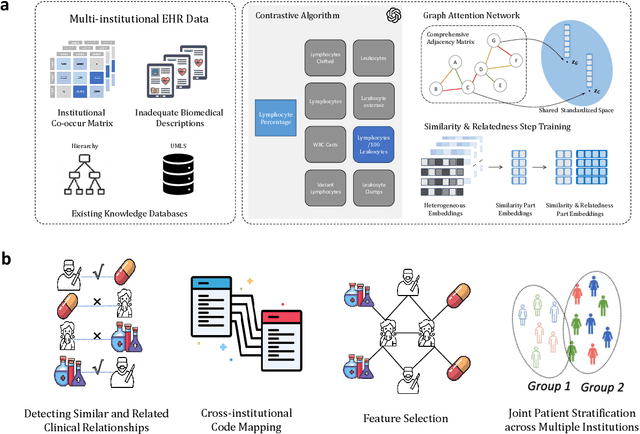
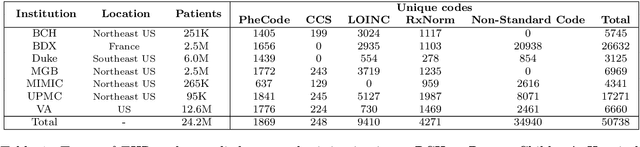
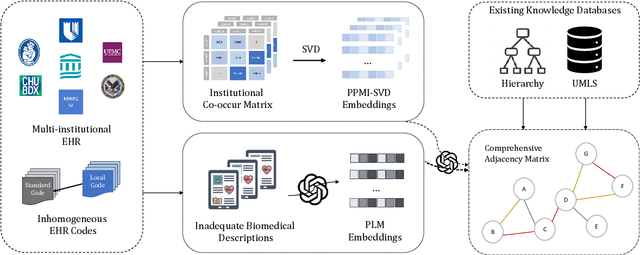

The adoption of EHRs has expanded opportunities to leverage data-driven algorithms in clinical care and research. A major bottleneck in effectively conducting multi-institutional EHR studies is the data heterogeneity across systems with numerous codes that either do not exist or represent different clinical concepts across institutions. The need for data privacy further limits the feasibility of including multi-institutional patient-level data required to study similarities and differences across patient subgroups. To address these challenges, we developed the GAME algorithm. Tested and validated across 7 institutions and 2 languages, GAME integrates data in several levels: (1) at the institutional level with knowledge graphs to establish relationships between codes and existing knowledge sources, providing the medical context for standard codes and their relationship to each other; (2) between institutions, leveraging language models to determine the relationships between institution-specific codes with established standard codes; and (3) quantifying the strength of the relationships between codes using a graph attention network. Jointly trained embeddings are created using transfer and federated learning to preserve data privacy. In this study, we demonstrate the applicability of GAME in selecting relevant features as inputs for AI-driven algorithms in a range of conditions, e.g., heart failure, rheumatoid arthritis. We then highlight the application of GAME harmonized multi-institutional EHR data in a study of Alzheimer's disease outcomes and suicide risk among patients with mental health disorders, without sharing patient-level data outside individual institutions.