 Add to Chrome
 Add to Firefox
 Add to Edge
EEG2MOTION: Towards Open-Vocabulary Human Motion Synthesis from Non-invasive Brain Signals
Aug 14, 2026
Human motion is governed by a hierarchical motor system where the brain provides high-level intentions and lower-level structures coordinate detailed dynamics. Existing brain-computer interfaces (BCIs) typically oversimplify this into constrained classification or low-dimensional control, failing to capture the richness of natural movement. Bridging this gap to achieve open-vocabulary, full-body motion synthesis remains challenging due to the substantial cross-modal divergence between sparse neural signals and high-dimensional kinematics, as well as the lack of large-scale paired EEG-motion datasets. To address this, we introduce EEG2MOTION, the first EEG-motion-text dataset for human motion synthesis, comprising nearly 20,000 paired samples across thousands of motions. Using this dataset, we first demonstrate via multimodal contrastive learning that non-invasive EEG embeddings can be effectively aligned with text, video, and motion representations to decode high-level semantics. We then propose EEG-conditioned Masked Motion Model (EMMM), a generative framework that unites an EEG encoder with a motion decoder to synthesize continuous, full-body human motions directly from brain activity. Experimental results show that EMMM generates coherent and realistic motion sequences from non-invasive brain signals. To the best of our knowledge, this is the first work to generate diverse full-body human motions from non-invasive brain signals, opening a new direction toward generative and open-vocabulary motor BCIs. See our project page: https://yulom.github.io/EEG2MOTIONdemopage/.

Poststroke rehabilitative mechanisms in individualized fatigue level-controlled treadmill training -- a Rat Model Study
Feb 20, 2025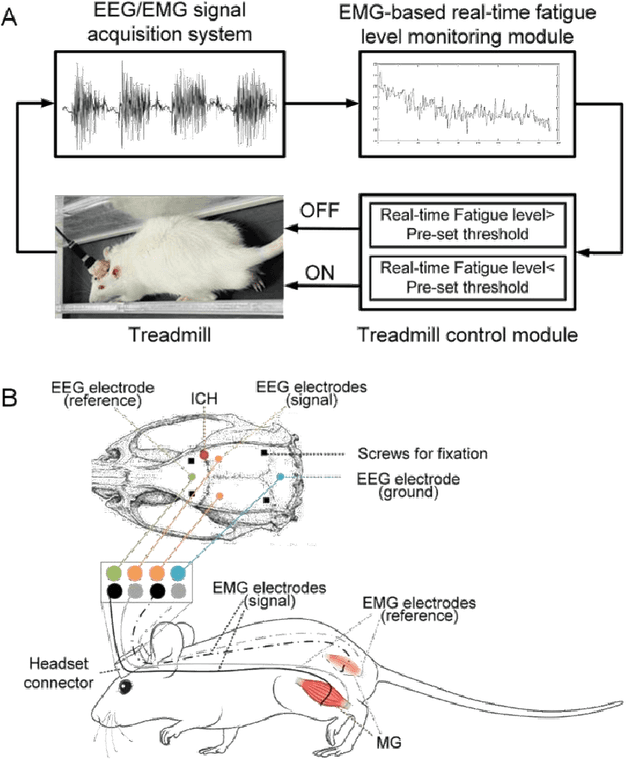
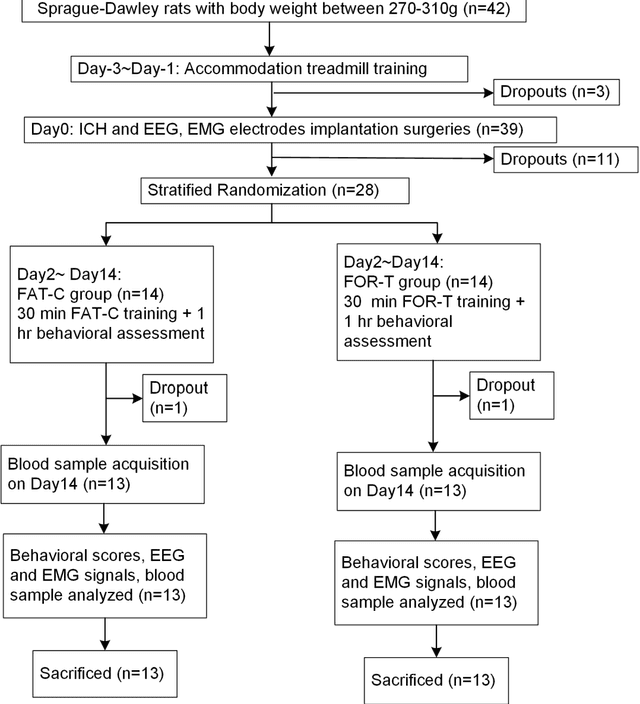
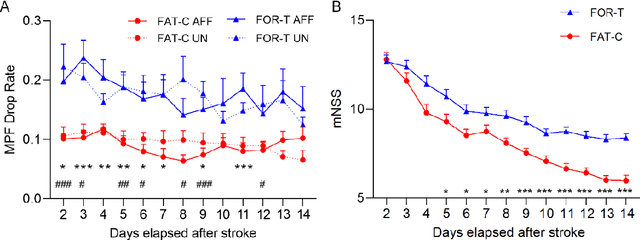
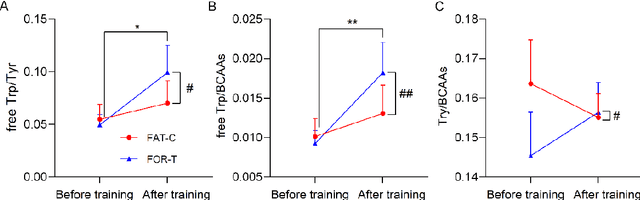
Individualized training improved post-stroke motor function rehabilitation efficiency. However, the mechanisms of how individualized training facilitates recovery is not clear. This study explored the cortical and corticomuscular rehabilitative effects in post-stroke motor function recovery during individualized training. Sprague-Dawley rats with intracerebral hemorrhage (ICH) were randomly distributed into two groups: forced training (FOR-T, n=13) and individualized fatigue-controlled training (FAT-C, n=13) to receive training respectively from day 2 to day 14 post-stroke. The FAT-C group exhibited superior motor function recovery and less central fatigue compared to the FOR-T group. EEG PSD slope analysis demonstrated a better inter-hemispheric balance in FAT-C group compare to the FOR-T group. The dCMC analysis indicated that training-induced fatigue led to a short-term down-regulation of descending corticomuscular coherence (dCMC) and an up-regulation of ascending dCMC. In the long term, excessive fatigue hindered the recovery of descending control in the affected hemisphere. The individualized strategy of peripheral fatigue-controlled training achieved better motor function recovery, which could be attributed to the mitigation of central fatigue, optimization of inter-hemispheric balance and enhancement of descending control in the affected hemisphere.