 Add to Chrome
 Add to Firefox
 Add to Edge
Mixture of Demonstrations for Textual Graph Understanding and Question Answering
Mar 23, 2026
Textual graph-based retrieval-augmented generation (GraphRAG) has emerged as a powerful paradigm for enhancing large language models (LLMs) in domain-specific question answering. While existing approaches primarily focus on zero-shot GraphRAG, selecting high-quality demonstrations is crucial for improving reasoning and answer accuracy. Furthermore, recent studies have shown that retrieved subgraphs often contain irrelevant information, which can degrade reasoning performance. In this paper, we propose MixDemo, a novel GraphRAG framework enhanced with a Mixture-of-Experts (MoE) mechanism for selecting the most informative demonstrations under diverse question contexts. To further reduce noise in the retrieved subgraphs, we introduce a query-specific graph encoder that selectively attends to information most relevant to the query. Extensive experiments across multiple textual graph benchmarks show that MixDemo significantly outperforms existing methods.

Adaptive AI decision interface for autonomous electronic material discovery
Apr 17, 2025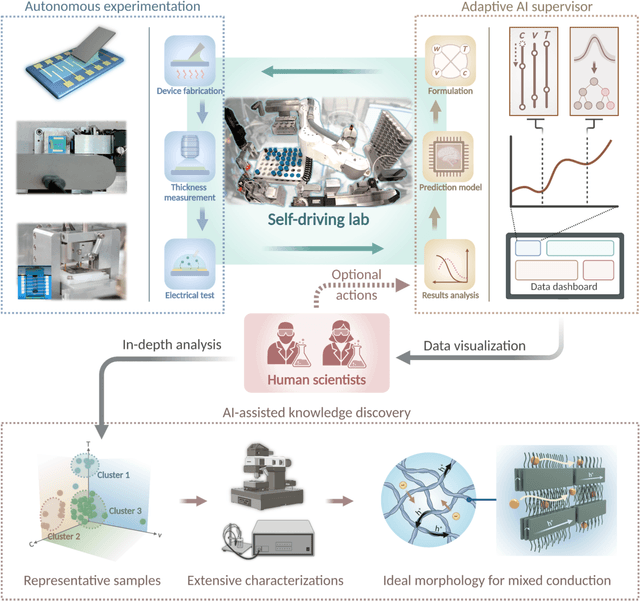
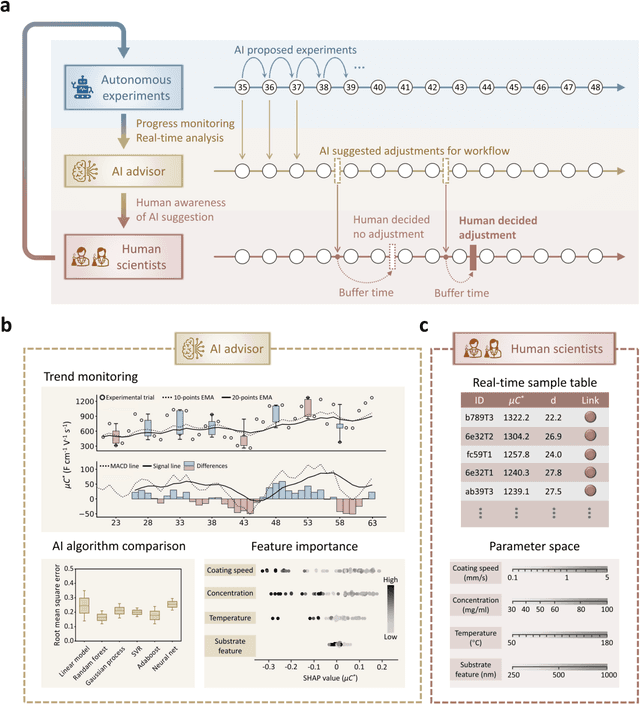
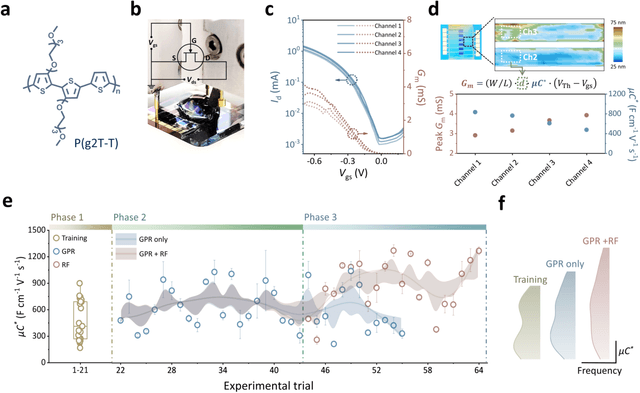
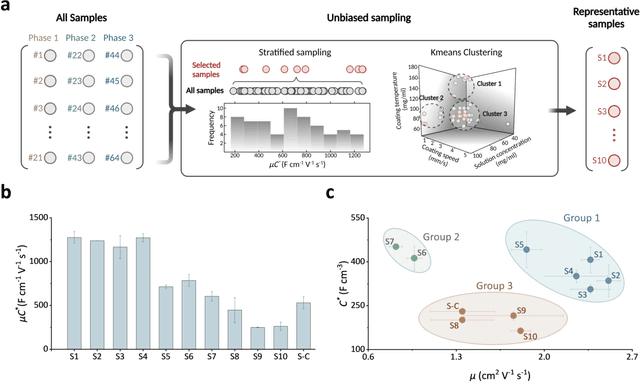
AI-powered autonomous experimentation (AI/AE) can accelerate materials discovery but its effectiveness for electronic materials is hindered by data scarcity from lengthy and complex design-fabricate-test-analyze cycles. Unlike experienced human scientists, even advanced AI algorithms in AI/AE lack the adaptability to make informative real-time decisions with limited datasets. Here, we address this challenge by developing and implementing an AI decision interface on our AI/AE system. The central element of the interface is an AI advisor that performs real-time progress monitoring, data analysis, and interactive human-AI collaboration for actively adapting to experiments in different stages and types. We applied this platform to an emerging type of electronic materials-mixed ion-electron conducting polymers (MIECPs) -- to engineer and study the relationships between multiscale morphology and properties. Using organic electrochemical transistors (OECT) as the testing-bed device for evaluating the mixed-conducting figure-of-merit -- the product of charge-carrier mobility and the volumetric capacitance ({\mu}C*), our adaptive AI/AE platform achieved a 150% increase in {\mu}C* compared to the commonly used spin-coating method, reaching 1,275 F cm-1 V-1 s-1 in just 64 autonomous experimental trials. A study of 10 statistically selected samples identifies two key structural factors for achieving higher volumetric capacitance: larger crystalline lamellar spacing and higher specific surface area, while also uncovering a new polymer polymorph in this material.