 Add to Chrome
 Add to Firefox
 Add to Edge
MedProbCLIP: Probabilistic Adaptation of Vision-Language Foundation Model for Reliable Radiograph-Report Retrieval
Feb 17, 2026
Vision-language foundation models have emerged as powerful general-purpose representation learners with strong potential for multimodal understanding, but their deterministic embeddings often fail to provide the reliability required for high-stakes biomedical applications. This work introduces MedProbCLIP, a probabilistic vision-language learning framework for chest X-ray and radiology report representation learning and bidirectional retrieval. MedProbCLIP models image and text representations as Gaussian embeddings through a probabilistic contrastive objective that explicitly captures uncertainty and many-to-many correspondences between radiographs and clinical narratives. A variational information bottleneck mitigates overconfident predictions, while MedProbCLIP employs multi-view radiograph encoding and multi-section report encoding during training to provide fine-grained supervision for clinically aligned correspondence, yet requires only a single radiograph and a single report at inference. Evaluated on the MIMIC-CXR dataset, MedProbCLIP outperforms deterministic and probabilistic baselines, including CLIP, CXR-CLIP, and PCME++, in both retrieval and zero-shot classification. Beyond accuracy, MedProbCLIP demonstrates superior calibration, risk-coverage behavior, selective retrieval reliability, and robustness to clinically relevant corruptions, underscoring the value of probabilistic vision-language modeling for improving the trustworthiness and safety of radiology image-text retrieval systems.

Benchmarking Robustness of Contrastive Learning Models for Medical Image-Report Retrieval
Jan 15, 2025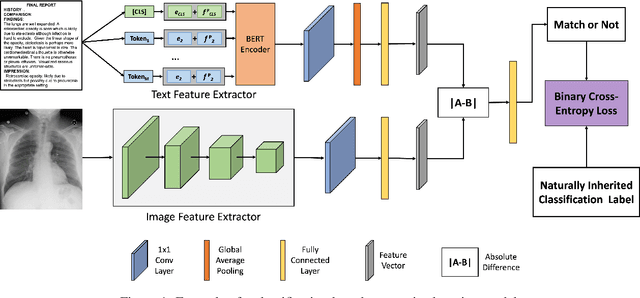
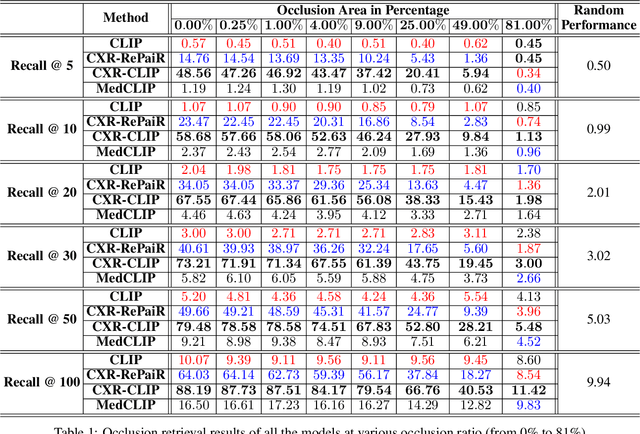
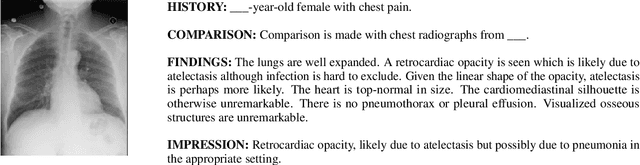
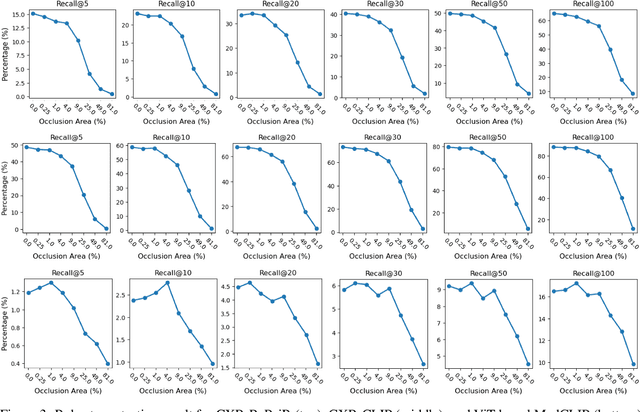
Medical images and reports offer invaluable insights into patient health. The heterogeneity and complexity of these data hinder effective analysis. To bridge this gap, we investigate contrastive learning models for cross-domain retrieval, which associates medical images with their corresponding clinical reports. This study benchmarks the robustness of four state-of-the-art contrastive learning models: CLIP, CXR-RePaiR, MedCLIP, and CXR-CLIP. We introduce an occlusion retrieval task to evaluate model performance under varying levels of image corruption. Our findings reveal that all evaluated models are highly sensitive to out-of-distribution data, as evidenced by the proportional decrease in performance with increasing occlusion levels. While MedCLIP exhibits slightly more robustness, its overall performance remains significantly behind CXR-CLIP and CXR-RePaiR. CLIP, trained on a general-purpose dataset, struggles with medical image-report retrieval, highlighting the importance of domain-specific training data. The evaluation of this work suggests that more effort needs to be spent on improving the robustness of these models. By addressing these limitations, we can develop more reliable cross-domain retrieval models for medical applications.