 Add to Chrome
 Add to Firefox
 Add to Edge
MedProbCLIP: Probabilistic Adaptation of Vision-Language Foundation Model for Reliable Radiograph-Report Retrieval
Feb 17, 2026
Vision-language foundation models have emerged as powerful general-purpose representation learners with strong potential for multimodal understanding, but their deterministic embeddings often fail to provide the reliability required for high-stakes biomedical applications. This work introduces MedProbCLIP, a probabilistic vision-language learning framework for chest X-ray and radiology report representation learning and bidirectional retrieval. MedProbCLIP models image and text representations as Gaussian embeddings through a probabilistic contrastive objective that explicitly captures uncertainty and many-to-many correspondences between radiographs and clinical narratives. A variational information bottleneck mitigates overconfident predictions, while MedProbCLIP employs multi-view radiograph encoding and multi-section report encoding during training to provide fine-grained supervision for clinically aligned correspondence, yet requires only a single radiograph and a single report at inference. Evaluated on the MIMIC-CXR dataset, MedProbCLIP outperforms deterministic and probabilistic baselines, including CLIP, CXR-CLIP, and PCME++, in both retrieval and zero-shot classification. Beyond accuracy, MedProbCLIP demonstrates superior calibration, risk-coverage behavior, selective retrieval reliability, and robustness to clinically relevant corruptions, underscoring the value of probabilistic vision-language modeling for improving the trustworthiness and safety of radiology image-text retrieval systems.

Beta Distribution Learning for Reliable Roadway Crash Risk Assessment
Nov 07, 2025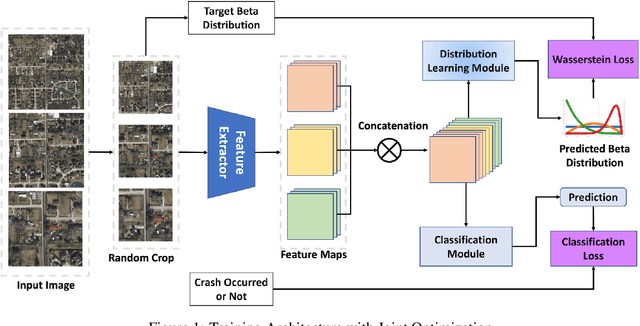

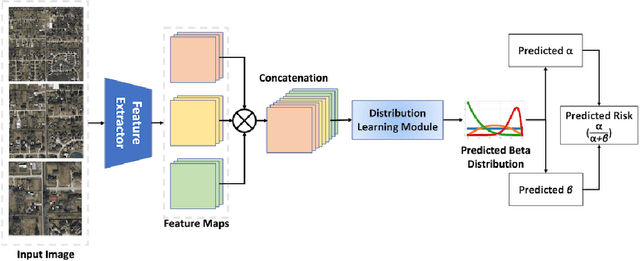

Roadway traffic accidents represent a global health crisis, responsible for over a million deaths annually and costing many countries up to 3% of their GDP. Traditional traffic safety studies often examine risk factors in isolation, overlooking the spatial complexity and contextual interactions inherent in the built environment. Furthermore, conventional Neural Network-based risk estimators typically generate point estimates without conveying model uncertainty, limiting their utility in critical decision-making. To address these shortcomings, we introduce a novel geospatial deep learning framework that leverages satellite imagery as a comprehensive spatial input. This approach enables the model to capture the nuanced spatial patterns and embedded environmental risk factors that contribute to fatal crash risks. Rather than producing a single deterministic output, our model estimates a full Beta probability distribution over fatal crash risk, yielding accurate and uncertainty-aware predictions--a critical feature for trustworthy AI in safety-critical applications. Our model outperforms baselines by achieving a 17-23% improvement in recall, a key metric for flagging potential dangers, while delivering superior calibration. By providing reliable and interpretable risk assessments from satellite imagery alone, our method enables safer autonomous navigation and offers a highly scalable tool for urban planners and policymakers to enhance roadway safety equitably and cost-effectively.