 Add to Chrome
 Add to Firefox
 Add to Edge
Mosaic: A Fleet of User Embedding Specialists for Recommendation at Meta
Jul 27, 2026
User representation is one of the highest-leverage modeling problems in industrial recommendation systems: a single advancement in how users are encoded can propagate across retrieval, ranking, and integrity tasks at platform scale. Prior industrial user representation work builds either a single user model that emits one or more embedding vectors or a shared backbone with task-specific adaptation. In this paper, we present Mosaic, a foundational user modeling platform that employs a fleet of specialists to learn user embeddings. The fleet comprises four architecturally diverse model families - memorization-driven, dense-heavy, sequential-based, and CoTrain models - each focusing on a distinct facet of user behavior. We developed MRM (Multi-task Relations Mining) and CRL (Cosine Redundancy Loss) techniques to maximize the marginal information contribution of each new specialist. We also introduce CoEval and User Tower Zero-Out, new logging-free embedding evaluation framework that improves development velocity while preserving downstream-aligned accuracy. Our hybrid CPU/GPU, online-and-offline serving stack allows each specialist to choose the adequate serving strategy to meet the freshness, latency, and computational requirements. Mosaic delivers consistent and significant offline NE improvements in addition to online gains.

HashReID: Dynamic Network with Binary Codes for Efficient Person Re-identification
Aug 23, 2023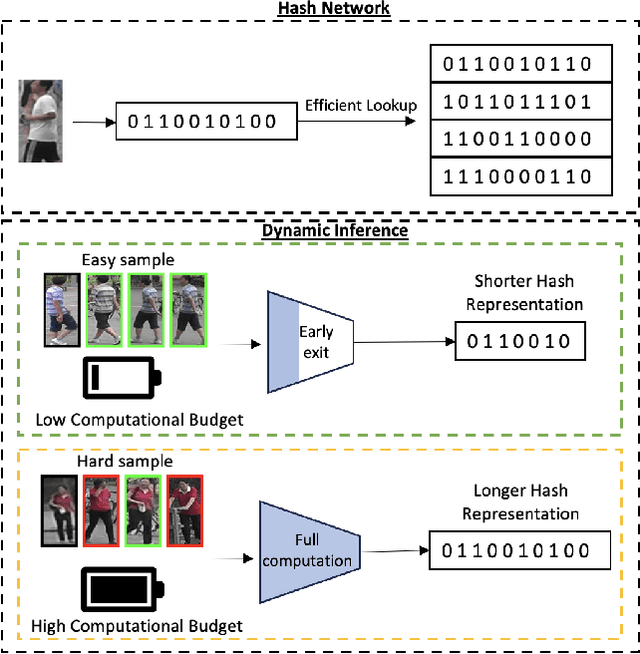
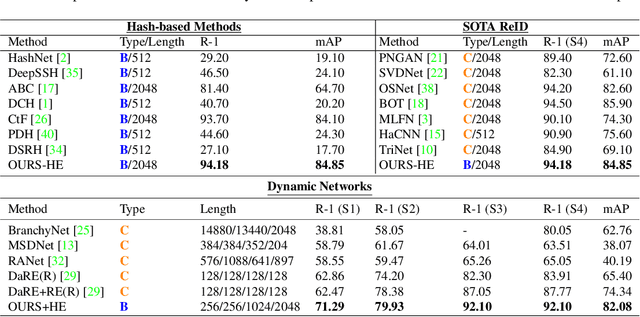
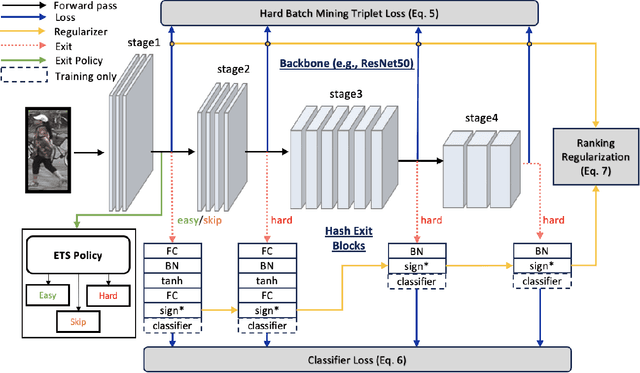
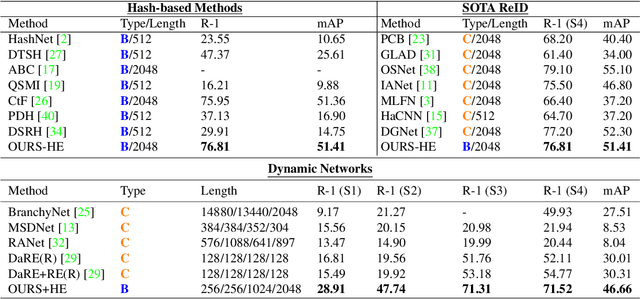
Biometric applications, such as person re-identification (ReID), are often deployed on energy constrained devices. While recent ReID methods prioritize high retrieval performance, they often come with large computational costs and high search time, rendering them less practical in real-world settings. In this work, we propose an input-adaptive network with multiple exit blocks, that can terminate computation early if the retrieval is straightforward or noisy, saving a lot of computation. To assess the complexity of the input, we introduce a temporal-based classifier driven by a new training strategy. Furthermore, we adopt a binary hash code generation approach instead of relying on continuous-valued features, which significantly improves the search process by a factor of 20. To ensure similarity preservation, we utilize a new ranking regularizer that bridges the gap between continuous and binary features. Extensive analysis of our proposed method is conducted on three datasets: Market1501, MSMT17 (Multi-Scene Multi-Time), and the BGC1 (BRIAR Government Collection). Using our approach, more than 70% of the samples with compact hash codes exit early on the Market1501 dataset, saving 80% of the networks computational cost and improving over other hash-based methods by 60%. These results demonstrate a significant improvement over dynamic networks and showcase comparable accuracy performance to conventional ReID methods. Code will be made available.