 Add to Chrome
 Add to Firefox
 Add to Edge
A Differentiable Digital Twin of Distributed Link Scheduling for Contention-Aware Networking
Dec 11, 2025
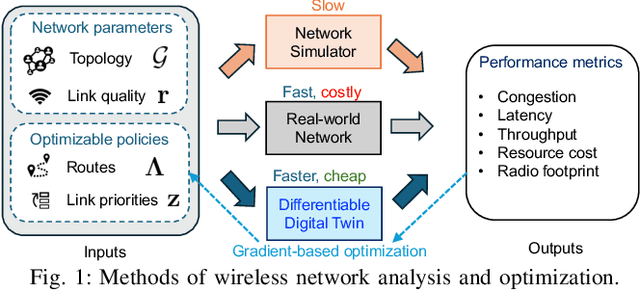
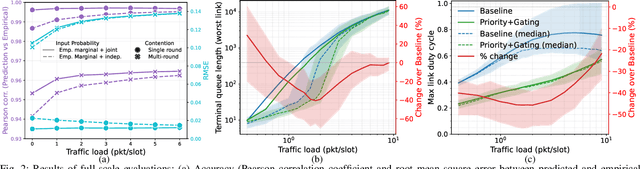
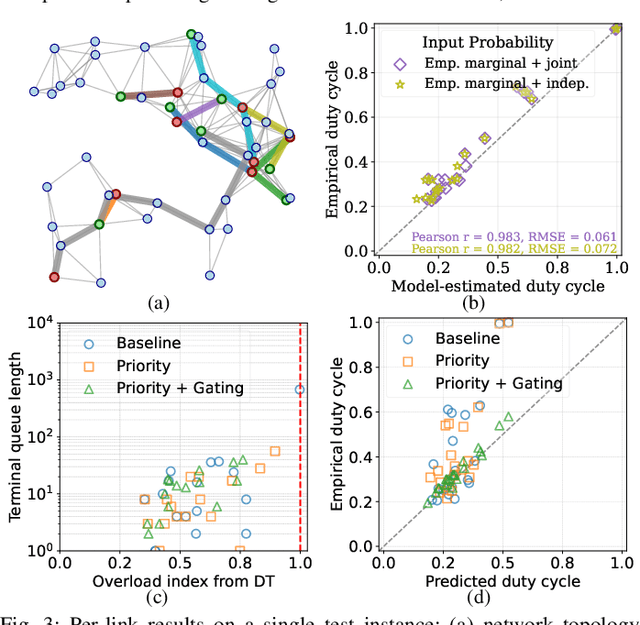
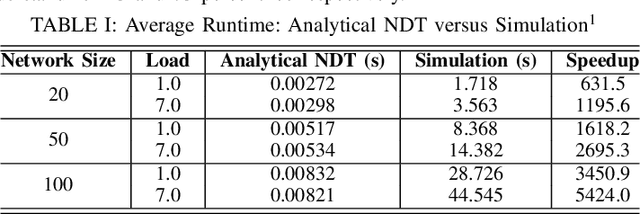
Many routing and flow optimization problems in wired networks can be solved efficiently using minimum cost flow formulations. However, this approach does not extend to wireless multi-hop networks, where the assumptions of fixed link capacity and linear cost structure collapse due to contention for shared spectrum resources. The key challenge is that the long-term capacity of a wireless link becomes a non-linear function of its network context, including network topology, link quality, and the traffic assigned to neighboring links. In this work, we pursue a new direction of modeling wireless network under randomized medium access control by developing an analytical network digital twin (NDT) that predicts link duty cycles from network context. We generalize randomized contention as finding a Maximal Independent Set (MIS) on the conflict graph using weighted Luby's algorithm, derive an analytical model of link duty cycles, and introduce an iterative procedure that resolves the circular dependency among duty cycle, link capacity, and contention probability. Our numerical experiments show that the proposed NDT accurately predicts link duty cycles and congestion patterns with up to a 5000x speedup over packet-level simulation, and enables us to optimize link scheduling using gradient descent for reduced congestion and radio footprint.

Generalizing Biased Backpressure Routing and Scheduling to Wireless Multi-hop Networks with Advanced Air-interfaces
Apr 30, 2025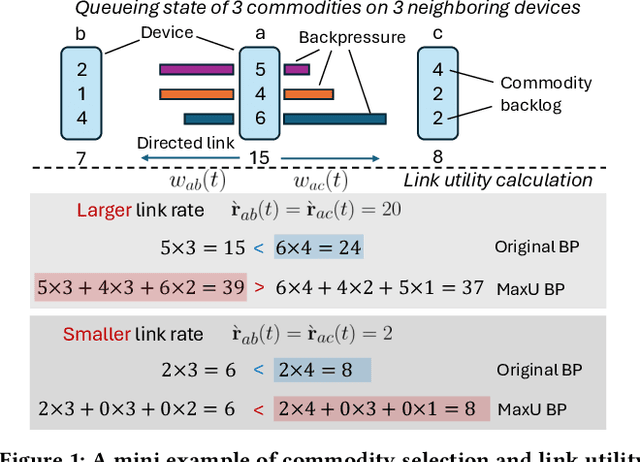
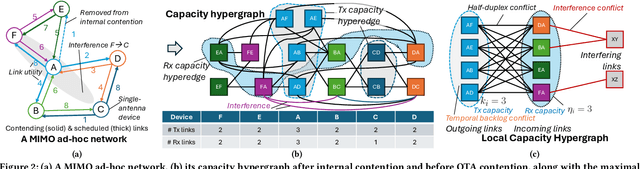
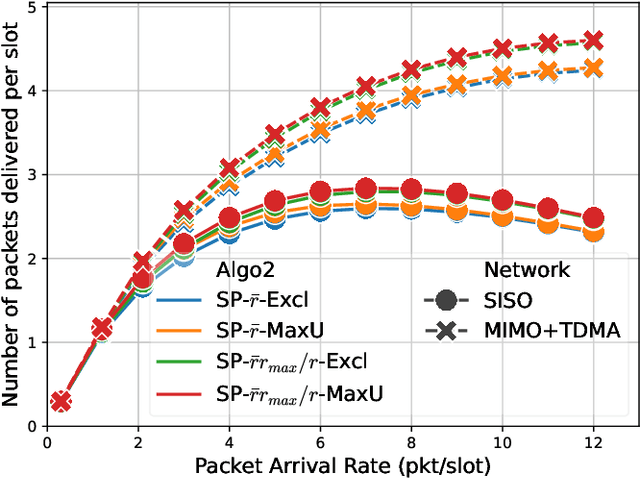
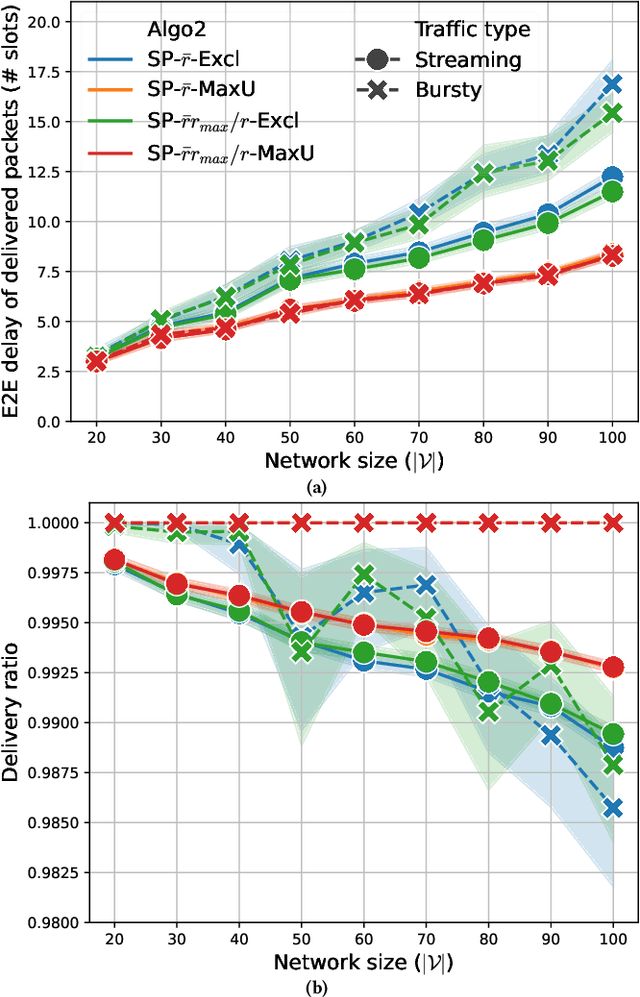
Backpressure (BP) routing and scheduling is a well-established resource allocation method for wireless multi-hop networks, known for its fully distributed operations and proven maximum queue stability. Recent advances in shortest path-biased BP routing (SP-BP) mitigate shortcomings such as slow startup and random walk, but exclusive link-level commodity selection still suffers from the last-packet problem and bandwidth underutilization. Moreover, classic BP routing implicitly assumes single-input-single-output (SISO) transceivers, which can lead to the same packets being scheduled on multiple outgoing links for multiple-input-multiple-output (MIMO) transceivers, causing detouring and looping in MIMO networks. In this paper, we revisit the foundational Lyapunov drift theory underlying BP routing and demonstrate that exclusive commodity selection is unnecessary, and instead propose a Max-Utility link-sharing method. Additionally, we generalize MaxWeight scheduling to MIMO networks by introducing attributed capacity hypergraphs (ACH), an extension of traditional conflict graphs for SISO networks, and by incorporating backlog reassignment into scheduling iterations to prevent redundant packet routing. Numerical evaluations show that our approach substantially mitigates the last-packet problem in state-of-the-art (SOTA) SP-BP under lightweight traffic, and slightly expands the network capacity region for heavier traffic.