 Add to Chrome
 Add to Firefox
 Add to Edge
Quantile Q-Learning: Revisiting Offline Extreme Q-Learning with Quantile Regression
Nov 15, 2025
Offline reinforcement learning (RL) enables policy learning from fixed datasets without further environment interaction, making it particularly valuable in high-risk or costly domains. Extreme $Q$-Learning (XQL) is a recent offline RL method that models Bellman errors using the Extreme Value Theorem, yielding strong empirical performance. However, XQL and its stabilized variant MXQL suffer from notable limitations: both require extensive hyperparameter tuning specific to each dataset and domain, and also exhibit instability during training. To address these issues, we proposed a principled method to estimate the temperature coefficient $β$ via quantile regression under mild assumptions. To further improve training stability, we introduce a value regularization technique with mild generalization, inspired by recent advances in constrained value learning. Experimental results demonstrate that the proposed algorithm achieves competitive or superior performance across a range of benchmark tasks, including D4RL and NeoRL2, while maintaining stable training dynamics and using a consistent set of hyperparameters across all datasets and domains.

Realtime Mobile Bandwidth and Handoff Predictions in 4G/5G Networks
Apr 27, 2021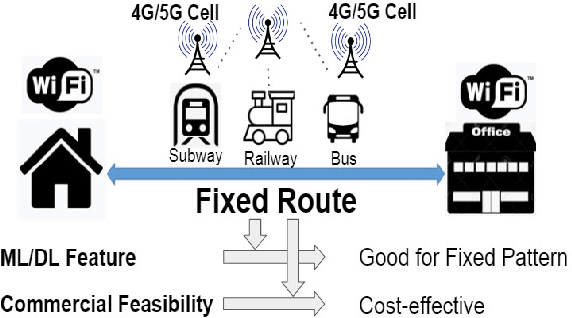
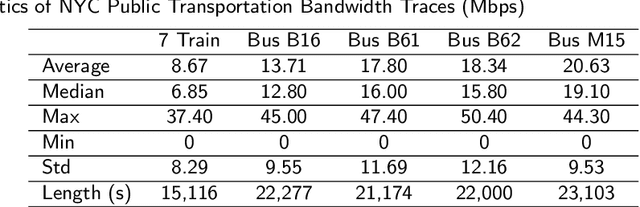
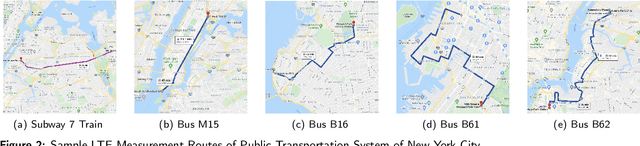
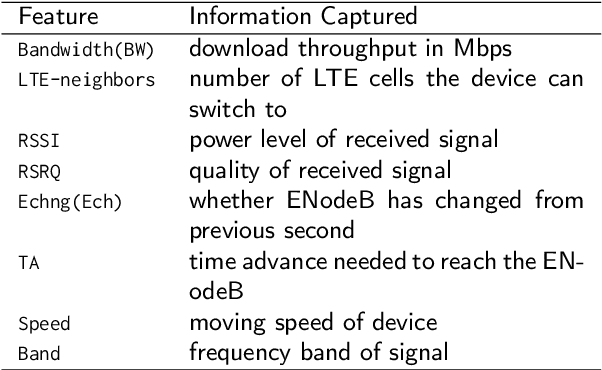
Mobile apps are increasingly relying on high-throughput and low-latency content delivery, while the available bandwidth on wireless access links is inherently time-varying. The handoffs between base stations and access modes due to user mobility present additional challenges to deliver a high level of user Quality-of-Experience (QoE). The ability to predict the available bandwidth and the upcoming handoffs will give applications valuable leeway to make proactive adjustments to avoid significant QoE degradation. In this paper, we explore the possibility and accuracy of realtime mobile bandwidth and handoff predictions in 4G/LTE and 5G networks. Towards this goal, we collect long consecutive traces with rich bandwidth, channel, and context information from public transportation systems. We develop Recurrent Neural Network models to mine the temporal patterns of bandwidth evolution in fixed-route mobility scenarios. Our models consistently outperform the conventional univariate and multivariate bandwidth prediction models. For 4G \& 5G co-existing networks, we propose a new problem of handoff prediction between 4G and 5G, which is important for low-latency applications like self-driving strategy in realistic 5G scenarios. We develop classification and regression based prediction models, which achieve more than 80\% accuracy in predicting 4G and 5G handoffs in a recent 5G dataset.