 Add to Chrome
 Add to Firefox
 Add to Edge
MIBE: Multi-subject Interaction Benchmark and Evaluator for Personalized Image Generation
Jul 01, 2026
Multi-subject personalized image generation requires the precise rendering of all requested reference identities and their specified interactions based on a guiding prompt. However, state-of-the-art models still struggle with this process, frequently omitting subjects, failing to preserve reference appearances, or misattributing interactions. Furthermore, existing metrics designed primarily for single-subject fidelity cannot reliably capture these errors, suffering severe degradation in ranking separability and failing to align with human preference as the subject count increases. To address this gap, we introduce Multi-subject Interaction Benchmark and Evaluator (MIBE), a unified framework comprising a Multi-subject Interaction Benchmark (MIB) and a Multi-subject Interaction Evaluator (MIE). MIB systematically covers diverse relation types and scene complexities through a decoupled data regime. This consists of a 60K-pair VLM-labeled Silver Set for scalable metric training and a 4K-pair double-blind Human Evaluation Gold Set covering a diverse range of state-of-the-art generators, with the Silver Set reaching 95.1% cross-VLM preference agreement. To demonstrate the utility of this benchmark, we present MIE, a lightweight, reference-conditioned evaluator trained exclusively on the Silver Set with a dual-head ranking and diagnosis objective. MIE exhibits strong cross-generator generalization on the Gold Set, achieving 0.922 overall pairwise accuracy against human preference, including 0.982 on seen generators and 0.884 on unseen generators. By outperforming a broad spectrum of baseline metrics, including CLIP and DINO variants, MIE demonstrates that diagnostic supervision can preserve ranking separability and human alignment where traditional evaluators collapse.

Diverse Yet Consistent: Context-Guided Diffusion with Energy-Based Joint Refinement for Multi-Agent Motion Prediction
May 21, 2026Deepgenerative models havebecomeapromisingapproach for human motion prediction due to their ability to capture multimodal distributions and represent diverse human be haviors. However, generating predictions that are both di verse and jointly consistent among interacting agents re mains challenging. In addition, most existing approaches are primarily evaluated using single-agent (marginal) met rics, which fail to fully reflect the joint dynamics of multi agent interactions. We propose a diffusion-based frame work that improves multi-agent motion prediction by lever aging rich contextual information from historical trajecto ries. This information is incorporated through a guidance mechanism to enhance the diversity and expressiveness of predicted motions. To further enforce interaction consis tency, we introduce an energy-based formulation that re fines the joint trajectory distribution while preserving the plausibility of individual trajectories. Extensive experi ments on four benchmark datasets demonstrate that our approach consistently outperforms existing methods. No tably, our approach substantially improves both marginal (ADE/FDE) and joint (JADE/JFDE) metrics on ETH/UCY over strong marginal baselines. Compared with prior joint prediction methods, it delivers significant gains in marginal metrics while maintaining competitive joint performance.
When Identities Collapse: A Stress-Test Benchmark for Multi-Subject Personalization
Mar 27, 2026Subject-driven text-to-image diffusion models have achieved remarkable success in preserving single identities, yet their ability to compose multiple interacting subjects remains largely unexplored and highly challenging. Existing evaluation protocols typically rely on global CLIP metrics, which are insensitive to local identity collapse and fail to capture the severity of multi-subject entanglement. In this paper, we identify a pervasive "Illusion of Scalability" in current models: while they excel at synthesizing 2-4 subjects in simple layouts, they suffer from catastrophic identity collapse when scaled to 6-10 subjects or tasked with complex physical interactions. To systematically expose this failure mode, we construct a rigorous stress-test benchmark comprising 75 prompts distributed across varying subject counts and interaction difficulties (Neutral, Occlusion, Interaction). Furthermore, we demonstrate that standard CLIP-based metrics are fundamentally flawed for this task, as they often assign high scores to semantically correct but identity-collapsed images (e.g., generating generic clones). To address this, we introduce the Subject Collapse Rate (SCR), a novel evaluation metric grounded in DINOv2's structural priors, which strictly penalizes local attention leakage and homogenization. Our extensive evaluation of state-of-the-art models (MOSAIC, XVerse, PSR) reveals a precipitous drop in identity fidelity as scene complexity grows, with SCR approaching 100% at 10 subjects. We trace this collapse to the semantic shortcuts inherent in global attention routing, underscoring the urgent need for explicit physical disentanglement in future generative architectures.
Implicit Guidance and Explicit Representation of Semantic Information in Points Cloud: A Survey
Jan 07, 2025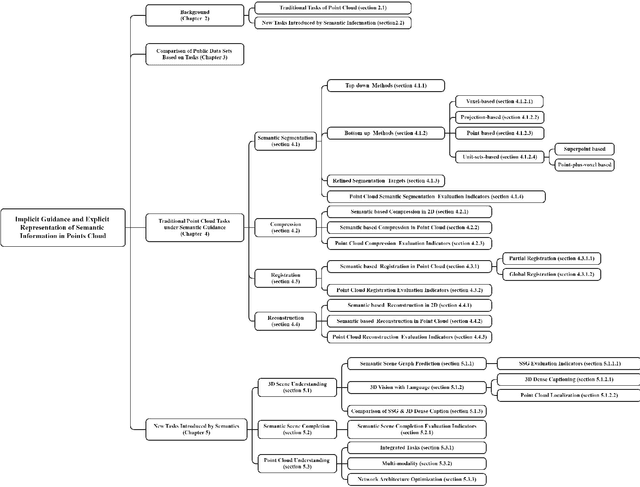

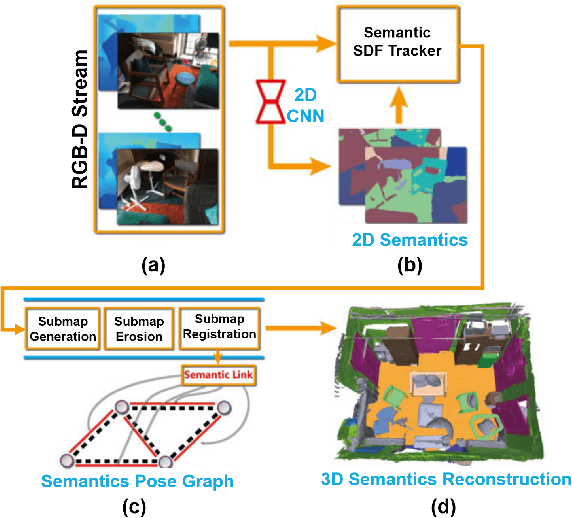

Point clouds, a prominent method of 3D representation, are extensively utilized across industries such as autonomous driving, surveying, electricity, architecture, and gaming, and have been rigorously investigated for their accuracy and resilience. The extraction of semantic information from scenes enhances both human understanding and machine perception. By integrating semantic information from two-dimensional scenes with three-dimensional point clouds, researchers aim to improve the precision and efficiency of various tasks. This paper provides a comprehensive review of the diverse applications and recent advancements in the integration of semantic information within point clouds. We explore the dual roles of semantic information in point clouds, encompassing both implicit guidance and explicit representation, across traditional and emerging tasks. Additionally, we offer a comparative analysis of publicly available datasets tailored to specific tasks and present notable observations. In conclusion, we discuss several challenges and potential issues that may arise in the future when fully utilizing semantic information in point clouds, providing our perspectives on these obstacles. The classified and organized articles related to semantic based point cloud tasks, and continuously followed up on relevant achievements in different fields, which can be accessed through https://github.com/Jasmine-tjy/Semantic-based-Point-Cloud-Tasks.