 Add to Chrome
 Add to Firefox
 Add to Edge
Meshy T2: Fast Native Mesh Generation with Flow Matching
Jul 28, 2026
Polygonal meshes are the standard surface representation of modern 3D pipelines, and generating high-quality meshes with artist-style topology is essential for film, gaming, and interactive 3D applications. Mainstream approaches serialize a mesh into a token sequence and decode it autoregressively, which is slow at inference and sensitive to error accumulation, making them impractical for interactive asset creation. We present Meshy T2, a fast native mesh generation framework built on flow matching. At its core is a vertex-set mesh VAE that encodes a mesh into one continuous latent token per vertex and decodes vertices, edge connectivity, and face winding order in a single pass, preserving high-precision geometry and artist-authored topology without vertex quantization or welding. Generation proceeds as a coarse-to-fine cascade of two flow-matching models: an image-conditioned voxel flow first sketches the overall shape as a coarse occupancy scaffold, and a mesh flow then populates the scaffold with per-vertex latent tokens, conditioned on the image, the scaffold, and a requested vertex budget. This design delivers three practical capabilities: interactive generation speed through parallel flow-based synthesis; effective face-count control through the requested vertex budget; and native support for multi-part assets, whose components emerge directly from the generated connectivity. In our experiments, Meshy T2 achieves state-of-the-art geometric fidelity and completes end-to-end image-to-mesh generation within a median of 6 seconds, over an order of magnitude faster than autoregressive baselines. Code and weights will be available at https://github.com/meshy-dev/meshy-t2.

Water Supply Prediction Based on Initialized Attention Residual Network
Dec 17, 2019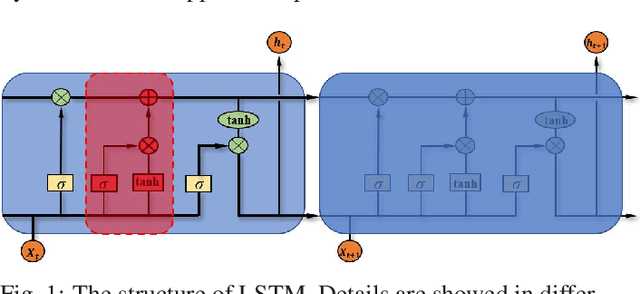
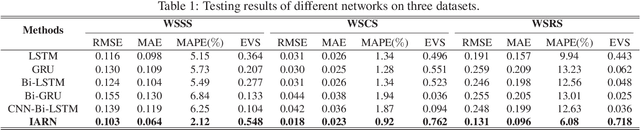
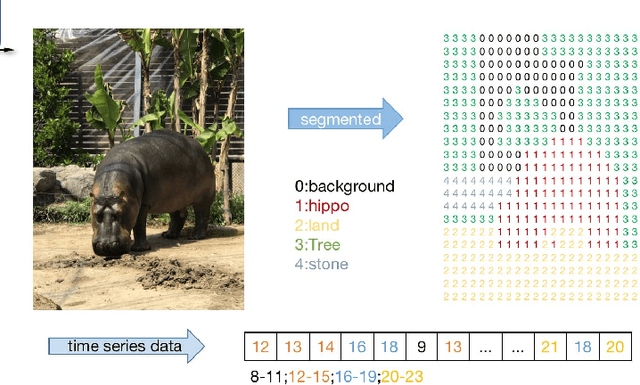
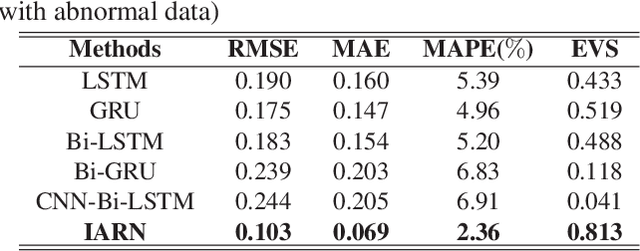
Real-time and accurate water supply forecast is crucial for water plant. However, most existing methods are likely affected by factors such as weather and holidays, which lead to a decline in the reliability of water supply prediction. In this paper, we address a generic artificial neural network, called Initialized Attention Residual Network (IARN), which is combined with an attention module and residual modules. Specifically, instead of continuing to use the recurrent neural network (RNN) in time-series tasks, we try to build a convolution neural network (CNN)to recede the disturb from other factors, relieve the limitation of memory size and get a more credible results. Our method achieves state-of-the-art performance on several data sets, in terms of accuracy, robustness and generalization ability.