 Add to Chrome
 Add to Firefox
 Add to Edge
KohakuRAG: A simple RAG framework with hierarchical document indexing
Mar 08, 2026
Retrieval-augmented generation (RAG) systems that answer questions from document collections face compounding difficulties when high-precision citations are required: flat chunking strategies sacrifice document structure, single-query formulations miss relevant passages through vocabulary mismatch, and single-pass inference produces stochastic answers that vary in both content and citation selection. We present KohakuRAG, a hierarchical RAG framework that preserves document structure through a four-level tree representation (document $\rightarrow$ section $\rightarrow$ paragraph $\rightarrow$ sentence) with bottom-up embedding aggregation, improves retrieval coverage through an LLM-powered query planner with cross-query reranking, and stabilizes answers through ensemble inference with abstention-aware voting. We evaluate on the WattBot 2025 Challenge, a benchmark requiring systems to answer technical questions from 32 documents with $\pm$0.1% numeric tolerance and exact source attribution. KohakuRAG achieves first place on both public and private leaderboards (final score 0.861), as the only team to maintain the top position across both evaluation partitions. Ablation studies reveal that prompt ordering (+80% relative), retry mechanisms (+69%), and ensemble voting with blank filtering (+1.2pp) each contribute substantially, while hierarchical dense retrieval alone matches hybrid sparse-dense approaches (BM25 adds only +3.1pp). We release KohakuRAG as open-source software at https://github.com/KohakuBlueleaf/KohakuRAG.

GenRC: Generative 3D Room Completion from Sparse Image Collections
Jul 19, 2024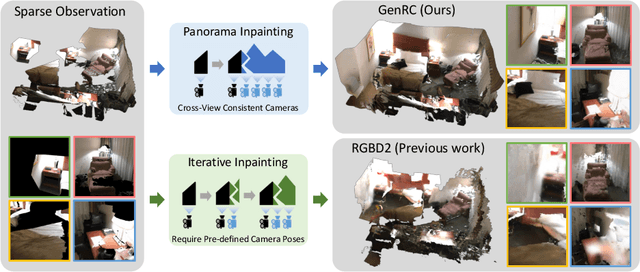

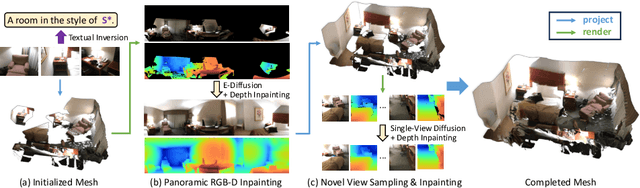

Sparse RGBD scene completion is a challenging task especially when considering consistent textures and geometries throughout the entire scene. Different from existing solutions that rely on human-designed text prompts or predefined camera trajectories, we propose GenRC, an automated training-free pipeline to complete a room-scale 3D mesh with high-fidelity textures. To achieve this, we first project the sparse RGBD images to a highly incomplete 3D mesh. Instead of iteratively generating novel views to fill in the void, we utilized our proposed E-Diffusion to generate a view-consistent panoramic RGBD image which ensures global geometry and appearance consistency. Furthermore, we maintain the input-output scene stylistic consistency through textual inversion to replace human-designed text prompts. To bridge the domain gap among datasets, E-Diffusion leverages models trained on large-scale datasets to generate diverse appearances. GenRC outperforms state-of-the-art methods under most appearance and geometric metrics on ScanNet and ARKitScenes datasets, even though GenRC is not trained on these datasets nor using predefined camera trajectories. Project page: https://minfenli.github.io/GenRC