 Add to Chrome
 Add to Firefox
 Add to Edge
Harness Engineering for LLM-Driven GPU Kernel Generation
Jul 20, 2026
Large language models (LLMs) can assist GPU kernel generation, but their practical effectiveness depends on whether generated code can be reliably constrained, validated, profiled, and selected. This paper presents a harness-centered system for LLM-driven GPU kernel optimization in the MLSys 2026 FlashInfer AI Kernel Generation Contest on NVIDIA Blackwell B200 GPUs. The system separates an evaluation harness from a profile-backed optimization controller: the harness enforces compilation, correctness, official-aligned timing, and artifact archival, while the controller turns profiler and workload evidence into bounded candidate-generation decisions. Human-authored skills capture operator constraints, references, profiling procedures, and promotion rules, while Codex and Claude Code agents generate candidate kernels inside those constraints. Across five operator definitions, the retained official-aligned artifacts achieved mean-latency speedups over supplied FlashInfer baselines of 1.62x, 18.05x, 29.68x, 1.12x, and 13.70x. The Agent-Assisted kernels outperform the Full-Agent artifacts across the evaluated definitions, indicating that expert-provided optimization directions, high-quality references, and workload context remain critical for reliable AI-driven kernel optimization.

Physics-Guided Graph Neural Networks for Real-time AC/DC Power Flow Analysis
Apr 29, 2023
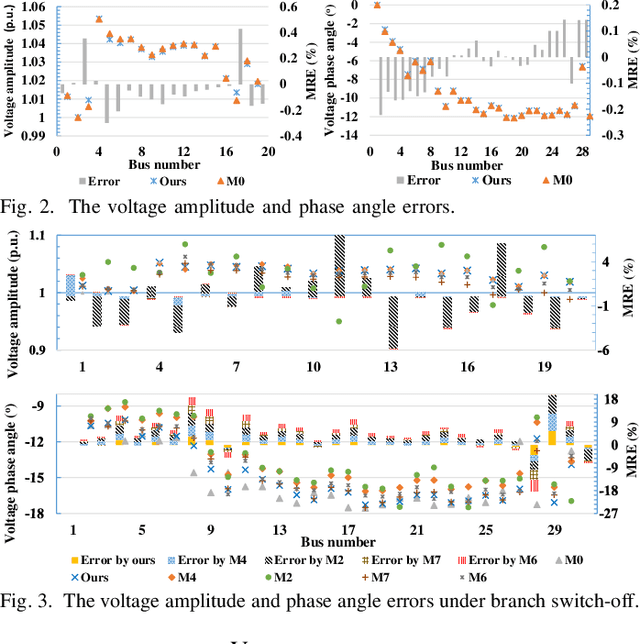

The increasing scale of alternating current and direct current (AC/DC) hybrid systems necessitates a faster power flow analysis tool than ever. This letter thus proposes a specific physics-guided graph neural network (PG-GNN). The tailored graph modelling of AC and DC grids is firstly advanced to enhance the topology adaptability of the PG-GNN. To eschew unreliable experience emulation from data, AC/DC physics are embedded in the PG-GNN using duality. Augmented Lagrangian method-based learning scheme is then presented to help the PG-GNN better learn nonconvex patterns in an unsupervised label-free manner. Multi-PG-GNN is finally conducted to master varied DC control modes. Case study shows that, relative to the other 7 data-driven rivals, only the proposed method matches the performance of the model-based benchmark, also beats it in computational efficiency beyond 10 times.