 Add to Chrome
 Add to Firefox
 Add to Edge
LLMs Can Assist with Proposal Selection at Large User Facilities
Dec 11, 2025
We explore how large language models (LLMs) can enhance the proposal selection process at large user facilities, offering a scalable, consistent, and cost-effective alternative to traditional human review. Proposal selection depends on assessing the relative strength among submitted proposals; however, traditional human scoring often suffers from weak inter-proposal correlations and is subject to reviewer bias and inconsistency. A pairwise preference-based approach is logically superior, providing a more rigorous and internally consistent basis for ranking, but its quadratic workload makes it impractical for human reviewers. We address this limitation using LLMs. Leveraging the uniquely well-curated proposals and publication records from three beamlines at the Spallation Neutron Source (SNS), Oak Ridge National Laboratory (ORNL), we show that the LLM rankings correlate strongly with the human rankings (Spearman $ρ\simeq 0.2-0.8$, improving to $\geq 0.5$ after 10\% outlier removal). Moreover, LLM performance is no worse than that of human reviewers in identifying proposals with high publication potential, while costing over two orders of magnitude less. Beyond ranking, LLMs enable advanced analyses that are challenging for humans, such as quantitative assessment of proposal similarity via embedding models, which provides information crucial for review committees.

Physics-Guided Graph Neural Networks for Real-time AC/DC Power Flow Analysis
Apr 29, 2023
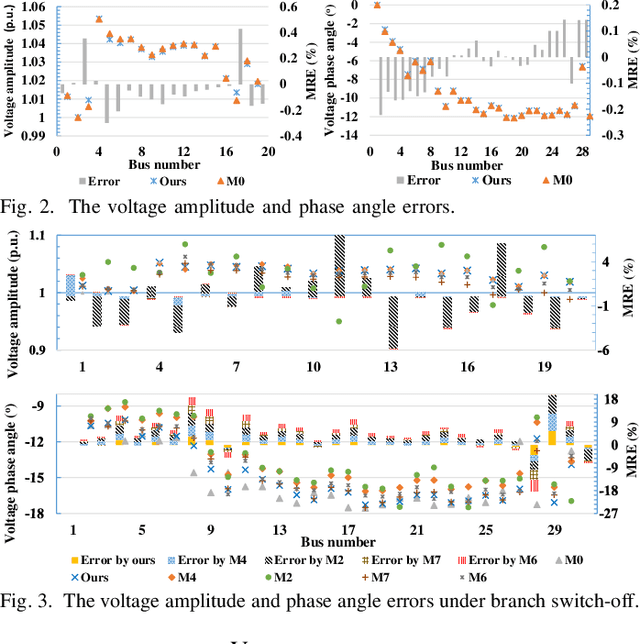

The increasing scale of alternating current and direct current (AC/DC) hybrid systems necessitates a faster power flow analysis tool than ever. This letter thus proposes a specific physics-guided graph neural network (PG-GNN). The tailored graph modelling of AC and DC grids is firstly advanced to enhance the topology adaptability of the PG-GNN. To eschew unreliable experience emulation from data, AC/DC physics are embedded in the PG-GNN using duality. Augmented Lagrangian method-based learning scheme is then presented to help the PG-GNN better learn nonconvex patterns in an unsupervised label-free manner. Multi-PG-GNN is finally conducted to master varied DC control modes. Case study shows that, relative to the other 7 data-driven rivals, only the proposed method matches the performance of the model-based benchmark, also beats it in computational efficiency beyond 10 times.