 Add to Chrome
 Add to Firefox
 Add to Edge
HERMES: A Multi-Granularity Labeling Substrate for Pre-training Data Mixtures
Jul 02, 2026
Most data-mixing methods assume the corpus has already been partitioned into groups, and the choice of those groups determines what a mixer can express. Existing labels, including provenance, topic or format taxonomies, and flat embedding clusters, commit to one semantic axis at one granularity; changing the resolution rebuilds the labels. We argue the bottleneck is the label system, not the mixer, and provide a hierarchical one. HERMES is a data-derived labeling substrate: a Learned Semantic Transform followed by 3-stage residual vector quantization annotates each document once into a coarse-to-fine code whose prefix length controls granularity up to approximately 130k cells. At coarse granularity HERMES sits at a plateau with KMeans-family methods on standard clustering metrics, so the contribution is the substrate, not the clusterer. On 1B-parameter, 25B-token pre-training, the hierarchy exposes an interaction fixed-granularity pipelines cannot test: at one prefix length, a combined Stage-2 rule contrast, equal-subbucket coverage versus size-proportional within-bucket quality top-30%, lifts a 16-task capability macro-average by +0.0253; at the next finer level, the same rule loses its measurable edge as candidate pools contract approximately 5x. HERMES reframes data mixture design from choosing among fixed label sets to navigating a reusable, data-derived granularity hierarchy.

GRASP: Geometry-aware Residual Alignment for Scalable Pretraining Data Attribution
Jun 05, 2026Scalable data attribution methods typically assign isolated utility scores to individual training examples. This prevalent additive assumption fundamentally fails to capture critical subset dynamics, including data redundancy and complementary coverage. In this work, we reframe attribution as subset-level counterfactual utility prediction and introduce GRASP, an interaction-aware surrogate. Grounded in a theoretical smoothness lower bound, GRASP explicitly models subset interactions through a quadratic geometric penalty. To achieve pretraining-scale efficiency without relying on hidden oracle tuning, we couple low-dimensional feature sketches with a strictly finite lower-confidence bound selection protocol. Extensive subset-retraining evaluations demonstrate that GRASP decisively outperforms existing scalable baselines. It more than doubles the task-level rank correlation for counterfactual subset fidelity while reducing upfront artifact construction costs by nearly an order of magnitude. Downstream diagnostics further show that this scoring mechanism transfers to language model curation and cross-domain vision selection, establishing a robust foundation for optimizing massive pretraining corpora.
ImagebindDC: Compressing Multi-modal Data with Imagebind-based Condensation
Nov 11, 2025

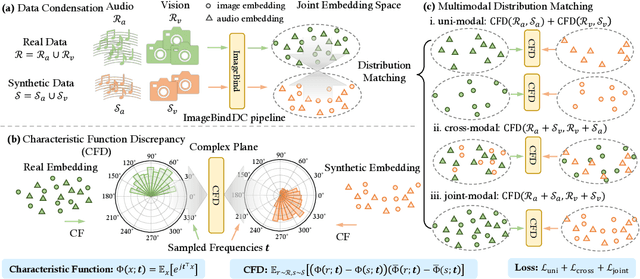

Data condensation techniques aim to synthesize a compact dataset from a larger one to enable efficient model training, yet while successful in unimodal settings, they often fail in multimodal scenarios where preserving intricate inter-modal dependencies is crucial. To address this, we introduce ImageBindDC, a novel data condensation framework operating within the unified feature space of ImageBind. Our approach moves beyond conventional distribution-matching by employing a powerful Characteristic Function (CF) loss, which operates in the Fourier domain to facilitate a more precise statistical alignment via exact infinite moment matching. We design our objective to enforce three critical levels of distributional consistency: (i) uni-modal alignment, which matches the statistical properties of synthetic and real data within each modality; (ii) cross-modal alignment, which preserves pairwise semantics by matching the distributions of hybrid real-synthetic data pairs; and (iii) joint-modal alignment, which captures the complete multivariate data structure by aligning the joint distribution of real data pairs with their synthetic counterparts. Extensive experiments highlight the effectiveness of ImageBindDC: on the NYU-v2 dataset, a model trained on just 5 condensed datapoints per class achieves lossless performance comparable to one trained on the full dataset, achieving a new state-of-the-art with an 8.2\% absolute improvement over the previous best method and more than 4$\times$ less condensation time.