 Add to Chrome
 Add to Firefox
 Add to Edge
Mapping Drivers of Greenness: Spatial Variable Selection for MODIS Vegetation Indices
Feb 07, 2026
Understanding how environmental drivers relate to vegetation condition motivates spatially varying regression models, but estimating a separate coefficient surface for every predictor can yield noisy patterns and poor interpretability when many predictors are irrelevant. Motivated by MODIS vegetation index studies, we examine predictors from spectral bands, productivity and energy fluxes, observation geometry, and land surface characteristics. Because these relationships vary with canopy structure, climate, land use, and measurement conditions, methods should both model spatially varying effects and identify where predictors matter. We propose a spatially varying coefficient model where each coefficient surface uses a tensor product B-spline basis and a Bayesian group lasso prior on the basis coefficients. This prior induces predictor level shrinkage, pushing negligible effects toward zero while preserving spatial structure. Posterior inference uses Markov chain Monte Carlo and provides uncertainty quantification for each effect surface. We summarize retained effects with spatial significance maps that mark locations where the 95 percent posterior credible interval excludes zero, and we define a spatial coverage probability as the proportion of locations where the credible interval excludes zero. Simulations recover sparsity and achieve prediction. A MODIS application yields a parsimonious subset of predictors whose effect maps clarify dominant controls across landscapes.

Predictive Exit: Prediction of Fine-Grained Early Exits for Computation- and Energy-Efficient Inference
Jun 09, 2022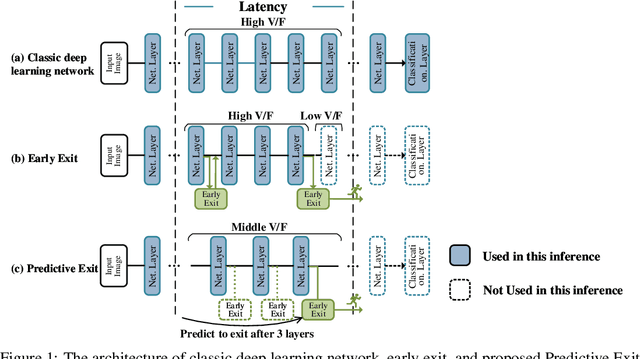
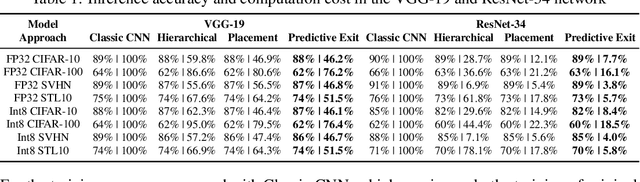
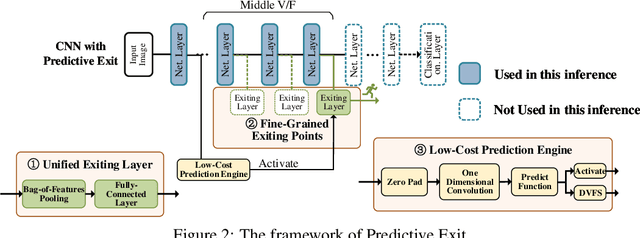
By adding exiting layers to the deep learning networks, early exit can terminate the inference earlier with accurate results. The passive decision-making of whether to exit or continue the next layer has to go through every pre-placed exiting layer until it exits. In addition, it is also hard to adjust the configurations of the computing platforms alongside the inference proceeds. By incorporating a low-cost prediction engine, we propose a Predictive Exit framework for computation- and energy-efficient deep learning applications. Predictive Exit can forecast where the network will exit (i.e., establish the number of remaining layers to finish the inference), which effectively reduces the network computation cost by exiting on time without running every pre-placed exiting layer. Moreover, according to the number of remaining layers, proper computing configurations (i.e., frequency and voltage) are selected to execute the network to further save energy. Extensive experimental results demonstrate that Predictive Exit achieves up to 96.2% computation reduction and 72.9% energy-saving compared with classic deep learning networks; and 12.8% computation reduction and 37.6% energy-saving compared with the early exit under state-of-the-art exiting strategies, given the same inference accuracy and latency.