 Add to Chrome
 Add to Firefox
 Add to Edge
FloorplanVLM: A Vision-Language Model for Floorplan Vectorization
Feb 06, 2026
Converting raster floorplans into engineering-grade vector graphics is challenging due to complex topology and strict geometric constraints. To address this, we present FloorplanVLM, a unified framework that reformulates floorplan vectorization as an image-conditioned sequence modeling task. Unlike pixel-based methods that rely on fragile heuristics or query-based transformers that generate fragmented rooms, our model directly outputs structured JSON sequences representing the global topology. This 'pixels-to-sequence' paradigm enables the precise and holistic constraint satisfaction of complex geometries, such as slanted walls and curved arcs. To support this data-hungry approach, we introduce a scalable data engine: we construct a large-scale dataset (Floorplan-2M) and a high-fidelity subset (Floorplan-HQ-300K) to balance geometric diversity and pixel-level precision. We then employ a progressive training strategy, using Supervised Fine-Tuning (SFT) for structural grounding and quality annealing, followed by Group Relative Policy Optimization (GRPO) for strict geometric alignment. To standardize evaluation on complex layouts, we establish and open-source FPBench-2K. Evaluated on this rigorous benchmark, FloorplanVLM demonstrates exceptional structural validity, achieving $\textbf{92.52%}$ external-wall IoU and robust generalization across non-Manhattan architectures.

DreamHome-Pano: Design-Aware and Conflict-Free Panoramic Interior Generation
Feb 06, 2026In modern interior design, the generation of personalized spaces frequently necessitates a delicate balance between rigid architectural structural constraints and specific stylistic preferences. However, existing multi-condition generative frameworks often struggle to harmonize these inputs, leading to "condition conflicts" where stylistic attributes inadvertently compromise the geometric precision of the layout. To address this challenge, we present DreamHome-Pano, a controllable panoramic generation framework designed for high-fidelity interior synthesis. Our approach introduces a Prompt-LLM that serves as a semantic bridge, effectively translating layout constraints and style references into professional descriptive prompts to achieve precise cross-modal alignment. To safeguard architectural integrity during the generative process, we develop a Conflict-Free Control architecture that incorporates structural-aware geometric priors and a multi-condition decoupling strategy, effectively suppressing stylistic interference from eroding the spatial layout. Furthermore, we establish a comprehensive panoramic interior benchmark alongside a multi-stage training pipeline, encompassing progressive Supervised Fine-Tuning (SFT) and Reinforcement Learning (RL). Experimental results demonstrate that DreamHome-Pano achieves a superior balance between aesthetic quality and structural consistency, offering a robust and professional-grade solution for panoramic interior visualization.
Modelling the semantics of text in complex document layouts using graph transformer networks
Feb 18, 2022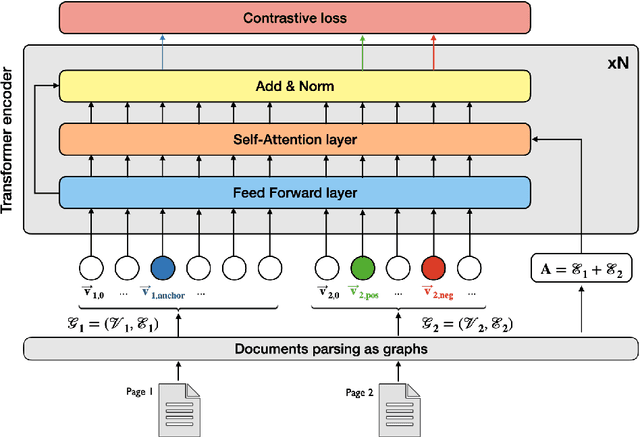
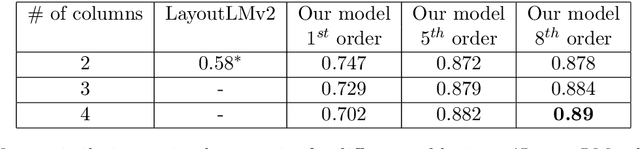
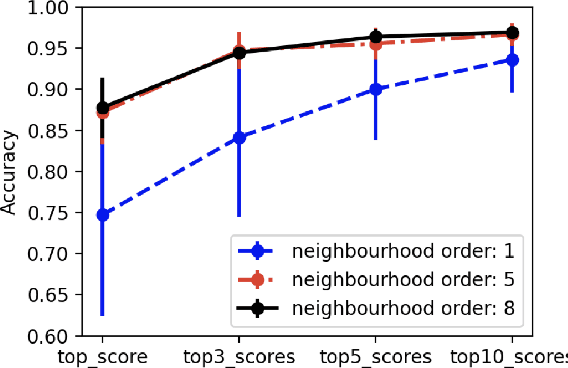
Representing structured text from complex documents typically calls for different machine learning techniques, such as language models for paragraphs and convolutional neural networks (CNNs) for table extraction, which prohibits drawing links between text spans from different content types. In this article we propose a model that approximates the human reading pattern of a document and outputs a unique semantic representation for every text span irrespective of the content type they are found in. We base our architecture on a graph representation of the structured text, and we demonstrate that not only can we retrieve semantically similar information across documents but also that the embedding space we generate captures useful semantic information, similar to language models that work only on text sequences.