 Add to Chrome
 Add to Firefox
 Add to Edge
MR-IQA-2: Faithful Image Quality Reflection via Fine-Grained Credit Assignment
Aug 19, 2026
Multimodal large language models (MLLMs) have shown strong potential for image quality assessment (IQA) by improving consistency between quality ratings and their underlying reasoning. However, most approaches supervise reasoning through human-provided ratings and rarely examine whether it faithfully reflects image quality. Rating accuracy alone does not ensure faithful reasoning; a shared reward also obscures supervision sources and may reinforce unfaithful reasoning when a correct rating occurs by chance. To improve the faithfulness and reliability of blind IQA, we aim to (1) decouple credit assignment for reasoning and rating and (2) provide verifiable supervision for faithful reasoning. We introduce MR-IQA-2, an actor-editor-judge framework that operationalizes reasoning-editing-reflection. The actor generates quality reasoning for an input image, and the editor revises the image according to the identified quality factors. A frozen judge compares the original and edited images and provides reflective supervision for the actor's reasoning. MR-IQA-2 further uses fine-grained credit assignment to decouple reasoning and rating supervision. Judge feedback supervises reasoning, whereas human ratings supervise the predicted rating. Masked token-specific updates distinguish these signals while preserving the causal relation from reasoning to rating. Across IQA benchmarks, MR-IQA-2 achieves competitive rating alignment with humans. Visual reflection also enables richer and more faithful visual understanding beyond rating, which may inform image-quality optimization and related downstream tasks. Code is available at https://github.com/RobinY99/MR-IQA-2.

Learning point embedding for 3D data processing
Aug 10, 2021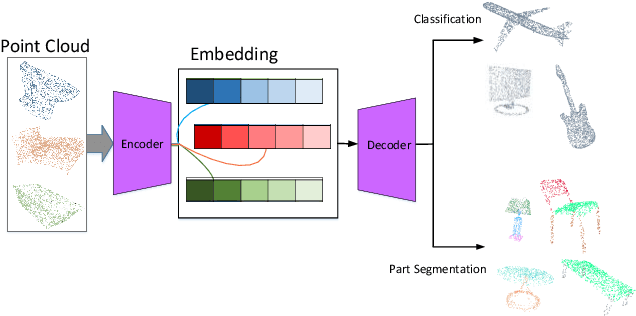

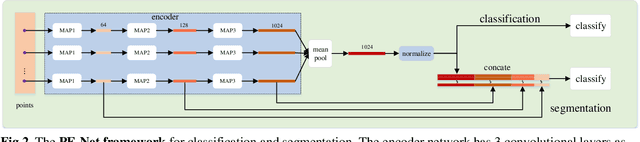

Among 2D convolutional networks on point clouds, point-based approaches consume point clouds of fixed size directly. By analysis of PointNet, a pioneer in introducing deep learning into point sets, we reveal that current point-based methods are essentially spatial relationship processing networks. In this paper, we take a different approach. Our architecture, named PE-Net, learns the representation of point clouds in high-dimensional space, and encodes the unordered input points to feature vectors, which standard 2D CNNs can be applied to. The recommended network can adapt to changes in the number of input points which is the limit of current methods. Experiments show that in the tasks of classification and part segmentation, PE-Net achieves the state-of-the-art performance in multiple challenging datasets, such as ModelNet and ShapeNetPart.