 Add to Chrome
 Add to Firefox
 Add to Edge
CSGaussian: Progressive Rate-Distortion Compression and Segmentation for 3D Gaussian Splatting
Jan 19, 2026
We present the first unified framework for rate-distortion-optimized compression and segmentation of 3D Gaussian Splatting (3DGS). While 3DGS has proven effective for both real-time rendering and semantic scene understanding, prior works have largely treated these tasks independently, leaving their joint consideration unexplored. Inspired by recent advances in rate-distortion-optimized 3DGS compression, this work integrates semantic learning into the compression pipeline to support decoder-side applications--such as scene editing and manipulation--that extend beyond traditional scene reconstruction and view synthesis. Our scheme features a lightweight implicit neural representation-based hyperprior, enabling efficient entropy coding of both color and semantic attributes while avoiding costly grid-based hyperprior as seen in many prior works. To facilitate compression and segmentation, we further develop compression-guided segmentation learning, consisting of quantization-aware training to enhance feature separability and a quality-aware weighting mechanism to suppress unreliable Gaussian primitives. Extensive experiments on the LERF and 3D-OVS datasets demonstrate that our approach significantly reduces transmission cost while preserving high rendering quality and strong segmentation performance.

ComNeck: Bridging Compressed Image Latents and Multimodal LLMs via Universal Transform-Neck
Jul 29, 2024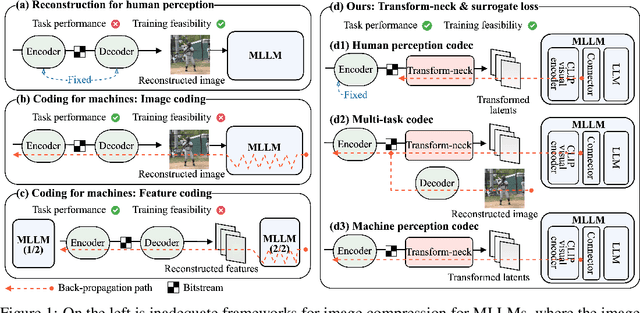

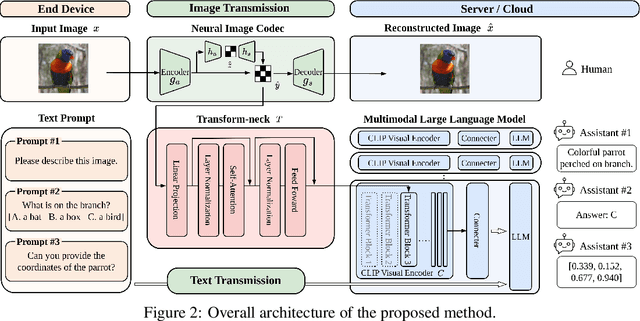
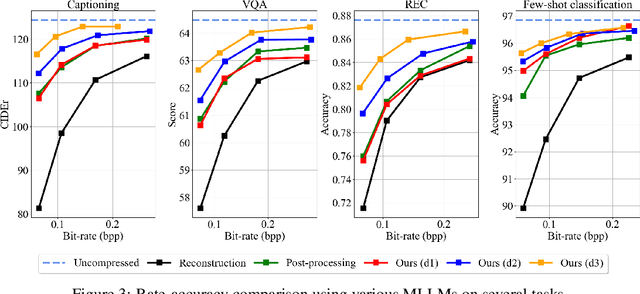
This paper presents the first-ever study of adapting compressed image latents to suit the needs of downstream vision tasks that adopt Multimodal Large Language Models (MLLMs). MLLMs have extended the success of large language models to modalities (e.g. images) beyond text, but their billion scale hinders deployment on resource-constrained end devices. While cloud-hosted MLLMs could be available, transmitting raw, uncompressed images captured by end devices to the cloud requires an efficient image compression system. To address this, we focus on emerging neural image compression and propose a novel framework with a lightweight transform-neck and a surrogate loss to adapt compressed image latents for MLLM-based vision tasks. The proposed framework is generic and applicable to multiple application scenarios, where the neural image codec can be (1) pre-trained for human perception without updating, (2) fully updated for joint human and machine perception, or (3) fully updated for only machine perception. The transform-neck trained with the surrogate loss is universal, for it can serve various downstream vision tasks enabled by a variety of MLLMs that share the same visual encoder. Our framework has the striking feature of excluding the downstream MLLMs from training the transform-neck, and potentially the neural image codec as well. This stands out from most existing coding for machine approaches that involve downstream networks in training and thus could be impractical when the networks are MLLMs. Extensive experiments on different neural image codecs and various MLLM-based vision tasks show that our method achieves great rate-accuracy performance with much less complexity, demonstrating its effectiveness.