 Add to Chrome
 Add to Firefox
 Add to Edge
Long-Context Long-Form Question Answering for Legal Domain
Feb 06, 2026
Legal documents have complex document layouts involving multiple nested sections, lengthy footnotes and further use specialized linguistic devices like intricate syntax and domain-specific vocabulary to ensure precision and authority. These inherent characteristics of legal documents make question answering challenging, and particularly so when the answer to the question spans several pages (i.e. requires long-context) and is required to be comprehensive (i.e. a long-form answer). In this paper, we address the challenges of long-context question answering in context of long-form answers given the idiosyncrasies of legal documents. We propose a question answering system that can (a) deconstruct domain-specific vocabulary for better retrieval from source documents, (b) parse complex document layouts while isolating sections and footnotes and linking them appropriately, (c) generate comprehensive answers using precise domain-specific vocabulary. We also introduce a coverage metric that classifies the performance into recall-based coverage categories allowing human users to evaluate the recall with ease. We curate a QA dataset by leveraging the expertise of professionals from fields such as law and corporate tax. Through comprehensive experiments and ablation studies, we demonstrate the usability and merit of the proposed system.

Prompt-Based Editing for Text Style Transfer
Jan 27, 2023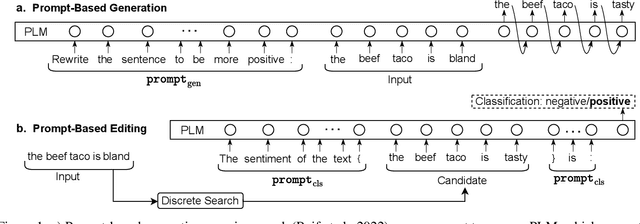
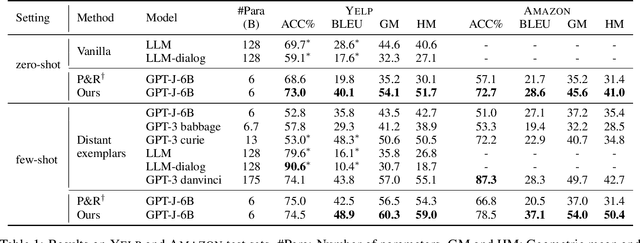
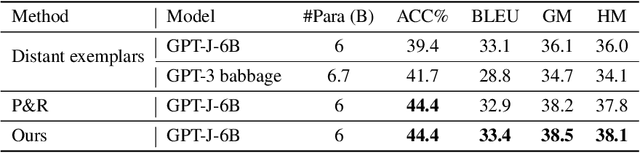
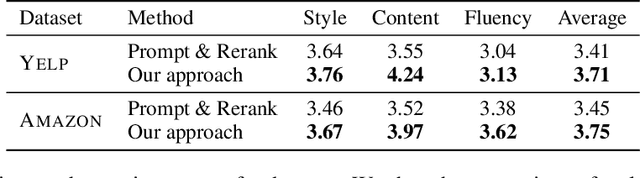
Prompting approaches have been recently explored in text style transfer, where a textual prompt is used to query a pretrained language model to generate style-transferred texts word by word in an autoregressive manner. However, such a generation process is less controllable and early prediction errors may affect future word predictions. In this paper, we present a prompt-based editing approach for text style transfer. Specifically, we prompt a pretrained language model for style classification and use the classification probability to compute a style score. Then, we perform discrete search with word-level editing to maximize a comprehensive scoring function for the style-transfer task. In this way, we transform a prompt-based generation problem into a classification one, which is a training-free process and more controllable than the autoregressive generation of sentences. In our experiments, we performed both automatic and human evaluation on three style-transfer benchmark datasets, and show that our approach largely outperforms the state-of-the-art systems that have 20 times more parameters. Additional empirical analyses further demonstrate the effectiveness of our approach.