 Add to Chrome
 Add to Firefox
 Add to Edge
IDEAL-Bench: Indoor Dataset and Evaluation suite for Analyzing 3D Layout reasoning
Jul 03, 2026
Spatial question answering is the dominant paradigm for evaluating spatial intelligence in Vision-Language Models (VLMs), but it leaves a complementary axis of spatial competence under-evaluated: holistic 3D layout inference, which predicts every visible object's pose and extent from a single image in a structured form. To this end, we introduce IDEAL-Bench, an evaluation suite that requires VLMs to predict structured 3D layouts on photorealistic indoor scenes across 10 room types, scored along five numerical dimensions and a perceptual render-and-compare protocol. By operating on semantically realistic scenes with full asset substitution under controlled lighting and viewpoint, IDEAL-Bench moves beyond CLEVR-style simple geometric primitives so that any image-space discrepancy reflects spatial reasoning alone. The benchmark is built on IDEAL-Scenes, a procedurally generated dataset of 1,000 re-renderable Blender environments with ground-truth layouts. Evaluating 15 prominent VLMs reveals three findings: the task remains substantially unsolved, with the strongest model reaching only 62.1/100 overall; all models exhibit a sharp asymmetry between object recognition and geometric regression, indicating that current VLMs are trained to describe scenes rather than to measure them; model rankings partially diverge from those on QA-based and primitive-reconstruction benchmarks: top-tier consensus holds, but mid-tier rankings shift substantially. Collectively, these findings establish IDEAL-Bench as a diagnostic suite, targeting the geometric and structural competencies that QA-based evaluation cannot surface, and paving the way towards more rigorous evaluation of spatial intelligence in next-generation VLMs. Together, these findings position IDEAL-Bench as a principled diagnostic for whether future VLMs achieve genuine spatial understanding rather than linguistic approximations of it.

Fréchet Video Motion Distance: A Metric for Evaluating Motion Consistency in Videos
Jul 23, 2024


Significant advancements have been made in video generative models recently. Unlike image generation, video generation presents greater challenges, requiring not only generating high-quality frames but also ensuring temporal consistency across these frames. Despite the impressive progress, research on metrics for evaluating the quality of generated videos, especially concerning temporal and motion consistency, remains underexplored. To bridge this research gap, we propose Fr\'echet Video Motion Distance (FVMD) metric, which focuses on evaluating motion consistency in video generation. Specifically, we design explicit motion features based on key point tracking, and then measure the similarity between these features via the Fr\'echet distance. We conduct sensitivity analysis by injecting noise into real videos to verify the effectiveness of FVMD. Further, we carry out a large-scale human study, demonstrating that our metric effectively detects temporal noise and aligns better with human perceptions of generated video quality than existing metrics. Additionally, our motion features can consistently improve the performance of Video Quality Assessment (VQA) models, indicating that our approach is also applicable to unary video quality evaluation. Code is available at https://github.com/ljh0v0/FMD-frechet-motion-distance.
Balancing Augmentation with Edge-Utility Filter for Signed GNNs
Oct 25, 2023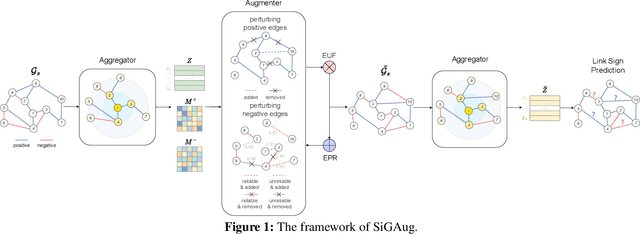
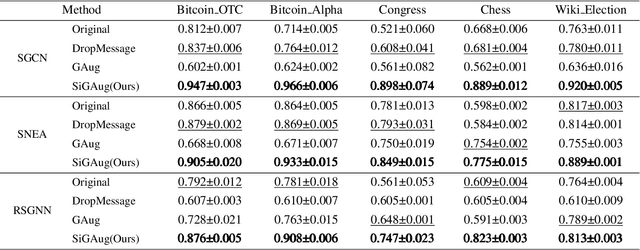
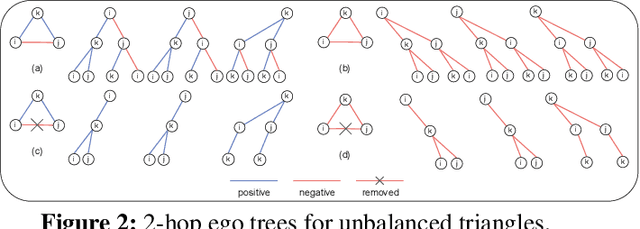

Signed graph neural networks (SGNNs) has recently drawn more attention as many real-world networks are signed networks containing two types of edges: positive and negative. The existence of negative edges affects the SGNN robustness on two aspects. One is the semantic imbalance as the negative edges are usually hard to obtain though they can provide potentially useful information. The other is the structural unbalance, e.g. unbalanced triangles, an indication of incompatible relationship among nodes. In this paper, we propose a balancing augmentation method to address the above two aspects for SGNNs. Firstly, the utility of each negative edge is measured by calculating its occurrence in unbalanced structures. Secondly, the original signed graph is selectively augmented with the use of (1) an edge perturbation regulator to balance the number of positive and negative edges and to determine the ratio of perturbed edges to original edges and (2) an edge utility filter to remove the negative edges with low utility to make the graph structure more balanced. Finally, a SGNN is trained on the augmented graph which effectively explores the credible relationships. A detailed theoretical analysis is also conducted to prove the effectiveness of each module. Experiments on five real-world datasets in link prediction demonstrate that our method has the advantages of effectiveness and generalization and can significantly improve the performance of SGNN backbones.