 Add to Chrome
 Add to Firefox
 Add to Edge
From SFT to RL: Demystifying the Post-Training Pipeline for LLM-based Vulnerability Detection
Feb 15, 2026
The integration of LLMs into vulnerability detection (VD) has shifted the field toward interpretable and context-aware analysis. While post-training methods have shown promise in general coding tasks, their systematic application to VD remains underexplored. In this paper, we present the first comprehensive investigation into the post-training pipeline for LLM-based VD, spanning from cold-start SFT to off-policy preference optimization and on-policy RL, uncovering how data curation, stage interactions, reward mechanisms, and evaluation protocols collectively dictate the efficacy of model training and assessment. Our study identifies practical guidelines and insights: (1) SFT based on rejection sampling greatly outperforms rationalization-based supervision, which can introduce hallucinations due to ground-truth leakage. (2) While increased SFT epochs constantly benefit preference optimization, excessive SFT inhibits self-exploration during RL, ultimately limiting performance gains. (3) Coarse-grained reward signals often mislead RL, whereas fine-grained root-cause judgments ensure reliable credit assignment. Specification-based rewards offer further benefits but incur significant effort in specification generation. (4) Although filtering extremely hard-to-detect vulnerability samples improves RL training efficiency, the cost of performance loss should be considered in practical applications. (5) Models trained under GRPO significantly outperform those using SFT and preference optimization (i.e., DPO and ORPO), as well as a series of zero-shot SOTA LLMs, underscoring the significant potential of on-policy RL for LLM-based VD. (6) In contrast to binary matching that tends to overestimate performance, LLM-as-a-Judge based on root-cause analysis provides a more robust evaluation protocol, although its accuracy varies across judge models with different levels of security expertise.

VULPO: Context-Aware Vulnerability Detection via On-Policy LLM Optimization
Nov 18, 2025The widespread reliance on open-source software dramatically increases the risk of vulnerability exploitation, underscoring the need for effective and scalable vulnerability detection (VD). Existing VD techniques, whether traditional machine learning-based or LLM-based approaches like prompt engineering, supervised fine-tuning, or off-policy preference optimization, remain fundamentally limited in their ability to perform context-aware analysis: They depend on fixed inputs or static preference datasets, cannot adaptively explore repository-level dependencies, and are constrained by function-level benchmarks that overlook critical vulnerability context. This paper introduces Vulnerability-Adaptive Policy Optimization (VULPO), an on-policy LLM reinforcement learning framework for context-aware VD. To support training and evaluation, we first construct ContextVul, a new dataset that augments high-quality function-level samples with lightweight method to extract repository-level context information. We then design multi-dimensional reward structuring that jointly captures prediction correctness, vulnerability localization accuracy, and the semantic relevance of vulnerability analysis, thereby guiding the model toward comprehensive contextual reasoning. To address the asymmetric difficulty of different vulnerability cases and mitigate reward hacking, VULPO incorporates label-level and sample-level difficulty-adaptive reward scaling, encouraging the model to explore challenging cases while maintaining balanced reward distribution. Extensive experiments demonstrate the superiority of our VULPO framework in context-aware VD: Our VULPO-4B substantially outperforms existing VD baselines based on prompt engineering and off-policy optimization, improving F1 by 85% over Qwen3-4B and achieving performance comparable to a 150x larger-scale model, DeepSeek-R1-0528.
Revisiting Pre-trained Language Models for Vulnerability Detection
Jul 22, 2025The rapid advancement of pre-trained language models (PLMs) has demonstrated promising results for various code-related tasks. However, their effectiveness in detecting real-world vulnerabilities remains a critical challenge. % for the security community. While existing empirical studies evaluate PLMs for vulnerability detection (VD), their inadequate consideration in data preparation, evaluation setups, and experimental settings undermines the accuracy and comprehensiveness of evaluations. This paper introduces RevisitVD, an extensive evaluation of 17 PLMs spanning smaller code-specific PLMs and large-scale PLMs using newly constructed datasets. Specifically, we compare the performance of PLMs under both fine-tuning and prompt engineering, assess their effectiveness and generalizability across various training and testing settings, and analyze their robustness against code normalization, abstraction, and semantic-preserving transformations. Our findings reveal that, for VD tasks, PLMs incorporating pre-training tasks designed to capture the syntactic and semantic patterns of code outperform both general-purpose PLMs and those solely pre-trained or fine-tuned on large code corpora. However, these models face notable challenges in real-world scenarios, such as difficulties in detecting vulnerabilities with complex dependencies, handling perturbations introduced by code normalization and abstraction, and identifying semantic-preserving vulnerable code transformations. Also, the truncation caused by the limited context windows of PLMs can lead to a non-negligible amount of labeling errors. This study underscores the importance of thorough evaluations of model performance in practical scenarios and outlines future directions to help enhance the effectiveness of PLMs for realistic VD applications.
FedCAP: Robust Federated Learning via Customized Aggregation and Personalization
Oct 16, 2024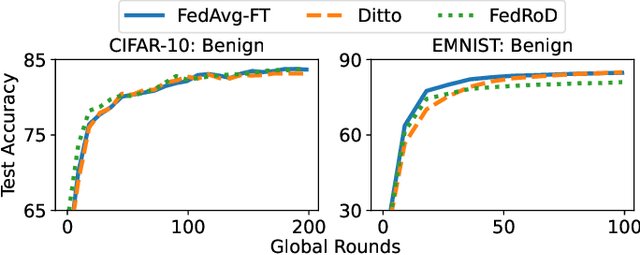
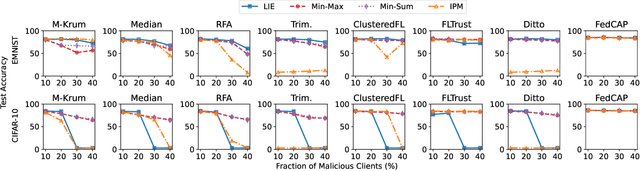
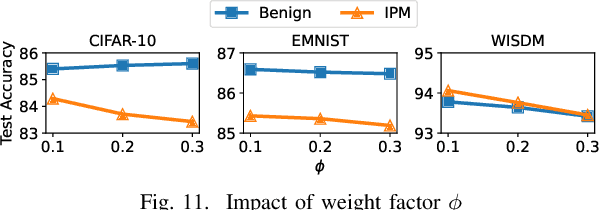
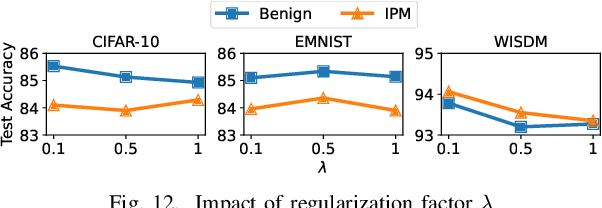
Federated learning (FL), an emerging distributed machine learning paradigm, has been applied to various privacy-preserving scenarios. However, due to its distributed nature, FL faces two key issues: the non-independent and identical distribution (non-IID) of user data and vulnerability to Byzantine threats. To address these challenges, in this paper, we propose FedCAP, a robust FL framework against both data heterogeneity and Byzantine attacks. The core of FedCAP is a model update calibration mechanism to help a server capture the differences in the direction and magnitude of model updates among clients. Furthermore, we design a customized model aggregation rule that facilitates collaborative training among similar clients while accelerating the model deterioration of malicious clients. With a Euclidean norm-based anomaly detection mechanism, the server can quickly identify and permanently remove malicious clients. Moreover, the impact of data heterogeneity and Byzantine attacks can be further mitigated through personalization on the client side. We conduct extensive experiments, comparing multiple state-of-the-art baselines, to demonstrate that FedCAP performs well in several non-IID settings and shows strong robustness under a series of poisoning attacks.