 Add to Chrome
 Add to Firefox
 Add to Edge
SE(3)-LIO: Smooth IMU Propagation With Jointly Distributed Poses on SE(3) Manifold for Accurate and Robust LiDAR-Inertial Odometry
Mar 17, 2026
In estimating odometry accurately, an inertial measurement unit (IMU) is widely used owing to its high-rate measurements, which can be utilized to obtain motion information through IMU propagation. In this paper, we address the limitations of existing IMU propagation methods in terms of motion prediction and motion compensation. In motion prediction, the existing methods typically represent a 6-DoF pose by separating rotation and translation and propagate them on their respective manifold, so that the rotational variation is not effectively incorporated into translation propagation. During motion compensation, the relative transformation between predicted poses is used to compensate motion-induced distortion in other measurements, while inherent errors in the predicted poses introduce uncertainty in the relative transformation. To tackle these challenges, we represent and propagate the pose on SE(3) manifold, where propagated translation properly accounts for rotational variation. Furthermore, we precisely characterize the relative transformation uncertainty by considering the correlation between predicted poses, and incorporate this uncertainty into the measurement noise during motion compensation. To this end, we propose a LiDAR-inertial odometry (LIO), referred to as SE(3)-LIO, that integrates the proposed IMU propagation and uncertainty-aware motion compensation (UAMC). We validate the effectiveness of SE(3)-LIO on diverse datasets. Our source code and additional material are available at: https://se3-lio.github.io/.

VIRD: View-Invariant Representation through Dual-Axis Transformation for Cross-View Pose Estimation
Mar 13, 2026Accurate global localization is crucial for autonomous driving and robotics, but GNSS-based approaches often degrade due to occlusion and multipath effects. As an emerging alternative, cross-view pose estimation predicts the 3-DoF camera pose corresponding to a ground-view image with respect to a geo-referenced satellite image. However, existing methods struggle to bridge the significant viewpoint gap between the ground and satellite views mainly due to limited spatial correspondences. We propose a novel cross-view pose estimation method that constructs view-invariant representations through dual-axis transformation (VIRD). VIRD first applies a polar transformation to the satellite view to establish horizontal correspondence, then uses context-enhanced positional attention on the ground and polar-transformed satellite features to resolve vertical misalignment, explicitly mitigating the viewpoint gap. A view-reconstruction loss is introduced to strengthen the view invariance further, encouraging the derived representations to reconstruct the original and cross-view images. Experiments on the KITTI and VIGOR datasets demonstrate that VIRD outperforms the state-of-the-art methods without orientation priors, reducing median position and orientation errors by 50.7% and 76.5% on KITTI, and 18.0% and 46.8% on VIGOR, respectively.
PIDLoc: Cross-View Pose Optimization Network Inspired by PID Controllers
Mar 04, 2025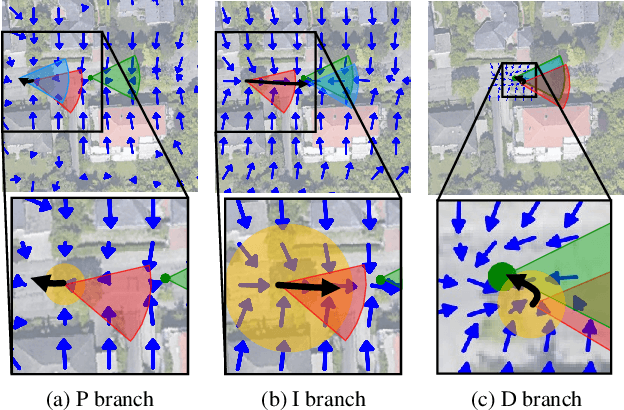
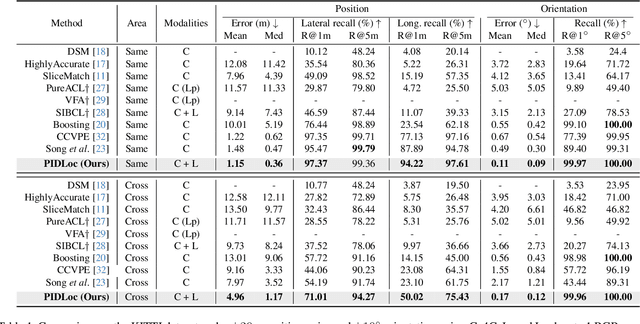
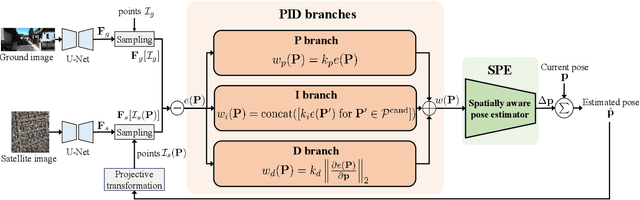
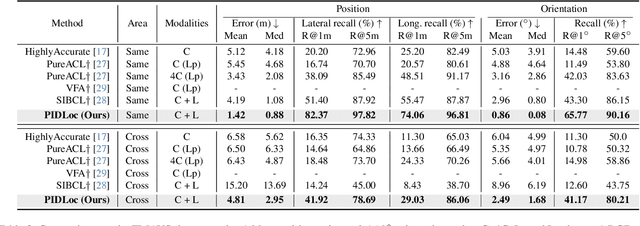
Accurate localization is essential for autonomous driving, but GNSS-based methods struggle in challenging environments such as urban canyons. Cross-view pose optimization offers an effective solution by directly estimating vehicle pose using satellite-view images. However, existing methods primarily rely on cross-view features at a given pose, neglecting fine-grained contexts for precision and global contexts for robustness against large initial pose errors. To overcome these limitations, we propose PIDLoc, a novel cross-view pose optimization approach inspired by the proportional-integral-derivative (PID) controller. Using RGB images and LiDAR, the PIDLoc comprises the PID branches to model cross-view feature relationships and the spatially aware pose estimator (SPE) to estimate the pose from these relationships. The PID branches leverage feature differences for local context (P), aggregated feature differences for global context (I), and gradients of feature differences for precise pose adjustment (D) to enhance localization accuracy under large initial pose errors. Integrated with the PID branches, the SPE captures spatial relationships within the PID-branch features for consistent localization. Experimental results demonstrate that the PIDLoc achieves state-of-the-art performance in cross-view pose estimation for the KITTI dataset, reducing position error by $37.8\%$ compared with the previous state-of-the-art.