 Add to Chrome
 Add to Firefox
 Add to Edge
Do Current Retrievers Cover All the Evidence? A Controlled Study of Conjunctive Cross-Page Retrieval
Jul 27, 2026
Finding a long document relevant to a multi-part request is not the same as establishing that it contains every requested piece of evidence. We study this gap for conjunctive document retrieval, where two or three explicit conditions must be supported on different pages of one document. We use n-Clue as a controlled measurement instrument: 1{,}000 queries over 2{,}021 documents pair all-condition golds with naturally occurring documents that satisfy only a subset, and a complete-first success requires a top-10 gold to precede every released subset qrel. Across 70 configurations, condition-wise decomposition improves two dense backbones by 6.8--7.3 points and lexical--visual fusion adds 8.7, while four generic rerankers all reduce Gold-NDCG; these directions replicate on a four-source stress set. Scaling one dense family from 0.6B to 8B changes complete-first success by 0.0 points. The strongest displayed hybrid illustrates the resulting gap: it finds a gold for 81.1\% of queries but succeeds complete-first on only 35.8\%, and the gap persists across condition count, target length, candidate density, query rendering, and the four-source stress set. Finally, page-aware visual systems surface stored support for every condition on only 5.1--5.3\% of queries. These results identify condition coverage, rather than gold discovery alone, as the central bottleneck.

ReinPool: Reinforcement Learning Pooling Multi-Vector Embeddings for Retrieval System
Jan 12, 2026Multi-vector embedding models have emerged as a powerful paradigm for document retrieval, preserving fine-grained visual and textual details through token-level representations. However, this expressiveness comes at a staggering cost: storing embeddings for every token inflates index sizes by over $1000\times$ compared to single-vector approaches, severely limiting scalability. We introduce \textbf{ReinPool}, a reinforcement learning framework that learns to dynamically filter and pool multi-vector embeddings into compact, retrieval-optimized representations. By training with an inverse retrieval objective and NDCG-based rewards, ReinPool identifies and retains only the most discriminative vectors without requiring manual importance annotations. On the Vidore V2 benchmark across three vision-language embedding models, ReinPool compresses multi-vector representations by $746$--$1249\times$ into single vectors while recovering 76--81\% of full multi-vector retrieval performance. Compared to static mean pooling baselines, ReinPool achieves 22--33\% absolute NDCG@3 improvement, demonstrating that learned selection significantly outperforms heuristic aggregation.
Efficient Industrial sLLMs through Domain Adaptive Continual Pretraining: Method, Evaluation and Applications
Jul 09, 2025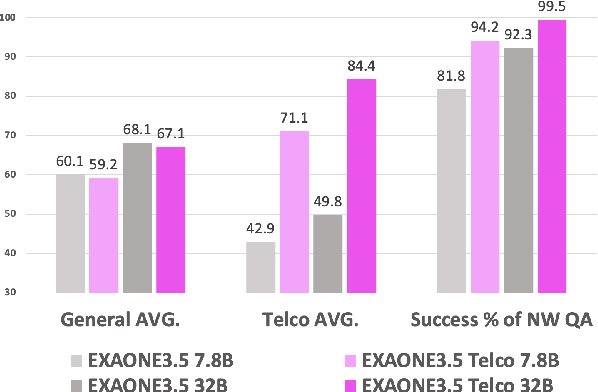
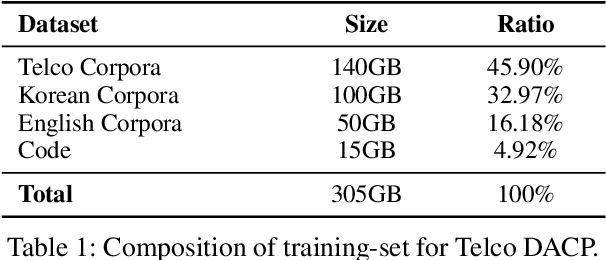
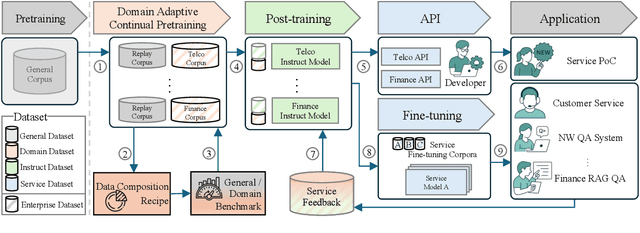
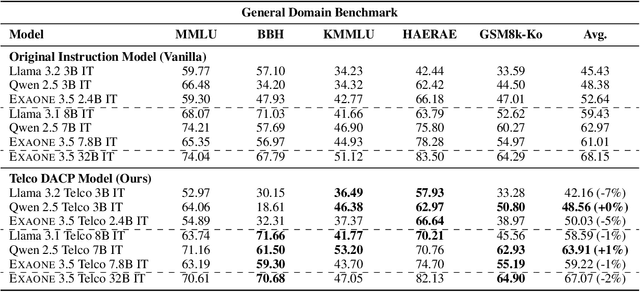
The emergence of open-source large language models (LLMs) has expanded opportunities for enterprise applications; however, many organizations still lack the infrastructure to deploy and maintain large-scale models. As a result, small LLMs (sLLMs) have become a practical alternative, despite their inherent performance limitations. While Domain Adaptive Continual Pretraining (DACP) has been previously explored as a method for domain adaptation, its utility in commercial applications remains under-examined. In this study, we validate the effectiveness of applying a DACP-based recipe across diverse foundation models and service domains. Through extensive experiments and real-world evaluations, we demonstrate that DACP-applied sLLMs achieve substantial gains in target domain performance while preserving general capabilities, offering a cost-efficient and scalable solution for enterprise-level deployment.