 Add to Chrome
 Add to Firefox
 Add to Edge
CD-Buffer: Complementary Dual-Buffer Framework for Test-Time Adaptation in Adverse Weather Object Detection
Mar 27, 2026
Test-Time Adaptation (TTA) enables real-time adaptation to domain shifts without off-line retraining. Recent TTA methods have predominantly explored additive approaches that introduce lightweight modules for feature refinement. Recently, a subtractive approach that removes domain-sensitive channels has emerged as an alternative direction. We observe that these paradigms exhibit complementary effectiveness patterns: subtractive methods excel under severe shifts by removing corrupted features, while additive methods are effective under moderate shifts requiring refinement. However, each paradigm operates effectively only within limited shift severity ranges, failing to generalize across diverse corruption levels. This leads to the following question: can we adaptively balance both strategies based on measured feature-level domain shift? We propose CD-Buffer, a novel complementary dual-buffer framework where subtractive and additive mechanisms operate in opposite yet coordinated directions driven by a unified discrepancy metric. Our key innovation lies in the discrepancy-driven coupling: Our framework couples removal and refinement through a unified discrepancy metric, automatically balancing both strategies based on feature-level shift severity. This establishes automatic channel-wise balancing that adapts differentiated treatment to heterogeneous shift magnitudes without manual tuning. Extensive experiments on KITTI, Cityscapes, and ACDC datasets demonstrate state-of-the-art performance, consistently achieving superior results across diverse weather conditions and severity levels.

DGSAM: Domain Generalization via Individual Sharpness-Aware Minimization
Mar 30, 2025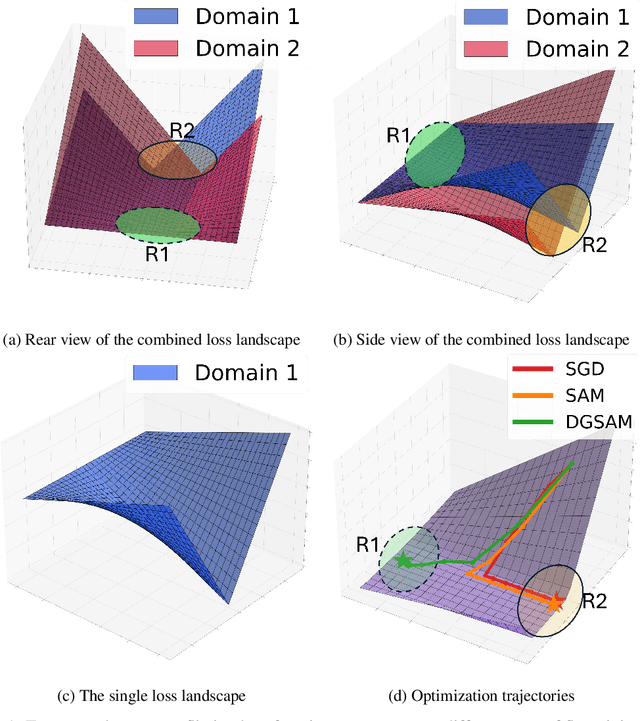
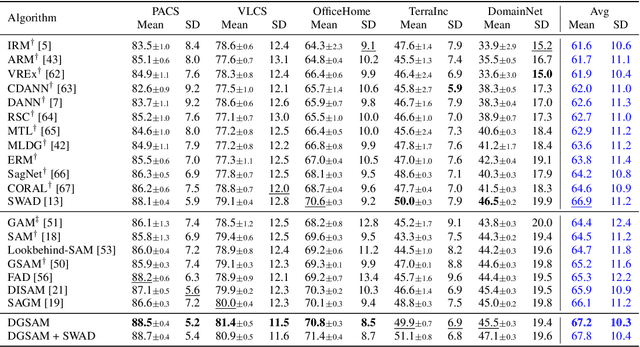


Domain generalization (DG) aims to learn models that can generalize well to unseen domains by training only on a set of source domains. Sharpness-Aware Minimization (SAM) has been a popular approach for this, aiming to find flat minima in the total loss landscape. However, we show that minimizing the total loss sharpness does not guarantee sharpness across individual domains. In particular, SAM can converge to fake flat minima, where the total loss may exhibit flat minima, but sharp minima are present in individual domains. Moreover, the current perturbation update in gradient ascent steps is ineffective in directly updating the sharpness of individual domains. Motivated by these findings, we introduce a novel DG algorithm, Decreased-overhead Gradual Sharpness-Aware Minimization (DGSAM), that applies gradual domain-wise perturbation to reduce sharpness consistently across domains while maintaining computational efficiency. Our experiments demonstrate that DGSAM outperforms state-of-the-art DG methods, achieving improved robustness to domain shifts and better performance across various benchmarks, while reducing computational overhead compared to SAM.