 Add to Chrome
 Add to Firefox
 Add to Edge
FEATHer: Fourier-Efficient Adaptive Temporal Hierarchy Forecaster for Time-Series Forecasting
Jan 16, 2026
Time-series forecasting is fundamental in industrial domains like manufacturing and smart factories. As systems evolve toward automation, models must operate on edge devices (e.g., PLCs, microcontrollers) with strict constraints on latency and memory, limiting parameters to a few thousand. Conventional deep architectures are often impractical here. We propose the Fourier-Efficient Adaptive Temporal Hierarchy Forecaster (FEATHer) for accurate long-term forecasting under severe limits. FEATHer introduces: (i) ultra-lightweight multiscale decomposition into frequency pathways; (ii) a shared Dense Temporal Kernel using projection-depthwise convolution-projection without recurrence or attention; (iii) frequency-aware branch gating that adaptively fuses representations based on spectral characteristics; and (iv) a Sparse Period Kernel reconstructing outputs via period-wise downsampling to capture seasonality. FEATHer maintains a compact architecture (as few as 400 parameters) while outperforming baselines. Across eight benchmarks, it achieves the best ranking, recording 60 first-place results with an average rank of 2.05. These results demonstrate that reliable long-range forecasting is achievable on constrained edge hardware, offering a practical direction for industrial real-time inference.

DLFormer: Enhancing Explainability in Multivariate Time Series Forecasting using Distributed Lag Embedding
Aug 29, 2024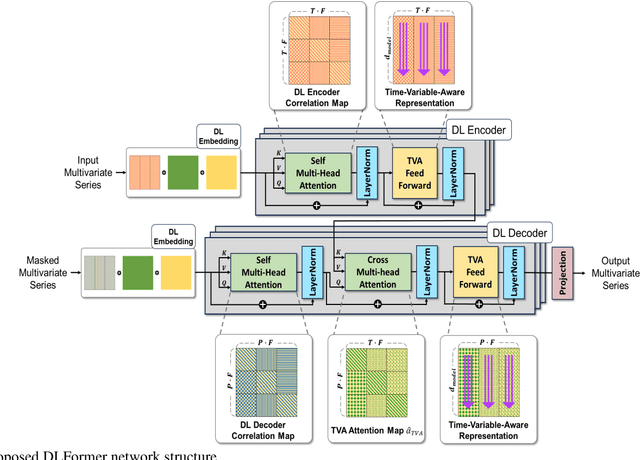
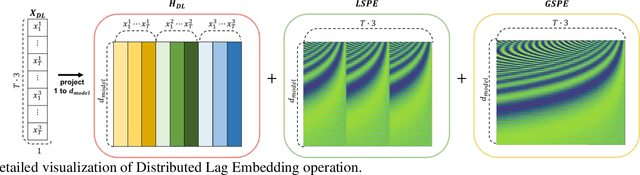
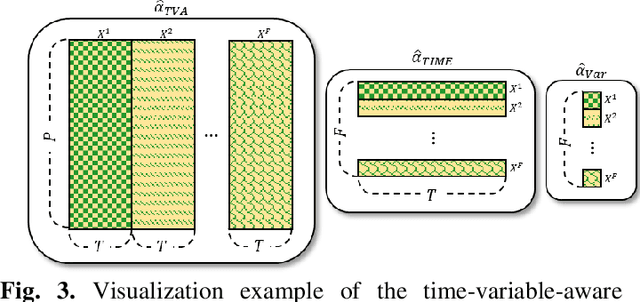
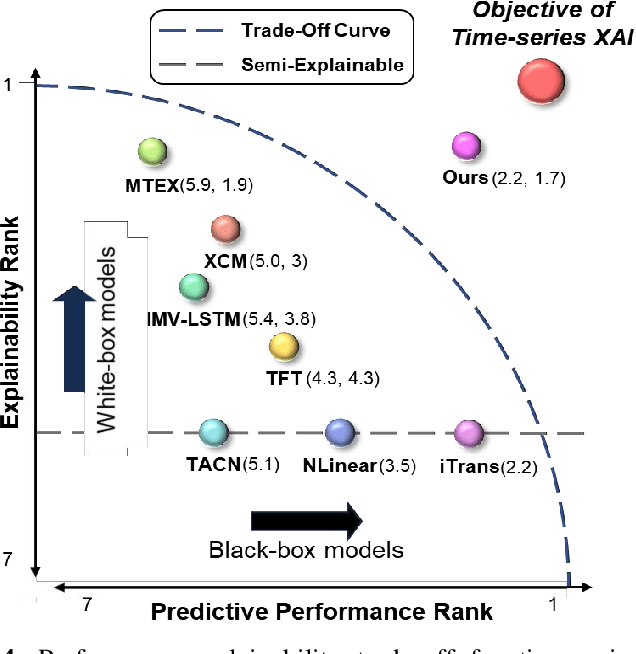
. Most real-world variables are multivariate time series influenced by past values and explanatory factors. Consequently, predicting these time series data using artificial intelligence is ongoing. In particular, in fields such as healthcare and finance, where reliability is crucial, having understandable explanations for predictions is essential. However, achieving a balance between high prediction accuracy and intuitive explainability has proven challenging. Although attention-based models have limitations in representing the individual influences of each variable, these models can influence the temporal dependencies in time series prediction and the magnitude of the influence of individual variables. To address this issue, this study introduced DLFormer, an attention-based architecture integrated with distributed lag embedding, to temporally embed individual variables and capture their temporal influence. Through validation against various real-world datasets, DLFormer showcased superior performance improvements compared to existing attention-based high-performance models. Furthermore, comparing the relationships between variables enhanced the reliability of explainability.