 Add to Chrome
 Add to Firefox
 Add to Edge
Single-Edge Node Injection Threats to GNN-Based Security Monitoring in Industrial Graph Systems
Feb 01, 2026
Graph neural networks (GNNs) are increasingly adopted in industrial graph-based monitoring systems (e.g., Industrial internet of things (IIoT) device graphs, power-grid topology models, and manufacturing communication networks) to support anomaly detection, state estimation, and asset classification. In such settings, an adversary that compromises a small number of edge devices may inject counterfeit nodes (e.g., rogue sensors, virtualized endpoints, or spoofed substations) to bias downstream decisions while evading topology- and homophily-based sanitization. This paper formulates deployment-oriented node-injection attacks under constrained resources and proposes the \emph{Single-Edge Graph Injection Attack} (SEGIA), in which each injected node attaches to the operational graph through a single edge. SEGIA integrates a pruned SGC surrogate, multi-hop neighborhood sampling, and reverse graph convolution-based feature synthesis with a similarity-regularized objective to preserve local homophily and survive edge pruning. Theoretical analysis and extensive evaluations across datasets and defenses show at least $25\%$ higher attack success than representative baselines under substantially smaller edge budgets. These results indicate a system-level risk in industrial GNN deployments and motivate lightweight admission validation and neighborhood-consistency monitoring.

A working likelihood approach to support vector regression with a data-driven insensitivity parameter
Mar 09, 2020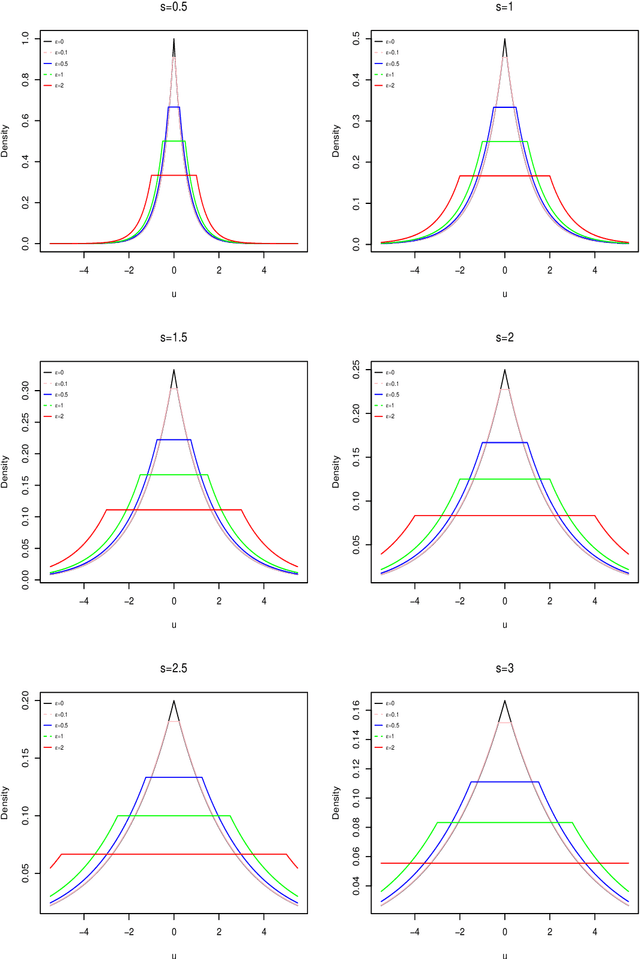
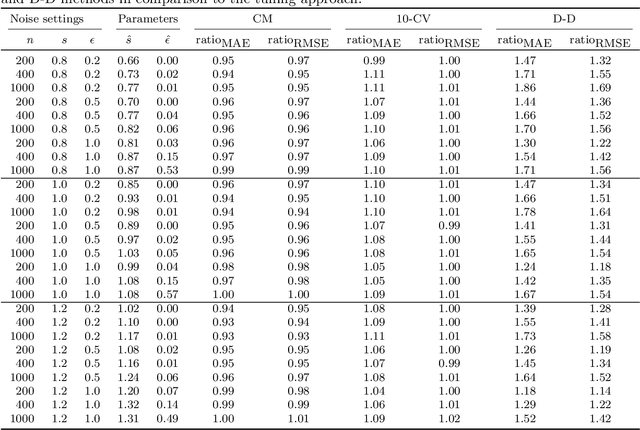


The insensitive parameter in support vector regression determines the set of support vectors that greatly impacts the prediction. A data-driven approach is proposed to determine an approximate value for this insensitive parameter by minimizing a generalized loss function originating from the likelihood principle. This data-driven support vector regression also statistically standardizes samples using the scale of noises. Nonlinear and linear numerical simulations with three types of noises ($\epsilon$-Laplacian distribution, normal distribution, and uniform distribution), and in addition, five real benchmark data sets, are used to test the capacity of the proposed method. Based on all of the simulations and the five case studies, the proposed support vector regression using a working likelihood, data-driven insensitive parameter is superior and has lower computational costs.