 Add to Chrome
 Add to Firefox
 Add to Edge
Improvement of Bayesian PINN Training Convergence in Solving Multi-scale PDEs with Noise
Aug 18, 2024
Bayesian Physics Informed Neural Networks (BPINN) have received considerable attention for inferring differential equations' system states and physical parameters according to noisy observations. However, in practice, Hamiltonian Monte Carlo (HMC) used to estimate the internal parameters of BPINN often encounters troubles, including poor performance and awful convergence for a given step size used to adjust the momentum of those parameters. To improve the efficacy of HMC convergence for the BPINN method and extend its application scope to multi-scale partial differential equations (PDE), we developed a robust multi-scale Bayesian PINN (dubbed MBPINN) method by integrating multi-scale deep neural networks (MscaleDNN) and Bayesian inference. In this newly proposed MBPINN method, we reframe HMC with Stochastic Gradient Descent (SGD) to ensure the most ``likely'' estimation is always provided, and we configure its solver as a Fourier feature mapping-induced MscaleDNN. The MBPINN method offers several key advantages: (1) it is more robust than HMC, (2) it incurs less computational cost than HMC, and (3) it is more flexible for complex problems. We demonstrate the applicability and performance of the proposed method through general Poisson and multi-scale elliptic problems in one- to three-dimensional spaces. Our findings indicate that the proposed method can avoid HMC failures and provide valid results. Additionally, our method can handle complex PDE and produce comparable results for general PDE. These findings suggest that our proposed approach has excellent potential for physics-informed machine learning for parameter estimation and solution recovery in the case of ill-posed problems.

A working likelihood approach to support vector regression with a data-driven insensitivity parameter
Mar 09, 2020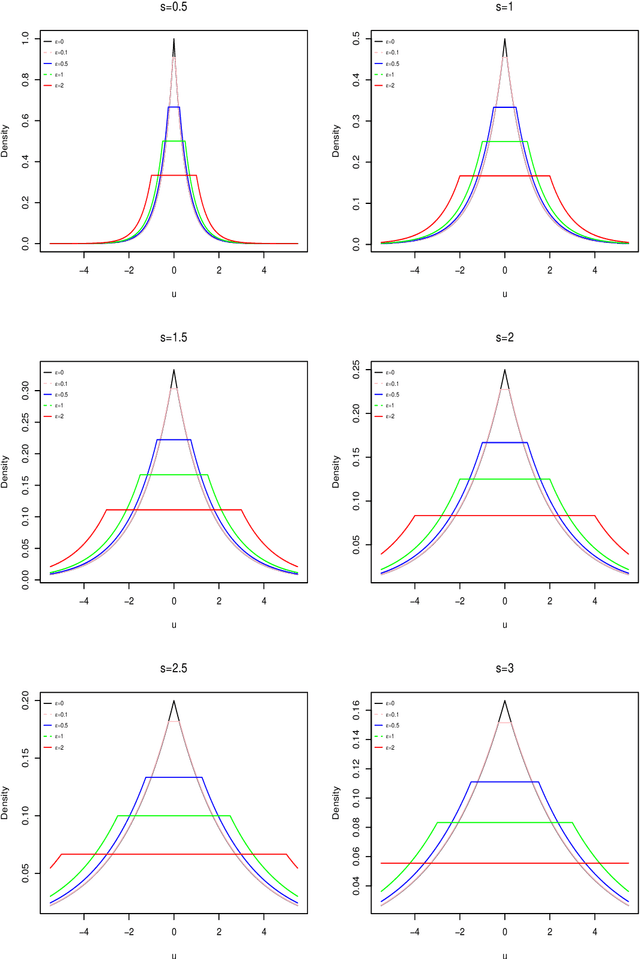
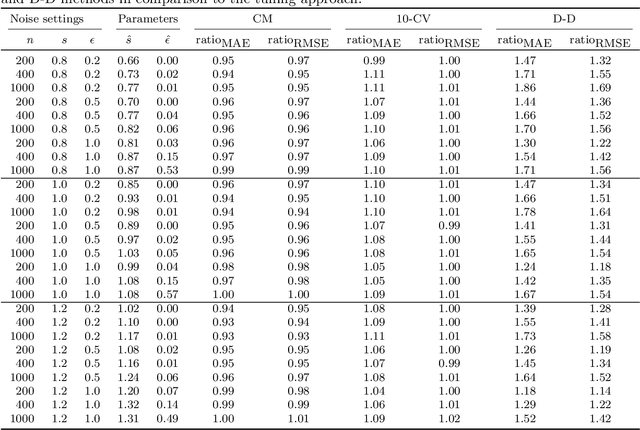


The insensitive parameter in support vector regression determines the set of support vectors that greatly impacts the prediction. A data-driven approach is proposed to determine an approximate value for this insensitive parameter by minimizing a generalized loss function originating from the likelihood principle. This data-driven support vector regression also statistically standardizes samples using the scale of noises. Nonlinear and linear numerical simulations with three types of noises ($\epsilon$-Laplacian distribution, normal distribution, and uniform distribution), and in addition, five real benchmark data sets, are used to test the capacity of the proposed method. Based on all of the simulations and the five case studies, the proposed support vector regression using a working likelihood, data-driven insensitive parameter is superior and has lower computational costs.