 Add to Chrome
 Add to Firefox
 Add to Edge
Joint Phase Noise and Off-Grid Channel Estimation for AFDM Systems via Sparse Bayesian Learning
Apr 20, 2026
In practical affine frequency division multiplexing (AFDM) systems, the intricate coupling of oscillator phase noise (PN) and off-grid fractional shifts traps conventional estimators in a severe high-SNR error floor. To address these challenges, we propose a joint PN and channel estimation method based on sparse Bayesian learning (JPNCE-SBL). Specifically, a reduced-rank subspace projection is first introduced to capture the dominant eigen-energy of the Wiener PN process. Concurrently, a dynamic grid evolution strategy is designed to iteratively eliminate off-grid errors without requiring computationally prohibitive global grid densification. Both components are integrated into a unified Expectation-Maximization (EM) framework, where the channel and PN estimates are jointly updated at each iteration to prevent error propagation. Simulation results demonstrate that JPNCE-SBL significantly outperforms existing benchmarks in both NMSE and BER, closely approaching the perfect channel state information case under practical PN conditions.

Theory and Algorithms for Partial Order Based Reduction in Planning
Jun 27, 2011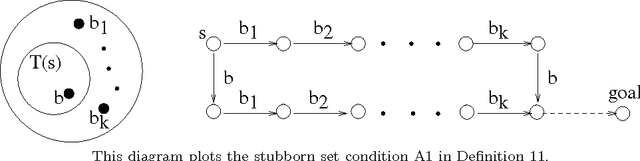
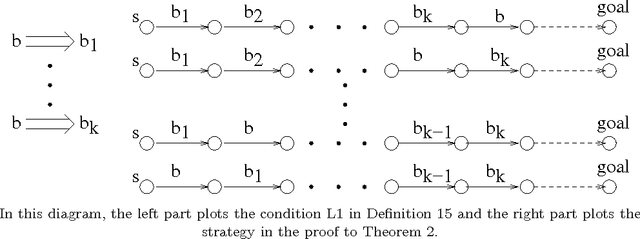
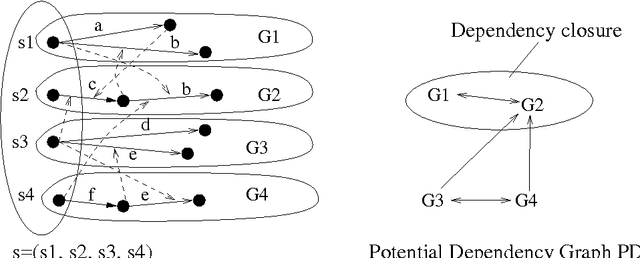
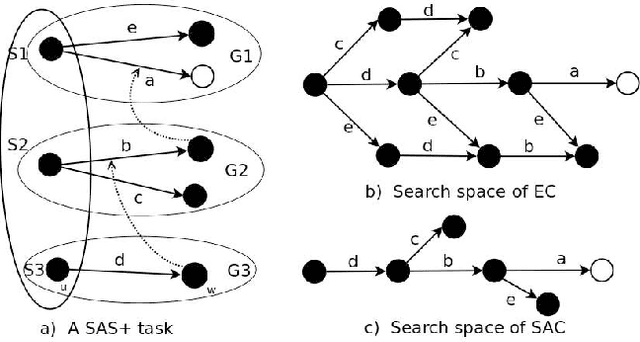
Search is a major technique for planning. It amounts to exploring a state space of planning domains typically modeled as a directed graph. However, prohibitively large sizes of the search space make search expensive. Developing better heuristic functions has been the main technique for improving search efficiency. Nevertheless, recent studies have shown that improving heuristics alone has certain fundamental limits on improving search efficiency. Recently, a new direction of research called partial order based reduction (POR) has been proposed as an alternative to improving heuristics. POR has shown promise in speeding up searches. POR has been extensively studied in model checking research and is a key enabling technique for scalability of model checking systems. Although the POR theory has been extensively studied in model checking, it has never been developed systematically for planning before. In addition, the conditions for POR in the model checking theory are abstract and not directly applicable in planning. Previous works on POR algorithms for planning did not establish the connection between these algorithms and existing theory in model checking. In this paper, we develop a theory for POR in planning. The new theory we develop connects the stubborn set theory in model checking and POR methods in planning. We show that previous POR algorithms in planning can be explained by the new theory. Based on the new theory, we propose a new, stronger POR algorithm. Experimental results on various planning domains show further search cost reduction using the new algorithm.