 Add to Chrome
 Add to Firefox
 Add to Edge
OneComp: One-Line Revolution for Generative AI Model Compression
Mar 30, 2026
Deploying foundation models is increasingly constrained by memory footprint, latency, and hardware costs. Post-training compression can mitigate these bottlenecks by reducing the precision of model parameters without significantly degrading performance; however, its practical implementation remains challenging as practitioners navigate a fragmented landscape of quantization algorithms, precision budgets, data-driven calibration strategies, and hardware-dependent execution regimes. We present OneComp, an open-source compression framework that transforms this expert workflow into a reproducible, resource-adaptive pipeline. Given a model identifier and available hardware, OneComp automatically inspects the model, plans mixed-precision assignments, and executes progressive quantization stages, ranging from layer-wise compression to block-wise refinement and global refinement. A key architectural choice is treating the first quantized checkpoint as a deployable pivot, ensuring that each subsequent stage improves the same model and that quality increases as more compute is invested. By converting state-of-the-art compression research into an extensible, open-source, hardware-aware pipeline, OneComp bridges the gap between algorithmic innovation and production-grade model deployment.

Optimization of phase-only holograms calculated with scaled diffraction calculation through deep neural networks
Dec 02, 2021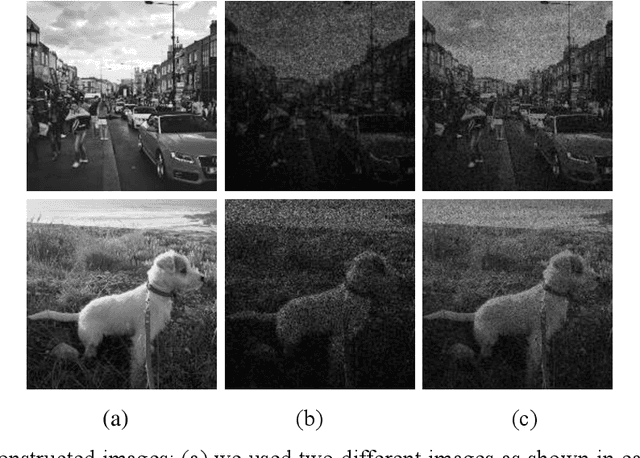
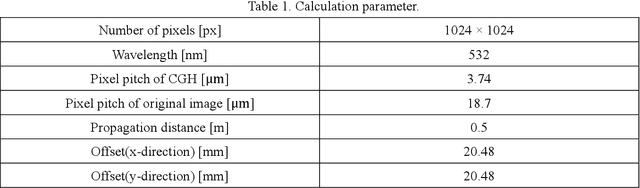
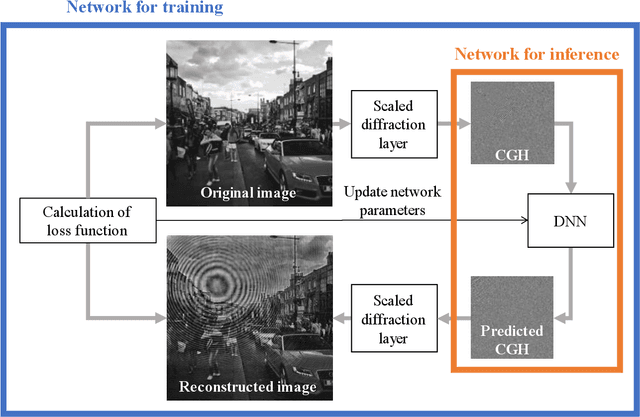
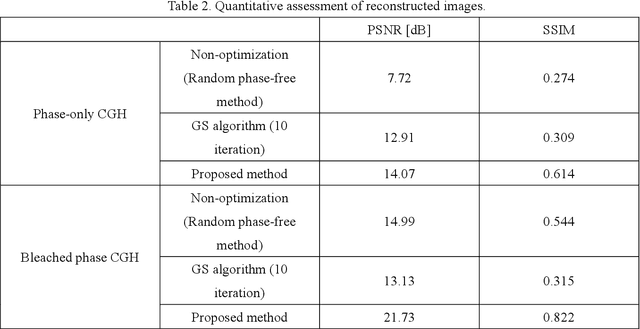
Computer-generated holograms (CGHs) are used in holographic three-dimensional (3D) displays and holographic projections. The quality of the reconstructed images using phase-only CGHs is degraded because the amplitude of the reconstructed image is difficult to control. Iterative optimization methods such as the Gerchberg-Saxton (GS) algorithm are one option for improving image quality. They optimize CGHs in an iterative fashion to obtain a higher image quality. However, such iterative computation is time consuming, and the improvement in image quality is often stagnant. Recently, deep learning-based hologram computation has been proposed. Deep neural networks directly infer CGHs from input image data. However, it is limited to reconstructing images that are the same size as the hologram. In this study, we use deep learning to optimize phase-only CGHs generated using scaled diffraction computations and the random phase-free method. By combining the random phase-free method with the scaled diffraction computation, it is possible to handle a zoomable reconstructed image larger than the hologram. In comparison to the GS algorithm, the proposed method optimizes both high quality and speed.