 Add to Chrome
 Add to Firefox
 Add to Edge
LOGOS: A Living Logic for AI Agent Teams That Evolve With Humans
Jul 12, 2026
AI agents are evolving from answer engines into persistent teams that use tools, delegate work, learn from experience, and modify the artifacts that shape their future behavior. The defining question for deployment is no longer merely what agents can do, but who controls what they are allowed to become. We introduce logos, a pluggable layer for self-evolution and governance that strengthens existing multiagent frameworks rather than replacing them. logos compiles heterogeneous multimodal inputs, including documents, images, audio, tables, databases, APIs, and human instructions into versioned agent packs containing agents, tools, knowledge, tests, permissions, and policies. During operation, it transforms agent activity into portable, auditable event traces and applies fail-closed verification across frameworks and backends. Every learned prompt, memory, skill, tool, role, or workflow remains an untrusted release candidate until held-out execution evidence, human-controlled policy, and explicit authorization permit its promotion. This architecture enables "verifiable human-agent loop engineering": agents can act, ask, learn, and propose improvements, while humans can steer objectives, permissions, approvals, and irreversible actions without interrupting continuous operation. logos provides a living logic for accountable automation. Agents may evolve at machine speed, but only evidence and human authority can close the loop.

EVE-Agent: Evidence-Verifiable Self-Evolving Agents
May 21, 2026Self-evolving agents should not train on examples they cannot justify. Data-free self-evolving search agents offer a scalable route to systems that generate their own questions, answer them, and improve from their own feedback without human annotations. Yet, without verifiable evidence, this loop can reward fluent but unsupported examples, turning the self-generated curriculum into an opaque and potentially unreliable training signal. We argue that evidence verifiability is a prerequisite for trustworthy self-evolution in search agents: each generated instance should include not only an answer but also a source-grounded span whose contribution to that answer can be measured. We introduce EVE-Agent, an Evidence-Verifiable Self-Evolving Agent that operationalizes this principle through a modification to the proposer--solver framework. The proposer generates a question, an answer, and a verbatim evidence span. An evidence verifier then rewards the span according to the marginal accuracy gain when the evidence is provided. This produces a training signal that favors evidence that genuinely helps answer the question, without requiring oracle answers, human labels, or external annotations. EVE-Agent leaves the backbone model, retriever, search tool, and optimization framework unchanged. Experiments show that EVE-Agent substantially improves evidence-grounded correctness over prior self-evolving search agents. The resulting curriculum is not merely self-generated but auditable by construction: each training example carries an inspectable source span that explains why it should be trusted.
OneComp: One-Line Revolution for Generative AI Model Compression
Mar 30, 2026Deploying foundation models is increasingly constrained by memory footprint, latency, and hardware costs. Post-training compression can mitigate these bottlenecks by reducing the precision of model parameters without significantly degrading performance; however, its practical implementation remains challenging as practitioners navigate a fragmented landscape of quantization algorithms, precision budgets, data-driven calibration strategies, and hardware-dependent execution regimes. We present OneComp, an open-source compression framework that transforms this expert workflow into a reproducible, resource-adaptive pipeline. Given a model identifier and available hardware, OneComp automatically inspects the model, plans mixed-precision assignments, and executes progressive quantization stages, ranging from layer-wise compression to block-wise refinement and global refinement. A key architectural choice is treating the first quantized checkpoint as a deployable pivot, ensuring that each subsequent stage improves the same model and that quality increases as more compute is invested. By converting state-of-the-art compression research into an extensible, open-source, hardware-aware pipeline, OneComp bridges the gap between algorithmic innovation and production-grade model deployment.
Quantization Error Propagation: Revisiting Layer-Wise Post-Training Quantization
Apr 13, 2025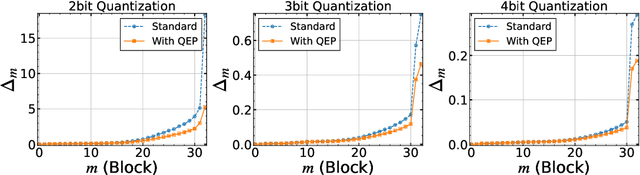
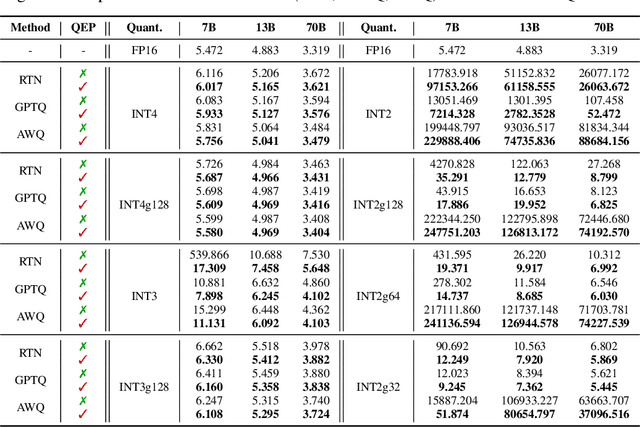
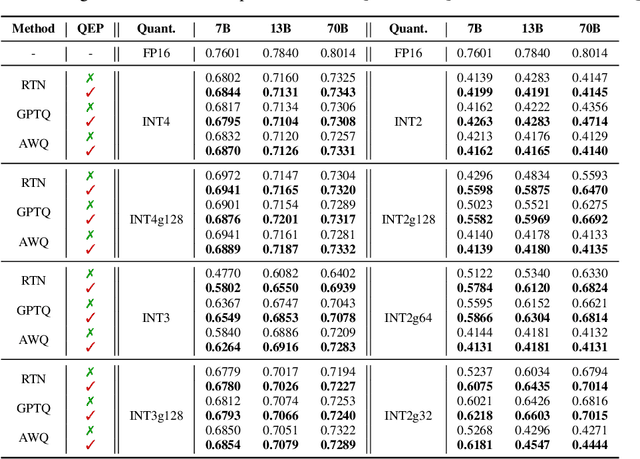
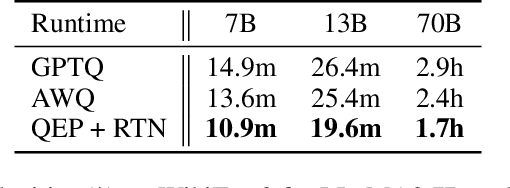
Layer-wise post-training quantization has emerged as a widely used technique for compressing large language models (LLMs) without retraining. However, recent progress in this line of research is saturating, underscoring the need to revisit its core limitation and explore further improvements. This study identifies a critical bottleneck in existing layer-wise PTQ methods: the accumulation of quantization errors across layers significantly degrades performance, particularly in low-bit regimes. To address this, we propose Quantization Error Propagation (QEP), a lightweight and general framework that enhances layer-wise PTQ by explicitly propagating the quantization error which enable compensating for accumulated quantization errors. Additionally, we introduce a tunable propagation mechanism that allows for control over both propagation strength and computational overhead, making the framework adaptable to various architectures and resource constraints. Empirical evaluation on LLaMA2 models (7B, 13B, 70B) demonstrate that incorporating QEP into standard layer-wise PTQ pipelines outperforms standard PTQ methods. Notably, QEP yields substantial performance improvements under extreme low-bit quantization settings.
Optimization by Parallel Quasi-Quantum Annealing with Gradient-Based Sampling
Sep 02, 2024Learning-based methods have gained attention as general-purpose solvers because they can automatically learn problem-specific heuristics, reducing the need for manually crafted heuristics. However, these methods often face challenges with scalability. To address these issues, the improved Sampling algorithm for Combinatorial Optimization (iSCO) using discrete Langevin dynamics has been proposed, demonstrating better performance than several learning-based solvers. This study proposes a different approach that integrates gradient-based update through continuous relaxation, combined with Quasi-Quantum Annealing (QQA). QQA smoothly transitions the objective function from a simple convex form, where half-integral solutions dominate, to the original objective function, where the variables are restricted to 0 or 1. Furthermore, we incorporate parallel run communication leveraging GPUs, enhancing exploration capabilities and accelerating convergence. Numerical experiments demonstrate that our approach is a competitive general-purpose solver, achieving comparable performance to iSCO across various benchmark problems. Notably, our method exhibits superior trade-offs between speed and solution quality for large-scale instances compared to iSCO, commercial solvers, and specialized algorithms.