 Add to Chrome
 Add to Firefox
 Add to Edge
PLAS-Net: Pixel-Level Area Segmentation for UAV-Based Beach Litter Monitoring
Apr 23, 2026
Accurate quantification of the physical exposure area of beach litter, rather than simple item counts, is essential for credible ecological risk assessment of marine debris. However, automated UAV-based monitoring predominantly relies on bounding-box detection, which systematically overestimates the planar area of irregular litter objects. To address this geometric limitation, we develop PLAS-Net (Pixel-level Litter Area Segmentor), an instance segmentation framework that extracts pixel-accurate physical footprints of coastal debris. Evaluated on UAV imagery from a monsoon-driven pocket beach in Koh Tao, Thailand, PLAS-Net achieves a mAP_50 of 58.7% with higher precision than eleven baseline models, demonstrating improved mask fidelity under complex coastal conditions. To illustrate how the accuracy of the masking affects the conclusions of environmental analysis, we conducted three downstream demonstrations: (i) power-law fitting of normalized plastic density (NPD) to characterize fragmentation dynamics; (ii) area-weighted ecological risk index (ERI) to map spatial pollution hotspots; and (iii) source composition analysis revealing the abundance-area paradox: fishing gear constitutes a small proportion of the total number of items, but has the largest physical area per unit item. Pixel-level area extraction can provide more valuable information for coastal monitoring compared to methods based solely on counting.

Underwater litter monitoring using consumer-grade aerial-aquatic speedy scanner (AASS) and deep learning based super-resolution reconstruction and detection network
Aug 07, 2024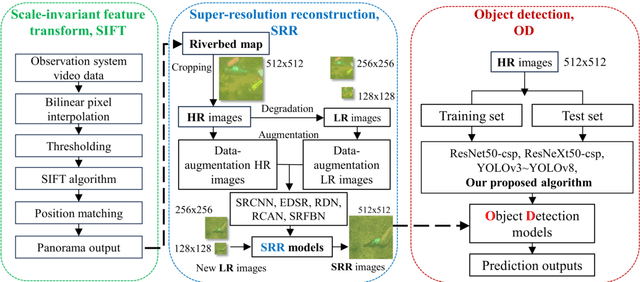

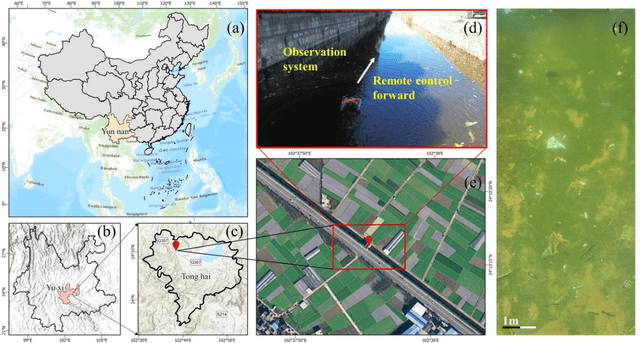

Underwater litter is widely spread across aquatic environments such as lakes, rivers, and oceans, significantly impacting natural ecosystems. Current monitoring technologies for detecting underwater litter face limitations in survey efficiency, cost, and environmental conditions, highlighting the need for efficient, consumer-grade technologies for automatic detection. This research introduces the Aerial-Aquatic Speedy Scanner (AASS) combined with Super-Resolution Reconstruction (SRR) and an improved YOLOv8 detection network. AASS enhances data acquisition efficiency over traditional methods, capturing high-quality images that accurately identify underwater waste. SRR improves image-resolution by mitigating motion blur and insufficient resolution, thereby enhancing detection tasks. Specifically, the RCAN model achieved the highest mean average precision (mAP) of 78.6% for detection accuracy on reconstructed images among the tested SRR models. With a magnification factor of 4, the SRR test set shows an improved mAP compared to the conventional bicubic set. These results demonstrate the effectiveness of the proposed method in detecting underwater litter.
Monitoring of Hermit Crabs Using drone-captured imagery and Deep Learning based Super-Resolution Reconstruction and Improved YOLOv8
Aug 07, 2024
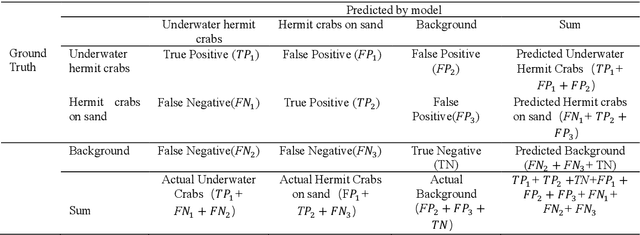
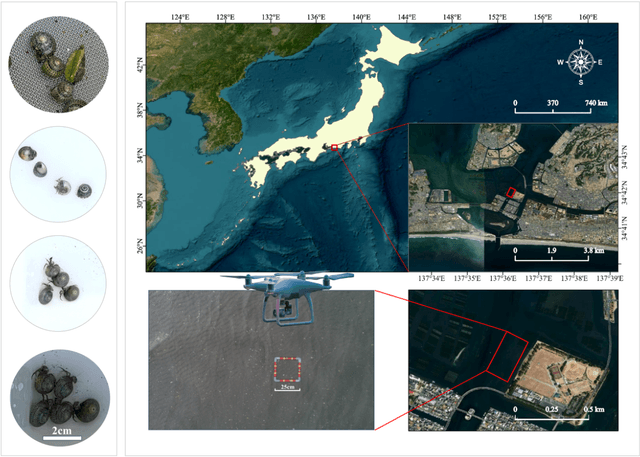

Hermit crabs play a crucial role in coastal ecosystems by dispersing seeds, cleaning up debris, and disturbing soil. They serve as vital indicators of marine environmental health, responding to climate change and pollution. Traditional survey methods, like quadrat sampling, are labor-intensive, time-consuming, and environmentally dependent. This study presents an innovative approach combining UAV-based remote sensing with Super-Resolution Reconstruction (SRR) and the CRAB-YOLO detection network, a modification of YOLOv8s, to monitor hermit crabs. SRR enhances image quality by addressing issues such as motion blur and insufficient resolution, significantly improving detection accuracy over conventional low-resolution fuzzy images. The CRAB-YOLO network integrates three improvements for detection accuracy, hermit crab characteristics, and computational efficiency, achieving state-of-the-art (SOTA) performance compared to other mainstream detection models. The RDN networks demonstrated the best image reconstruction performance, and CRAB-YOLO achieved a mean average precision (mAP) of 69.5% on the SRR test set, a 40% improvement over the conventional Bicubic method with a magnification factor of 4. These results indicate that the proposed method is effective in detecting hermit crabs, offering a cost-effective and automated solution for extensive hermit crab monitoring, thereby aiding coastal benthos conservation.