 Add to Chrome
 Add to Firefox
 Add to Edge
An Exploratory Study on LLM-Generated Code and Comments in Code Repositories
Jul 02, 2026
The use of LLMs in software development has become increasingly widespread on tasks such as code generation and summarization. Reports from large technology companies showed that around 20% to 30% of their code are generated by LLMs. However, there remains skepticism about the practical usage of LLM-generated code and comments, such as concerns on more time for debugging the generated code and the unnaturalness of the generated comments. In this paper, we study the code and comments detected as likely to be generated by LLMs and their characteristics, the differences between company- and community-maintained repositories, and how likely bugs are associated with LLM-generated code. We conduct extensive experiments on active company- and community-maintained repositories from 2021 to 2025 using various tools and techniques that detect code and comments generated by LLMs. Based on our detector-based proxy analysis, the results suggest that code detected as likely to be generated by LLMs decreased over time and appeared frequently in test cases, while that of comments remains relatively stable. Proxy results further suggest that code detected as likely to be generated by LLMs shows substantial intra-repository code clones, whereas comments exhibit a relatively low proportion of grammatically correct sentences. In addition, the company-maintained repositories show a higher percentage of code and comments detected as likely to be generated by LLMs, and only a small percentage of the human-labelled bugs are detected as being likely associated with LLM-generated code.

Is persona enough for personality? Using ChatGPT to reconstruct an agent's latent personality from simple descriptions
Jun 18, 2024
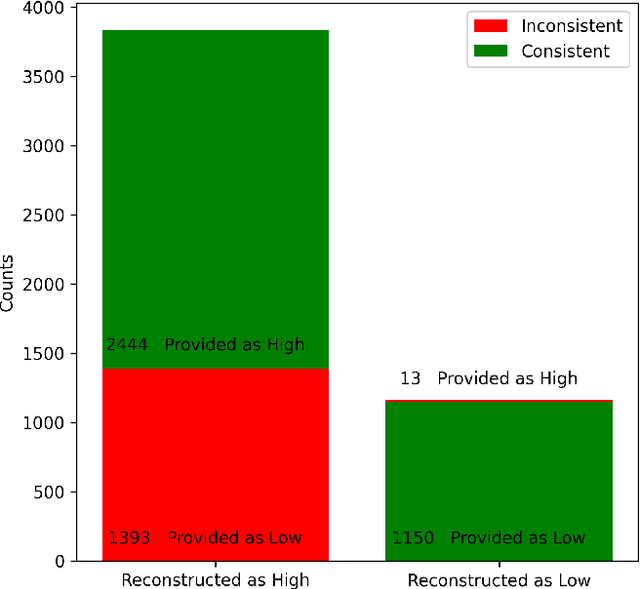
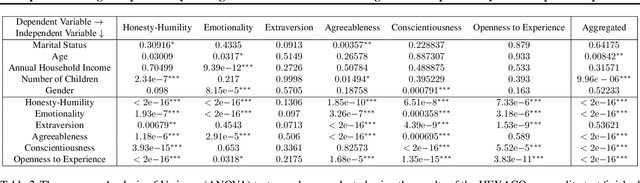
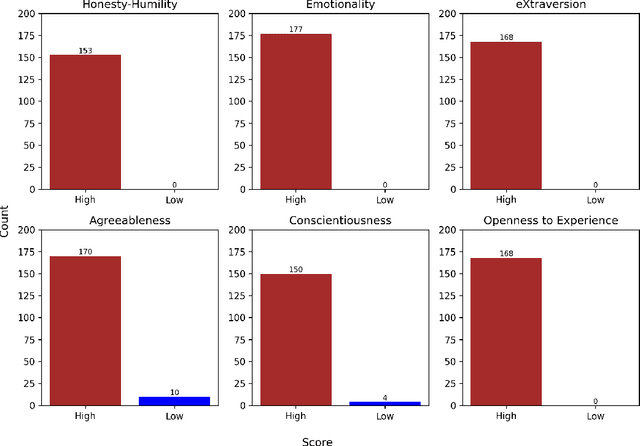
Personality, a fundamental aspect of human cognition, contains a range of traits that influence behaviors, thoughts, and emotions. This paper explores the capabilities of large language models (LLMs) in reconstructing these complex cognitive attributes based only on simple descriptions containing socio-demographic and personality type information. Utilizing the HEXACO personality framework, our study examines the consistency of LLMs in recovering and predicting underlying (latent) personality dimensions from simple descriptions. Our experiments reveal a significant degree of consistency in personality reconstruction, although some inconsistencies and biases, such as a tendency to default to positive traits in the absence of explicit information, are also observed. Additionally, socio-demographic factors like age and number of children were found to influence the reconstructed personality dimensions. These findings have implications for building sophisticated agent-based simulacra using LLMs and highlight the need for further research on robust personality generation in LLMs.