 Add to Chrome
 Add to Firefox
 Add to Edge
VTouch++: A Multimodal Dataset with Vision-Based Tactile Enhancement for Bimanual Manipulation
Apr 22, 2026
Embodied intelligence has advanced rapidly in recent years; however, bimanual manipulation-especially in contact-rich tasks remains challenging. This is largely due to the lack of datasets with rich physical interaction signals, systematic task organization, and sufficient scale. To address these limitations, we introduce the VTOUCH dataset. It leverages vision based tactile sensing to provide high-fidelity physical interaction signals, adopts a matrix-style task design to enable systematic learning, and employs automated data collection pipelines covering real-world, demand-driven scenarios to ensure scalability. To further validate the effectiveness of the dataset, we conduct extensive quantitative experiments on cross-modal retrieval as well as real-robot evaluation. Finally, we demonstrate real-world performance through generalizable inference across multiple robots, policies, and tasks.

Variational quantum compiling with double Q-learning
Mar 22, 2021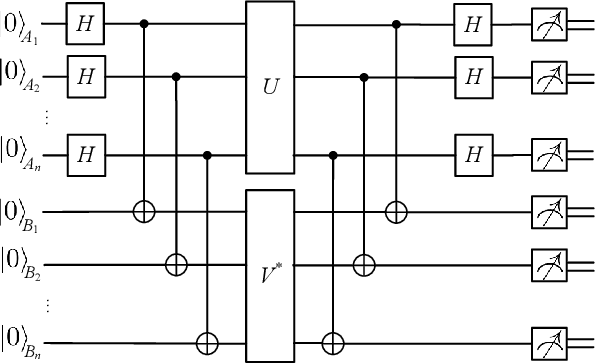

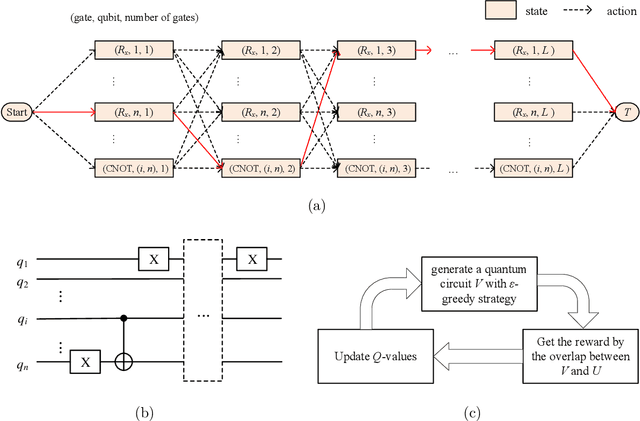
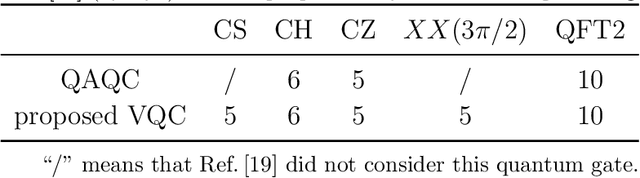
Quantum compiling aims to construct a quantum circuit V by quantum gates drawn from a native gate alphabet, which is functionally equivalent to the target unitary U. It is a crucial stage for the running of quantum algorithms on noisy intermediate-scale quantum (NISQ) devices. However, the space for structure exploration of quantum circuit is enormous, resulting in the requirement of human expertise, hundreds of experimentations or modifications from existing quantum circuits. In this paper, we propose a variational quantum compiling (VQC) algorithm based on reinforcement learning (RL), in order to automatically design the structure of quantum circuit for VQC with no human intervention. An agent is trained to sequentially select quantum gates from the native gate alphabet and the qubits they act on by double Q-learning with \epsilon-greedy exploration strategy and experience replay. At first, the agent randomly explores a number of quantum circuits with different structures, and then iteratively discovers structures with higher performance on the learning task. Simulation results show that the proposed method can make exact compilations with less quantum gates compared to previous VQC algorithms. It can reduce the errors of quantum algorithms due to decoherence process and gate noise in NISQ devices, and enable quantum algorithms especially for complex algorithms to be executed within coherence time.
* 21 pages, 10 figures