 Add to Chrome
 Add to Firefox
 Add to Edge
Domain-Agnostic Neural Topic Modeling with Contextual Token-Level Semantic Graph Representation
Aug 17, 2026
Recent advances in neural topic models with pre-trained language models (PLMs) have achieved strong performance by leveraging general-domain pre-training, yet their topic interpretability often degrades on specialized corpora. This limitation primarily stems from the geometry of the embedding space, where domain-specific terms unseen during pre-training collapse into an indistinguishable region, and neither domain-specific re-training, word-level graph enrichment, nor parameter-efficient fine-tuning can restructure this space without inheriting the capacity ceiling of the underlying encoder. Our key insight is that a learnable graph layer operating on token-level PLM embeddings can acquire corpus-specific semantic structure that the frozen encoder lacks, because token-level graphs preserve document-local context that word-level representations discard and joint optimization with the topic objective reshapes embedding geometry directly from target-domain evidence. We instantiate this insight as DARTopic, a domain-agnostic framework that constructs token-level semantic graphs from frozen PLM embeddings and jointly trains a GNN encoder with topic inference. Across three benchmarks spanning general, biomedical, and legal domains, DARTopic consistently outperforms strong baselines in topic coherence and document clus- tering without any encoder fine-tuning, while demonstrating robustness to PLM choice and favorable runtime efficiency over fine-tuning based alternatives.

Pointer-Augmented Autoregressive Generation of Patent Claims with Joint Topology and Content Decoding
Jul 27, 2026Autoregressive decoders emit flat token sequences and cannot enforce hierarchical constraints across output segments, a limitation that becomes acute in patent claim generation, where a claim set forms a dependency forest whose scope must narrow monotonically with depth. Topology and content are mutually dependent: a dependent claim's wording must reflect its parent's scope, yet the parent must be chosen before that wording exists, so neither post-hoc parsing nor grammar-constrained decoding suffices. We propose SPG (Structure-aware Patent Generation), which predicts topology inside the autoregressive pass. A pointer head selects each dependent claim's parent, and its gradients, together with a depth-adaptive scope regularizer, reshape the shared decoder's representations during training. A second stage then applies a violation-weighted preference objective over self-generated deficient candidates, supplying the negative signal that granted-patent corpora lack. On HUPD-DCG, SPG on Llama-3-8B-Instruct recovers 79.0\% of gold parent links, a quantity its training reward never supervises, and raises antecedent consistency from 0.292 to 0.478 over a supervised baseline of equal scale, with expert evaluation corroborating these gains.
PHAGE: Patent Heterogeneous Attention-Guided Graph Encoder for Representation Learning
May 11, 2026Patent claims form a directed dependency structure in which dependent claims inherit and refine the scope of earlier claims; however, existing patent encoders linearize claims as text and discard this hierarchy. Directly encoding this structure into self-attention poses two challenges: claim dependencies mix relation types that differ in semantics and extraction reliability, and the dependency graph is defined over claims while Transformers attend over tokens. PHAGE addresses the first challenge through a deterministic graph construction pipeline that separates near-deterministic legal citations from noisier rule-based technical relations, preserving type distinctions as heterogeneous edges. It addresses the second through a connectivity mask and learnable relation-aware biases that lift claim-level topology into token-level attention, allowing the encoder to differentially weight each relation type. A dual-granularity contrastive objective then aligns representations with both inter-patent taxonomy and intra-patent topology. PHAGE outperforms all baselines on classification, retrieval, and clustering, showing that intra-document claim topology is a stronger inductive bias than inter-document structure and that this bias persists in the encoder weights after training.
Adaptive Cost-Efficient Evaluation for Reliable Patent Claim Validation
Apr 05, 2026Automated validation of patent claims demands zero-defect tolerance, as even a single structural flaw can render a claim legally defective. Existing evaluation paradigms suffer from a rigidity-resource dilemma: lightweight encoders struggle with nuanced legal dependencies, while exhaustive verification via Large Language Models (LLMs) is prohibitively costly. To bridge this gap, we propose ACE (Adaptive Cost-efficient Evaluation), a hybrid framework that uses predictive entropy to route only high-uncertainty claims to an expert LLM. The expert then executes a Chain of Patent Thought (CoPT) protocol grounded in 35 U.S.C. statutory standards. This design enables ACE to handle long-range legal dependencies more effectively while preserving efficiency. ACE achieves the best F1 among the evaluated methods at 94.95\%, while reducing operational costs by 78\% compared to standalone LLM deployments. We also construct ACE-40k, a 40,000-claim benchmark with MPEP-grounded error annotations, to facilitate further research.
FlowPlan-G2P: A Structured Generation Framework for Transforming Scientific Papers into Patent Descriptions
Jan 05, 2026Over 3.5 million patents are filed annually, with drafting patent descriptions requiring deep technical and legal expertise. Transforming scientific papers into patent descriptions is particularly challenging due to their differing rhetorical styles and stringent legal requirements. Unlike black-box text-to-text approaches that struggle to model structural reasoning and legal constraints, we propose FlowPlan-G2P, a novel framework that mirrors the cognitive workflow of expert drafters by reformulating this task into three stages: (1) Concept Graph Induction, extracting technical entities and relationships into a directed graph via expert-like reasoning; (2) Paragraph and Section Planning, reorganizing the graph into coherent clusters aligned with canonical patent sections; and (3) Graph-Conditioned Generation, producing legally compliant paragraphs using section-specific subgraphs and tailored prompts. Experiments demonstrate that FlowPlan-G2P significantly improves logical coherence and legal compliance over end-to-end LLM baselines. Our framework establishes a new paradigm for paper-to-patent generation and advances structured text generation for specialized domains.
Pat-DEVAL: Chain-of-Legal-Thought Evaluation for Patent Description
Jan 01, 2026Patent descriptions must deliver comprehensive technical disclosure while meeting strict legal standards such as enablement and written description requirements. Although large language models have enabled end-to-end automated patent drafting, existing evaluation approaches fail to assess long-form structural coherence and statutory compliance specific to descriptions. We propose Pat-DEVAL, the first multi-dimensional evaluation framework dedicated to patent description bodies. Leveraging the LLM-as-a-judge paradigm, Pat-DEVAL introduces Chain-of-Legal-Thought (CoLT), a legally-constrained reasoning mechanism that enforces sequential patent-law-specific analysis. Experiments validated by patent expert on our Pap2Pat-EvalGold dataset demonstrate that Pat-DEVAL achieves a Pearson correlation of 0.69, significantly outperforming baseline metrics and existing LLM evaluators. Notably, the framework exhibits a superior correlation of 0.73 in Legal-Professional Compliance, proving that the explicit injection of statutory constraints is essential for capturing nuanced legal validity. By establishing a new standard for ensuring both technical soundness and legal compliance, Pat-DEVAL provides a robust methodological foundation for the practical deployment of automated patent drafting systems.
PatentMind: A Multi-Aspect Reasoning Graph for Patent Similarity Evaluation
May 25, 2025Patent similarity evaluation plays a critical role in intellectual property analysis. However, existing methods often overlook the intricate structure of patent documents, which integrate technical specifications, legal boundaries, and application contexts. We introduce PatentMind, a novel framework for patent similarity assessment based on a Multi-Aspect Reasoning Graph (MARG). PatentMind decomposes patents into three core dimensions: technical feature, application domain, and claim scope, to compute dimension-specific similarity scores. These scores are dynamically weighted through a four-stage reasoning process which integrates contextual signals to emulate expert-level judgment. To support evaluation, we construct PatentSimBench, a human-annotated benchmark comprising 500 patent pairs. Experimental results demonstrate that PatentMind achieves a strong correlation ($r=0.938$) with expert annotations, significantly outperforming embedding-based models and advanced prompt engineering methods.These results highlight the effectiveness of modular reasoning frameworks in overcoming key limitations of embedding-based methods for analyzing patent similarity.
PatentScore: Multi-dimensional Evaluation of LLM-Generated Patent Claims
May 25, 2025Natural language generation (NLG) metrics play a central role in evaluating generated texts, but are not well suited for the structural and legal characteristics of patent documents. Large language models (LLMs) offer strong potential in automating patent generation, yet research on evaluating LLM-generated patents remains limited, especially in evaluating the generation quality of patent claims, which are central to defining the scope of protection. Effective claim evaluation requires addressing legal validity, technical accuracy, and structural compliance. To address this gap, we introduce PatentScore, a multi-dimensional evaluation framework for assessing LLM-generated patent claims. PatentScore incorporates: (1) hierarchical decomposition for claim analysis; (2) domain-specific validation patterns based on legal and technical standards; and (3) scoring across structural, semantic, and legal dimensions. Unlike general-purpose NLG metrics, PatentScore reflects patent-specific constraints and document structures, enabling evaluation beyond surface similarity. We evaluate 400 GPT-4o-mini generated Claim 1s and report a Pearson correlation of $r = 0.819$ with expert annotations, outperforming existing NLG metrics. Furthermore, we conduct additional evaluations using open models such as Claude-3.5-Haiku and Gemini-1.5-flash, all of which show strong correlations with expert judgments, confirming the robustness and generalizability of our framework.
A Novel Patent Similarity Measurement Methodology: Semantic Distance and Technological Distance
Mar 23, 2023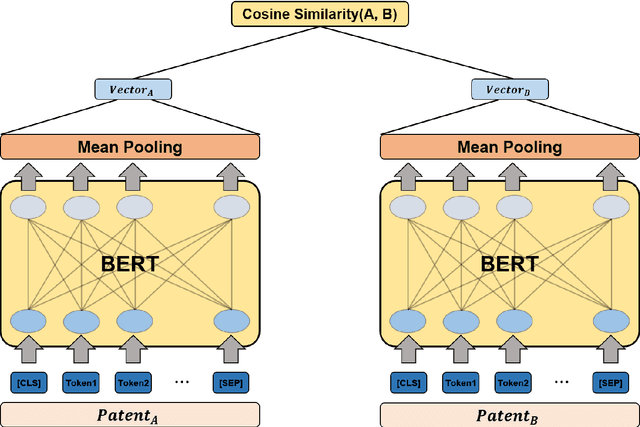
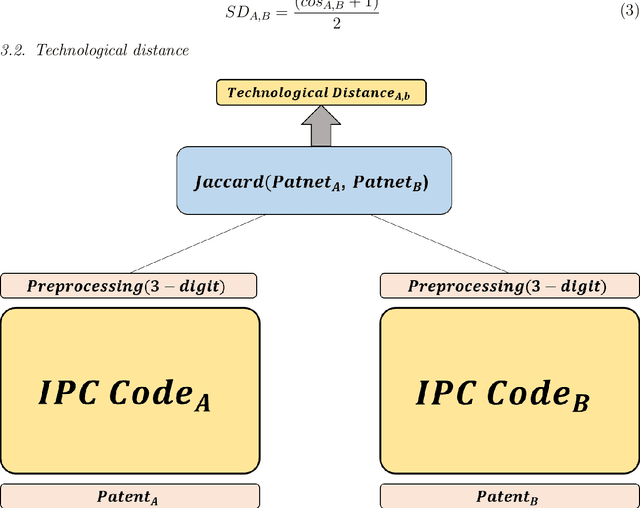
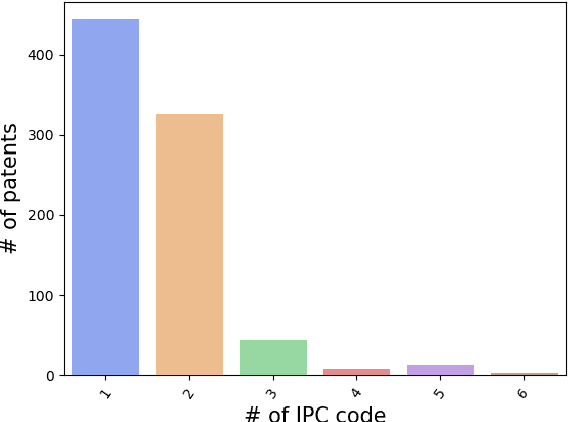
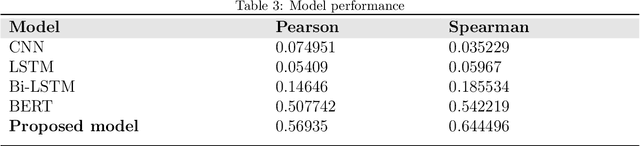
Measuring similarity between patents is an essential step to ensure novelty of innovation. However, a large number of methods of measuring the similarity between patents still rely on manual classification of patents by experts. Another body of research has proposed automated methods; nevertheless, most of it solely focuses on the semantic similarity of patents. In order to tackle these limitations, we propose a hybrid method for automatically measuring the similarity between patents, considering both semantic and technological similarities. We measure the semantic similarity based on patent texts using BERT, calculate the technological similarity with IPC codes using Jaccard similarity, and perform hybridization by assigning weights to the two similarity methods. Our evaluation result demonstrates that the proposed method outperforms the baseline that considers the semantic similarity only.
Multi label classification of Artificial Intelligence related patents using Modified D2SBERT and Sentence Attention mechanism
Mar 03, 2023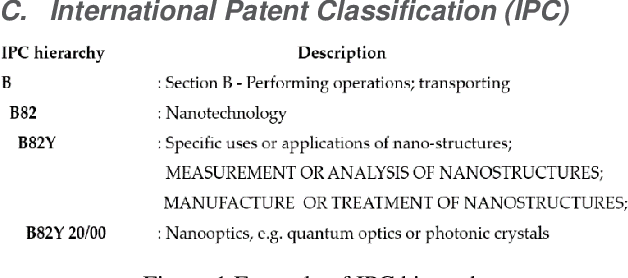

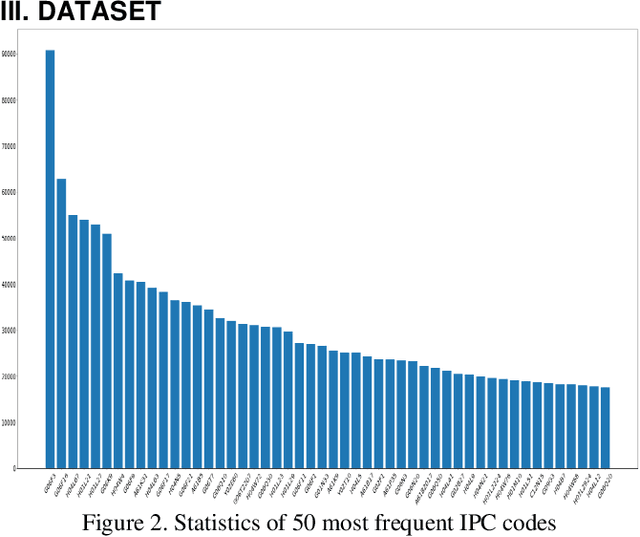
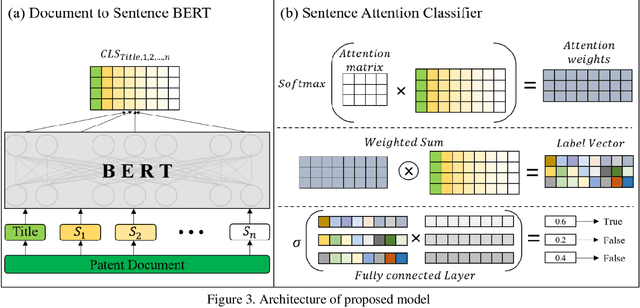
Patent classification is an essential task in patent information management and patent knowledge mining. It is very important to classify patents related to artificial intelligence, which is the biggest topic these days. However, artificial intelligence-related patents are very difficult to classify because it is a mixture of complex technologies and legal terms. Moreover, due to the unsatisfactory performance of current algorithms, it is still mostly done manually, wasting a lot of time and money. Therefore, we present a method for classifying artificial intelligence-related patents published by the USPTO using natural language processing technique and deep learning methodology. We use deformed BERT and sentence attention overcome the limitations of BERT. Our experiment result is highest performance compared to other deep learning methods.